16 November 2026
Country Analysis
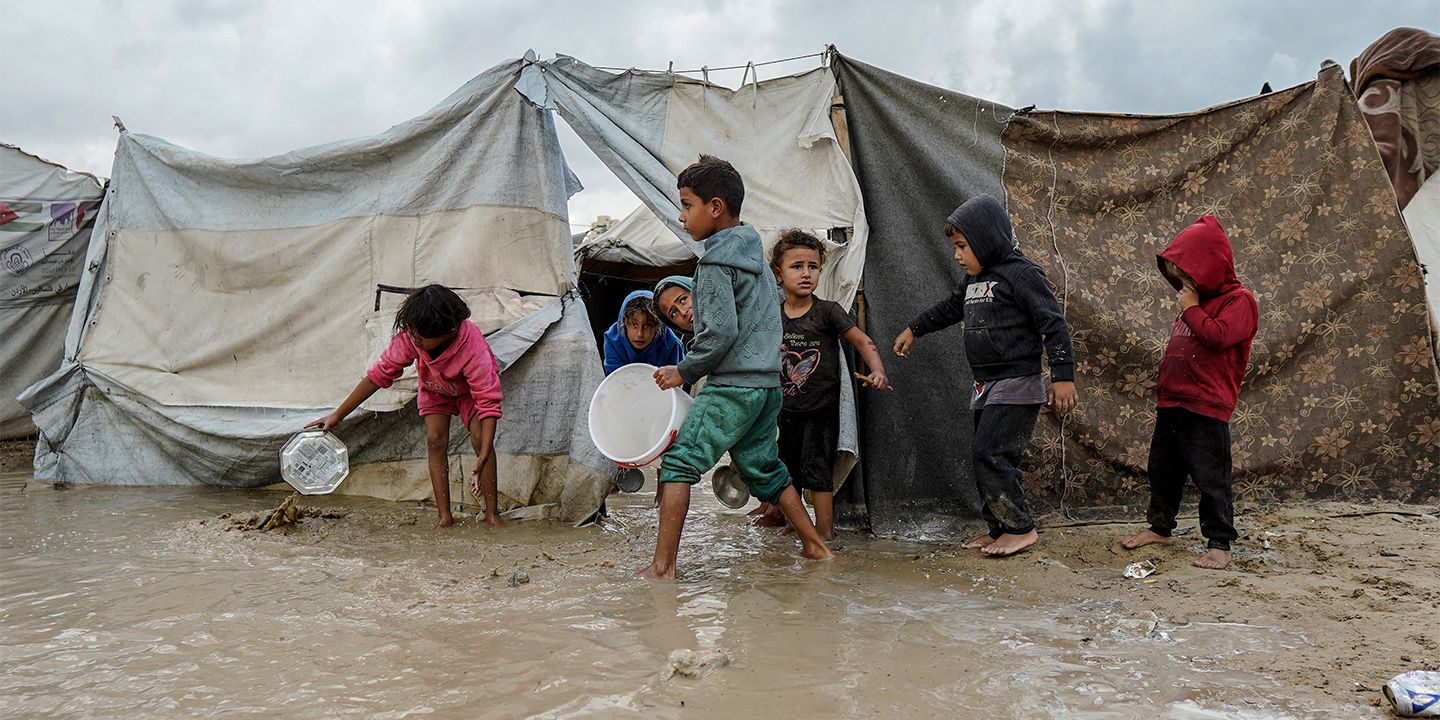
As Palestinians brace for the fourth winter since the start of Israel’s genocide in Gaza, living conditions across the enclave are becoming more dire amid the onset of seasonal flooding. The first major winter storm of the season, on 6 November, resulted in the flooding of over 700,000 tents housing displaced persons in a single day. Thousands of families were left without shelter, essential services were disrupted and in the days that followed several people were killed when a sand dune collapsed onto their tent.
Noting the continued constraints to distributing essential aid ahead of winter, UN Under-Secretary-General for Humanitarian Affairs and Emergency Relief Coordinator Tom Fletcher has called for immediate action to end the “collective punishment” and “predictable, preventable suffering” of Palestinians in Gaza. He stressed that humanitarians had sounded the alarm for months about the need for essential winter supplies, only to be told by foreign ministers and other partners to wait for progress following Israeli elections in October.
Israel’s conduct across the enclave places Palestinians in Gaza at particular risk during winter. Over 80 percent of all structures remain damaged or destroyed, while Israel continues to deny entry of major reconstruction materials, further undermining water and sanitation, healthcare facilities, energy supplies and housing. Of the approximately 1.7 million people who remain internally displaced, some 1.4 million are living in tents or makeshift shelters, with roughly 950,000 confined to flood-prone areas, according to the World Health Organization. More than a year after the so-called ceasefire took effect, Palestinians remain unable to rebuild critical, life-sustaining infrastructure and lack even adequate temporary shelter. Israel continues to obstruct the delivery of tents, with over 150,000 awaiting entry approval just outside Gaza.
The consequences of these conditions are already evident. An infant has died from severe hypothermia, acute respiratory infections have increased by 33,000 cases compared to the same period last year and hospitals in Gaza have reported a surge in meningitis cases among children. On 12 November a joint media stakeout at the UN, led by the United Kingdom, Qatar and Jordan and involving 53 countries and international organizations, called for urgent humanitarian access to Gaza as winter nears. Earlier in the day, an Israeli airstrike hit a hospital in Gaza, killing six people and injuring 27 others.
Israel must immediately open all border crossings for Gaza, allow unimpeded access for humanitarian aid and ensure humanitarian organizations can operate freely across the enclave. States must enact concrete measures to ensure Israel upholds its obligations under international law and its responsibilities as an occupying power toward Palestinians in Gaza, including by halting arms transfers to Israel, suspending trade agreements and imposing targeted sanctions on Israeli officials.
Reports of clashes between Ethiopian and Eritrean forces near the long-disputed border town of Badme have heightened fears of a wider regional conflict. Between 11 and 13 November the Ethiopian National Defense Forces and Eritrean Defense Forces reportedly exchanged fire, with Ethiopian drones and Eritrean heavy artillery deployed near the border.
Badme was at the center of the devastating 1998–2000 Ethiopia-Eritrea war, which ended with the signing of the Algiers Peace Agreement in December 2000. In 2002 the independent Eritrea-Ethiopia Boundary Commission awarded Badme to Eritrea. However, Ethiopia’s refusal to implement the ruling contributed to nearly two decades of hostility between the two countries. While engagement between Ethiopia and Eritrea improved significantly following a historic rapprochement in 2018 and the countries subsequently allied during the 2020–2022 war in Ethiopia’s Tigray region, relations have since deteriorated. Notably, over the past year, tensions have mounted as the two countries have publicly exchanged statements over Ethiopia’s aspirations to secure access to a port on the Red Sea. Diplomatic relations between Ethiopia and Eritrea broke down in September amid renewed fighting in Tigray.
Amid growing regional tensions, atrocity risks are also mounting within Ethiopia. In Oromia, at least 94 Orthodox Christians were reportedly killed in a series of attacks between 20 October and 5 November. The Ethiopian Human Rights Commission attributed a 24 October attack in Sirka district to the Oromo Liberation Army (OLA), documenting civilian deaths and attacks on civilian infrastructure. The OLA has rejected this finding. Attacks targeting civilians on the basis of their ethnicity may constitute the crime against humanity of persecution if committed as part of a widespread or systematic attack against a civilian population.
Violence has also escalated around Moyale since October, where clashes involving forces and militias affiliated with the Oromia and Somali regional authorities have fueled longstanding disputes over administrative boundaries, territory and resources. The violence has displaced an estimated 50,000 people into neighboring Kenya, with women and children arriving in urgent need of food, shelter and medical assistance.
Ethiopia and Eritrea must cease hostilities, resume diplomatic dialogue and protect civilians. Ethiopian authorities must safeguard vulnerable communities, investigate attacks and pursue a peaceful resolution to the Oromia-Somali border dispute. The Global Centre for the Responsibility to Protect’s Horn of Africa expert, Sarah Hunter, said, “Escalating tensions across Ethiopia and its borders threaten to engulf the Horn of Africa. Without urgent action to address these interconnected crises, civilians face a growing risk of further atrocities. The international community, including the UN and African Union, must prioritize diplomacy and accountability to ensure a durable peace.”
On 12 November the International Criminal Court (ICC) Pre-Trial Chamber II ordered the formal closure of the Situation in Afghanistan I case, finding that the Office of the Prosecutor (OTP) failed to “effectively carry out any further investigative or prosecutorial activities.” Authorized in 2020, the investigation covered alleged war crimes and crimes against humanity committed on Afghan territory from 1 May 2003 involving United States (US) military and intelligence actors, former Afghan government forces and the Taliban, as well as the so-called Islamic State in Iraq and the Levant-Khorasan. Alleged crimes included murder, torture, deliberate attacks against civilians and unlawful detention. On 13 November the OTP filed a notice of appeal and requested a stay of the closure decision.
The decision follows a series of procedural disputes over the scope and organization of the Afghanistan investigation. In 2026 the Chamber separated the proceedings into two situations: Afghanistan II, concerning alleged crimes committed by the Taliban since the 2021 takeover, and Afghanistan I, covering the remaining aspects of the original investigation. Closing Afghanistan I consequently leaves a significant accountability gap for atrocity crimes committed by a range of actors across more than two decades of conflict.
The closure comes amid a drastic escalation in US pressure on the Court. On 9 October the US imposed institution-wide sanctions on the ICC, marking a drastic escalation in its campaign against the Court and threatening its ability to pursue accountability for the world’s gravest crimes. The US has repeatedly sought to obstruct the Court’s work, including to prevent potential prosecutions of US nationals. While the sanctions and the closure decision are distinct developments, the decision risks further narrowing the Court’s pursuit of accountability for alleged crimes involving US personnel.
While the ICC unsealed on 5 October four arrest warrants in the Afghanistan II situation against senior Taliban officials for the alleged crime against humanity of gender persecution, the closure of Afghanistan I underscores the importance of other initiatives to contribute to accountability, most notably the UN Human Rights Council-mandated Independent Investigative Mechanism for Afghanistan (IIM-A). The IIM-A is the only international investigative body mandated to collect, preserve and analyze evidence of serious violations and abuses perpetrated by all parties in Afghanistan, which may support future accountability efforts. The IIM-A’s mandate is not time-limited, meaning it can assess past, ongoing and future crimes.
The international community must ensure that the closure of one accountability pathway does not end efforts to secure justice for victims and survivors. State parties to the Rome Statute should stand firmly with the victims of atrocity crimes and support the OTP’s appeal and request for a stay of the closure decision pending the Appeals Chamber’s determination. UN member states must ensure the IIM-A is fully operationalized without delay and provided with the political, financial and technical support its mandate demands.
Ralph Bunche Institute for International Studies
The Graduate Center, CUNY
365 Fifth Avenue, Suite 5203
New York, NY 10016-4309, USA