7 October 2026
Atrocity Alert
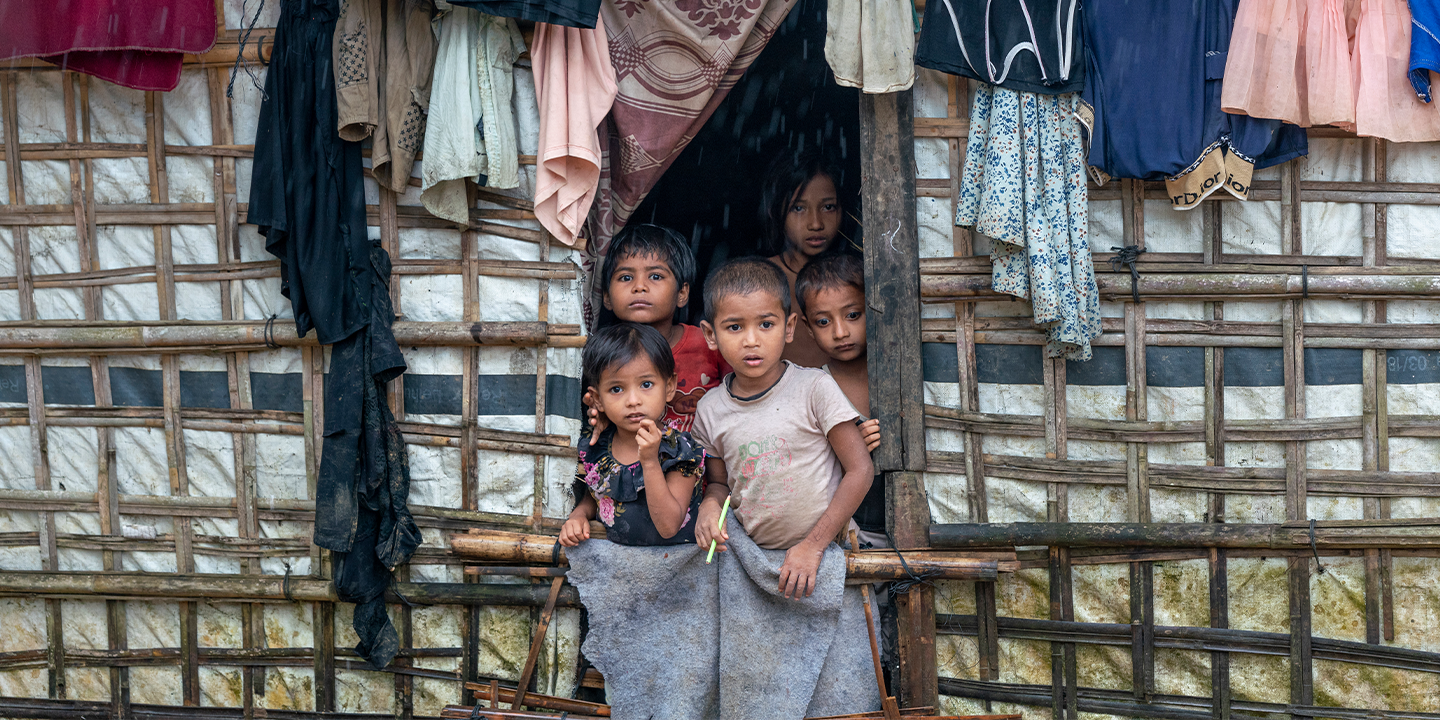
On 28 September airstrikes by Myanmar’s (Burma) military struck a crowded market in Kyauktaw Township, Rakhine State, killing at least 50 civilians, including women and children, and injuring at least 58 others. The market served multiple communities, including ethnic Rakhine and Rohingya populations. Additional airstrikes struck displacement camps and a makeshift medical facility in Ponnagyun Township on 4-5 October, reportedly killing at least eight civilians and injuring 11 others. The attacks reflect the military’s continued reliance on indiscriminate and disproportionate airstrikes amid territorial losses to resistance organizations, including the Arakan Army (AA), which controls most of Rakhine State.
Civilians also face grave protection risks in AA-controlled areas. Rohingya communities have endured killings, forced recruitment, arbitrary detention, forced labor and displacement. Reports of land confiscation and the destruction of Rohingya villages further illustrate the scale of abuses. Under International Humanitarian Law, intentionally directing attacks against civilians is prohibited, while indiscriminate and disproportionate attacks may also constitute violations and, in certain circumstances, war crimes.
Despite these unsafe conditions, Malaysia returned 1,476 Myanmar nationals on 29 September as part of a broader repatriation initiative, in coordination with Myanmar’s military-backed authorities. Although Malaysian authorities describe the returns as voluntary, those returned were held in immigration detention without access to independent protection assessments. On 8 October Malaysian Prime Minister Anwar Ibrahim hosted military leader and President Min Aung Hlaing, pledging further cooperation on returns and Myanmar’s reintegration into the Association of Southeast Asian Nations (ASEAN).
Edem Wosornu, Assistant High Commissioner for Protection at the UN Refugee Agency (UNHCR), warned that those returned to Myanmar “may face serious risks” and that some “may be in need of international protection.” UNHCR has also raised serious concerns about whether consent to return was genuinely voluntary and informed, particularly given the agency’s inability to access those in detention.
Malaysia’s actions prompt grave concern regarding compliance with the principle of non-refoulement, which prohibits returning individuals to places where they face persecution or other serious harm. Prolonged detention in poor and often degrading conditions may further undermine the ability of people seeking protection to make a free and informed decision about return. As atrocities and conflict continue unabated in Myanmar, regional engagement that prioritizes political normalization and repatriation over civilian protection emboldens perpetrators and exposes returnees to further violations.
ASEAN member states must uphold their obligations under international law, immediately suspend returns to Myanmar and ensure UNHCR has unrestricted access to immigration detention facilities to assess protection needs. All engagement with Myanmar’s military-backed authorities should prioritize an end to attacks on civilians, unhindered humanitarian access and accountability for atrocity crimes. The international community must also strengthen support for refugees and host countries while pursuing meaningful measures to end impunity in Myanmar.
There is growing evidence that the Israeli military’s sustained incursions into southern Syria since the fall of former Syrian President Bashar al-Assad in December 2024 are having a significant impact on civilians. On 8 October the Syrian Network for Human Rights published a report documenting Israeli practices and violations in Syria between December 2024 and October 2026, finding that Israel conducted approximately 453 ground incursion operations, killed at least 69 individuals and arbitrarily detained at least 162 individuals. Following Assad’s fall, Israeli forces seized control of the UN buffer zone established in 1974 and intensified cross-border military operations. They have also established military bases and outposts, primarily in Dar’a and Quneitra governorates.
During September the UN Commission of Inquiry (CoI) on the Syrian Arab Republic warned that “Israeli military activity in South Syria is increasingly sustained and entrenched.” The Office of the UN High Commissioner for Human Rights (OHCHR) documented some 280 incidents involving Israeli armed incursions in September alone, including raids on homes, restrictions on movement, harassment and intimidation of civilians, arbitrary detention and the destruction of livelihoods. This was the highest monthly total recorded since the beginning of 2026. In his September speech for the opening of the UN General Assembly’s 81st Session, Syria’s interim President, Ahmed al-Sharaa, denounced Israel’s ongoing attacks on Syria, called for Israel to withdraw its forces from internationally-recognized Syrian territory and stressed that Israel’s “aggressions” undermine “peace and security.”
The CoI has previously found several instances of Israeli forces detaining Syrians, some of whom were transferred to Israel, that “violate the prohibition against arbitrary detention,” and that such acts “may amount to war crimes.” According to information shared by OHCHR, 49 Syrians remain in Israeli custody, with reports of prolonged detention, transfers between facilities and allegations of torture and ill-treatment, although a comprehensive, up-to-date total has not been independently verified by the Office. On 9 October OHCHR called on Israeli authorities to “cease actions that harass or intimidate civilians in Syrian villages” and stressing that “no person may be detained absent proper basis in international law.” The High Commissioner also called for a prompt and impartial investigation into the recent killing of a young Syrian man by Israeli forces in the Quneitra governorate.
Beyond incursions and detention, the CoI is also investigating reports of “extensive ecological damage to forests, agricultural livelihood and property” in southern Syria, including damage to private and agricultural property protected under international law.
Israel must respect the territorial sovereignty of Syria, withdraw forces from Syrian territory in accordance with the 1974 agreement and halt all military incursions – including accompanying arbitrary detention of civilians – into southern Syria. States must also initiate and support investigations into potential war crimes by Israel and take steps to ensure that patterns of unlawful conduct elsewhere in the region are not repeated in Syria.
On Friday, 9 October, the United States (US) imposed institution-wide sanctions on the International Criminal Court (ICC), marking a drastic escalation in its campaign against the Court and threatening its ability to pursue accountability for the world’s gravest crimes. Under Executive Order 14203, US persons, including individuals and companies, are generally prohibited from providing material support or services to designated individuals and entities.
Executive Order 14203 was initially signed by US President Donald Trump in February 2025 and has been utilized to impose sanctions on 17 individuals to date. The new measures announced on 9 October designate the ICC itself as a sanctioned entity under the Executive Order. The new restrictions are explicitly aimed to dismantle the Court’s operational capacity by cutting off its access to essential resources, including blocking the ICC from accessing US-based bank accounts, cloud storage and software, while freezing any assets the Court holds in the US. Additionally, because international companies and foreign banks fear being penalized or losing access to the US financial system, these rules pressure global institutions to stop working with the ICC as well. If the Court cannot pay staff, secure financial services or maintain tech operations, ongoing investigations and trials could stall entirely. Human rights groups and civil society actors worldwide also face the threat of secondary sanctions simply for collaborating with the ICC to collect evidence, document atrocities and protect vulnerable witnesses.
The consequences extend far beyond the Court’s own operations. For millions of victims and survivors of mass atrocities worldwide, the ICC is often their only avenue for justice and accountability. Disrupting its investigations, prosecutions and ability to protect witnesses risks further undermining efforts to secure justice for international crimes. In a statement on 9 October, UN Secretary-General António Guterres called the sanctions “a serious blow to our collective pursuit of international criminal justice, of which the International Criminal Court is a key pillar. Accountability for international crimes and delivery of justice to victims are central to our global commitment to peace, security, human rights and fundamental freedoms.”
The European Union (EU) must activate the EU Blocking Statute to immediately shield the ICC and its personnel. By amending this regulation to neutralize US Executive Order 14203, the EU can legally prohibit European banks, technology companies and service providers from complying with the US restrictions. Activating this legal tool is a vital, concrete action to safeguard the independence of global justice, prevent a chilling effect on human rights defenders and guarantee that the Court retains unimpeded access to the financial and technological infrastructure it needs to combat impunity. All 125 States Parties to the Rome Statute must refuse to let these measures compromise the Court’s operational capacity, while pursuing every diplomatic and legal channel to contest the sanctions and their validity under international law.

Ralph Bunche Institute for International Studies
The Graduate Center, CUNY
365 Fifth Avenue, Suite 5203
New York, NY 10016-4309, USA