8 July 2026
Atrocity Alert
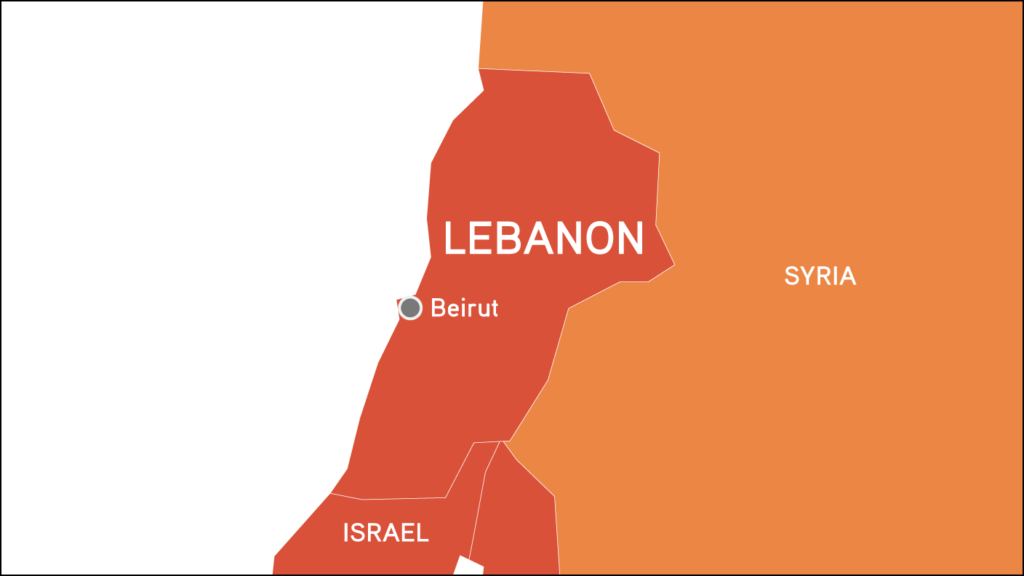
Populations in Lebanon are at risk of atrocity crimes, including likely war crimes, as Israeli forces continue attacks amid a ceasefire between Lebanon and Israel. Hezbollah has also perpetrated likely war crimes.
On 2 March, just two days after the United States (US) and Israel initiated a joint military campaign against Iran, Israel launched an extensive attack against Lebanon. The escalation followed missile strikes by Hezbollah towards Israel in retaliation for the killing of Iran’s Supreme leader, Ayatollah Ali Khamenei. Israeli forces have since carried out raids in southern Lebanon, threatening a widespread ground invasion, and launched airstrikes across the country. At the time of writing, more than 4,200 people have been killed and over 12,000 injured, according to Lebanon’s Ministry of Public Health. Some 1.2 million people – approximately 20 percent of Lebanon’s population – have been forcibly displaced due to Israel’s offensive since March.
A report by the Office of the UN High Commissioner for Human Rights (OHCHR) found that during the first three weeks of the recent escalation Israeli forces conducted direct attacks on civilians, including medical personnel, prevented residents from evacuating safely and targeted essential infrastructure. Israel’s defense minister directed forces to accelerate the destruction of all bridges over the Litani River in southern Lebanon under the guise of counterterror operations. Attacks on power stations, water infrastructure and financial institutions have been documented while Human Rights Watch (HRW) reported Israel’s unlawful use of white phosphorus on residential areas in southern Lebanon. Peacekeepers from the UN Interim Force in Lebanon (UNIFIL) have also faced heightened insecurity and attacks on their bases.
On 16 April the US announced it had brokered a temporary ceasefire between Lebanon and Israel. Despite multiple extensions to the ceasefire, exchanges of fire have continued.
Before this offensive, populations across Lebanon, particularly the south, were still recovering from intense sustained cross-border hostilities between Israel and Hezbollah from 2023-2024. On 8 October 2023, following the deadly attack on Israel by Hamas and other Palestinian armed groups and the subsequent launch of Israel’s assault on Gaza, Hezbollah fired rockets and artillery into Israel. The continued tensions escalated further on 17 September 2024, when thousands of handheld pagers and radios exploded simultaneously across Lebanon and Syria, killing at least a dozen people and wounding over 3,000 others. The operation was later confirmed to have been carried out by Israel.
In October 2024 Israel launched a ground invasion into southern Lebanon – the first since 2006 – accompanied by increased shelling and air raids against border towns. UNIFIL warned this violated UN Security Council (UNSC) Resolution 1701, which was adopted in 2006 during the last major conflict between Hezbollah and Israel. Within two weeks, Israel had issued mass displacement orders for 25 percent of Lebanon, displacing an estimated 1.3 million people, including to neighboring countries. Hezbollah’s activities displaced over 60,000 residents of northern Israel and killed and injured over a dozen others. According to Lebanon’s Ministry of Public Health, between October 2023 and November 2024 Israeli forces killed over 3,000 people and injured more than 13,000.
On 27 November 2024 a ceasefire agreement between Israel and Hezbollah – primarily mediated by the US and France – took effect, reaffirming both parties’ commitment to Resolution 1701. Despite the ceasefire, violations were widespread and exposed civilians to continued harm. In June 2025 Israel intensified attacks on alleged Hezbollah-related targets, launching near-daily airstrikes that resulted in civilian casualties and the destruction of civilian objects, and continued to occupy several locations in southern Lebanon. By November 2025 UNIFIL had documented nearly 7,800 airspace violations – almost all attributed to Israel – and over 2,500 Israeli ground violations. OHCHR reported that Israeli attacks killed at least 127 civilians in Lebanon in the first year since the ceasefire entered into force. UN experts also recorded four incidents involving projectiles launched from Lebanon toward Israel. In January 2026 Lebanon filed a complaint with the UNSC regarding Israel’s ceasefire violations, citing over 2,000 breaches of Lebanese sovereignty in the last three months of 2025 alone.
These violations have had sustained humanitarian consequences. HRW found repeated Israeli attacks on infrastructure critical to reconstruction efforts in southern Lebanon, which may amount to war crimes. Amnesty International also documented the damage or destruction of over 10,000 structures between October 2024 and January 2025. More than 64,000 people remained displaced following the 2024 ceasefire, unable to return due to security risks and mass destruction. Following Israel’s March 2026 offensive, many who managed to return have faced repeated displacement.
Since the initial ceasefire took effect on 16 April, over 600 people have been killed in Lebanon, along with two UNIFIL peacekeepers. In late April over 1.2 million people were projected to face acute food insecurity between April and August 2026 as a result of the conflict. The World Health Organization has documented ongoing attacks on healthcare, with 196 attacks recorded since 2 March. Israel has continued to issue forced displacement orders and established a military boundary demarcated by a so-called yellow line extending approximately 10 kilometers into southern Lebanon. Following an expansion of Israel’s military operations, which included blanket displacement orders for the entire area south of the Zahrani River and enhanced strikes, on 2 June Israel and Hezbollah announced another temporary, partial truce. Days later, Hezbollah rejected the agreement following renewed attacks by Israel, which have since escalated.
While the signing of a Trilateral Framework by Israel, the US and Lebanon in late June affirmed the parties’ “shared goal of achieving lasting peace and security,” the agreement appears to impose constraints on access to justice for victims of war crimes, conditions the withdrawal of Israeli forces on the disarmament of Hezbollah and impedes the return for displaced residents. Meanwhile, Israel continues to launch airstrikes on Lebanon, while senior officials have instructed forces to prepare for long-term presence in the south.
Israel’s continued offensive in Lebanon, amid the so-called ceasefire and Trilateral Framework, risks further destabilizing the region and normalizing patterns of unlawful conduct against civilians. Ongoing violence and destruction by Israeli forces repeats actions from prior offensives in Lebanon, including those which may amount to possible war crimes.
Israel is replicating tactics used to commit atrocities in Gaza in Lebanon and UN experts have warned of these parallels, such as the destruction of homes as a form of collective punishment. This also includes the issuance of mass displacement orders, attacks on densely populated areas with little or no warning, widespread destruction of civilian infrastructure, targeting of healthcare and the repeated use of white phosphorus. Senior Israeli officials have explicitly referenced Gaza as a model for operations in Lebanon. The Israeli military’s actions to empty and destroy villages in southern Lebanon, including the demolition of critical bridges, risks severing the south from the rest of the country.
The extensive failure of the international community to hold Israel accountable for the atrocities in Gaza, as well as for its large-scale and near daily violations of the 2024 ceasefire agreement with Hezbollah, has emboldened Israel to launch the current assault on Lebanon with little regard for international law. Without meaningful accountability, populations in Lebanon remain at increasing risk of atrocities, as well as prolonged occupation.
Efforts to ensure and enforce a permanent ceasefire between all parties must be prioritized. Parties to the Trilateral Framework must ensure its implementation neither prevents the return of displaced populations nor impedes recourse to justice. Israel and Hezbollah must recommit to Resolution 1701. Israel must cease its military offensive and withdraw all forces from Lebanon.
States must take steps and refrain from providing any assistance to Israel that would risk complicity in grave violations of international law, including potential atrocity crimes. This includes imposing a two-way arms embargo on Israel and suspending military and intelligence cooperation. The European Union should suspend its Association Agreement with Israel. States should also impose sanctions on Israeli government officials and uphold the arrest warrant issued by the International Criminal Court (ICC) for Prime Minister Benjamin Netanyahu.
The Lebanese government should promptly finalize earlier moves to grant the ICC jurisdiction.


Ralph Bunche Institute for International Studies
The Graduate Center, CUNY
365 Fifth Avenue, Suite 5203
New York, NY 10016-4309, USA