
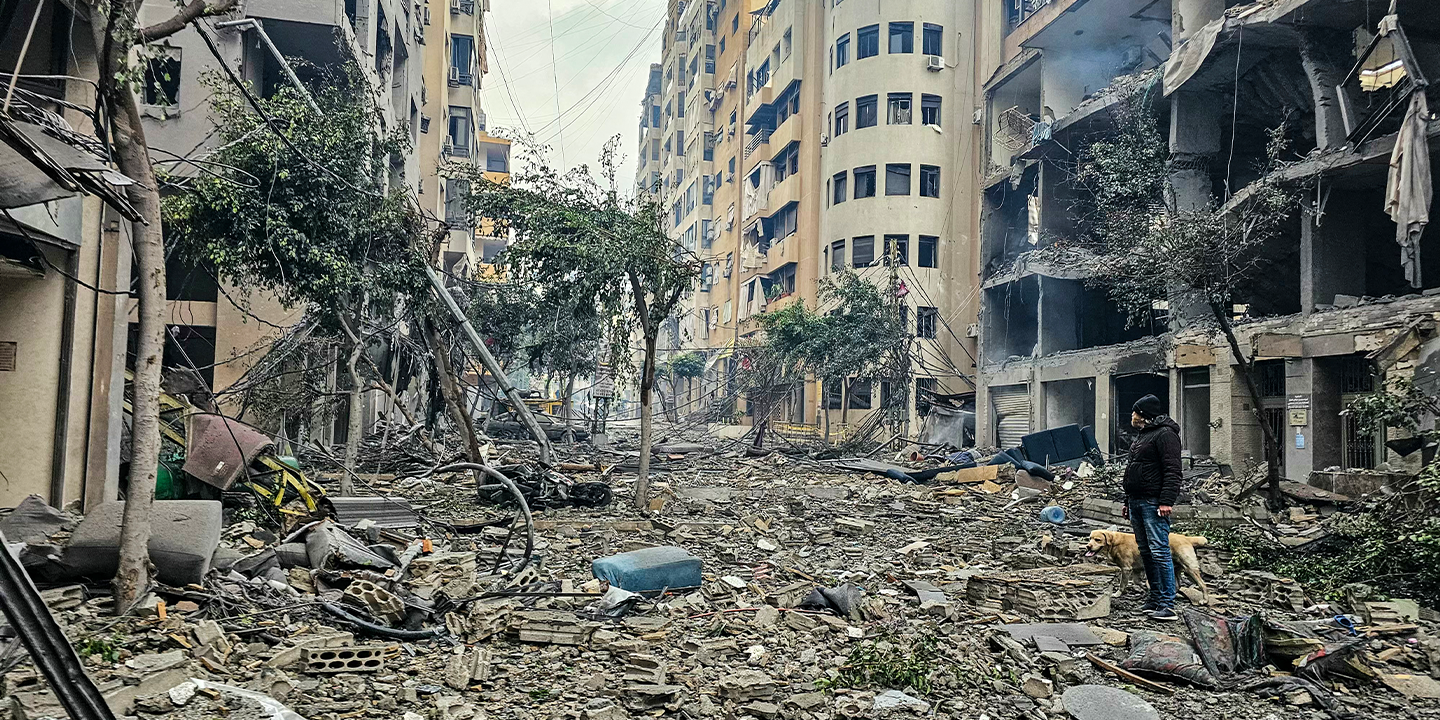
Photo Source: © -/AFP via Getty Images
Atrocity Alert No. 474: Lebanon and the Occupied Palestinian Territory, Sudan and Belarus
18 March 2026
Atrocity Alert is a weekly publication by the Global Centre for the Responsibility to Protect highlighting situations where populations are at risk of, or are enduring, mass atrocity crimes.
ISRAEL EXPANDS OFFENSIVE IN LEBANON AMID ATTACKS ACROSS GAZA AND THE WEST BANK
On 16 March Israeli forces began expanding ground operations in southern Lebanon. The mobilization of ground forces adds to the destruction from Israeli airstrikes, which have been ongoing since 2 March. Israeli attacks have killed at least 900 people in Lebanon since then, including over 111 children. Amid these developments, the government has taken steps to approve the mobilization of approximately 450,000 Israeli reservists.
Israeli airstrikes have leveled multiple residential buildings, often with several members of the same family killed together. The attacks are further straining Lebanon’s health system and increasing risks for medical personnel providing life-saving care. Over three dozen medical staff have been killed, including 12 in a single attack alone on 13 March after a healthcare center was struck in southern Lebanon. The Office of the UN High Commissioner for Human Rights has warned that deliberate attacks on civilians or civilian objects amount to war crimes.
Israel has also issued mass evacuation orders across an estimated fourteen percent of Lebanon’s territory. These orders have forcibly displaced over one million people, nearly 300,000 of them children. Israeli Defense Minister Israel Katz has signaled that displaced residents will not be allowed to return home until the safety of northern Israeli communities from Hezbollah is guaranteed, raising fears about a prolonged occupation by Israeli forces.
The United Kingdom, France, Germany, Italy and Canada issued a joint statement calling for an expanded Israeli ground offensive to be “averted.” Prior to Israel’s latest assault on Lebanon, the UN Interim Force in Lebanon had documented over 10,000 Israeli violations in the year following the November 2024 ceasefire agreement between Israel and Hezbollah.
Israel’s widening offensive in Lebanon comes amid ongoing ceasefire violations in Gaza and continued attacks across the Occupied Palestinian Territory (OPT). Between 14-15 March, at least a dozen Palestinians were killed in Gaza, including a pregnant woman and two boys. In a separate incident in the Occupied West Bank, a family traveling in a car came under fire, killing both parents and two of their children, and leaving two more children injured and orphaned. The UN Human Rights Office in the OPT issued a statement condemning the recent killings and noting that “killing entire families together in homes and shelters has been a fixed feature of Israeli military activity in Gaza since 7 October 2023, wiping out generations at a time.” The statement emphasized that “accountability for all violations of Palestinians’ rights is indispensable for any meaningful reversal of these disturbing patterns.”
States must resolutely act to halt Israel’s offensive in Lebanon and prevent any attempts at prolonging its presence. All states must condemn Israel’s ongoing attacks across the OPT and confront continued violations of the ceasefire in Gaza.
ESCALATING DRONE ATTACKS ACROSS SUDAN PUT CIVILIANS AT HEIGHTENED RISK
In recent months, drones have become an increasingly prominent feature of the conflict in Sudan, deployed by both the Sudanese Armed Forces (SAF) and the Rapid Support Forces (RSF) across multiple regions of the country. Civilians and local communities are bearing the brunt as homes, schools, markets and hospitals are increasingly damaged or destroyed by the frequent strikes. According to the Office of the UN High Commissioner for Human Rights, more than 200 civilians were killed by drone strikes in White Nile State and the Kordofan regions between 4 and 12 March, including at least 152 victims by SAF strikes in West Kordofan alone.
Recent attacks illustrate the deadly pattern and geographic scope of the drone strikes. On 12 March an alleged SAF strike against a market in Adikong, West Darfur, killed at least 11 civilians and wounded more than 20 others, including children. The day before, RSF drones struck a secondary school and a health center in Shukeiri, White Nile State, killing at least 17 people, including students, teachers and a health worker. Following these attacks, UN High Commissioner for Human Rights Volker Türk said he was “appalled” by the devastating impact of drones on civilians, noting that “it is deeply troubling that despite multiple reminders, warnings and appeals, parties to the conflict in Sudan continue to use increasingly powerful drones to deploy explosive weapons with wide-area impacts in populated areas.”
The surge in drone attacks underscores the need for urgent measures aimed at protecting civilians and preventing further atrocities. On 26 February the United Kingdom, Germany, Norway, the Netherlands and Ireland announced plans for the establishment of a coalition focused on preventing atrocities and supporting justice in Sudan. This announcement followed the publication of the UN Fact-Finding Mission report, which documented evidence of widespread atrocity crimes, including genocide, during the siege and takeover of El Fasher by the RSF in late October 2025. As early as June 2023, Sudanese and international human rights organizations and defenders, including the Global Centre for the Responsibility to Protect, documented these atrocities, issuing repeated warnings about escalating risks to civilian populations and calling for urgent action. Despite this reporting, the international community did not implement timely or effective measures to prevent atrocities, allowing the violence to continue and expand.
By prioritizing atrocity prevention, the newly established coalition reflects a strategic shift in how the international community seeks to address ongoing and emerging atrocities in Sudan. The coalition must act on real-time reporting, coordinate preventive measures among member states, support local civil society and ensure all available diplomatic, economic and operational tools are used to reduce civilian harm as violence escalates. Parties to the conflict must immediately stop using drones in populated areas and ensure full compliance with International Humanitarian Law, including halting attacks on hospitals and other civilian objects.
INTERNATIONAL CRIMINAL COURT OPENS INVESTIGATION INTO BELARUS
On 12 March the Office of the Prosecutor (OTP) of the International Criminal Court (ICC) announced the opening of an investigation into the Situation in Lithuania/Belarus. The OTP found a reasonable basis to believe that since May 2020 Belarusian authorities have committed the crimes against humanity of deportation and persecution against individuals opposing or perceived to oppose the government. This is the first international criminal investigation into alleged crimes linked to Belarus’ post-2020 crackdown, offering a pathway to accountability for victims and survivors.
The investigation follows a preliminary examination launched in early October 2024 after Lithuania referred the case on 30 September 2024. The OTP concluded that “coercive acts leading to deportation” were committed pursuant to a state policy. The recurrent and patterned nature of these acts supports the finding that they were encouraged or approved at the highest levels of government. The ICC may exercise jurisdiction because the crimes are transboundary, with many political prisoners and activists forcibly expelled to Lithuania.
In its latest report, the UN Human Rights Council (HRC)-mandated Group of Independent Experts (GIE) on the Human Rights Situation in Belarus reaffirmed that grave, systematic and widespread violations persist, including those amounting to the crimes against humanity of political persecution and imprisonment. Since 2020 over 500,000 people have fled Belarus due to a well-founded fear of persecution.
The GIE found that Belarusians remain at risk even after fleeing abroad. Authorities target individuals in exile through weaponized administrative procedures and systematic judicial harassment, effectively stripping them of legal status and security. This includes threats and intimidation, pressure on family members remaining in Belarus, in absentia trials, property seizures and restrictions on access to essential services such as passport renewal, placing many at risk of de facto statelessness.
Monika Platek, a member of the GIE, noted that this strategy was evident in 2025 during state-authorized prisoner releases, which involved forced expulsions and deprivation of identity documents. That year, Belarus released up to 342 political prisoners by presidential pardon, more than half of whom were expelled to Lithuania and Ukraine, some without documents, in exchange for political concessions.
The GIE emphasized the urgent need for accountability at national and international levels to counter a “pervasive culture of impunity in Belarus.” ICC States Parties, particularly those hosting Belarusian refugees, should refer the situation to expand the Court’s territorial jurisdiction and ensure equal access to justice for all victims. States should also cooperate fully with the ICC by facilitating evidence collection, executing arrest warrants, surrendering suspects and protecting victims and witnesses. At the 61st session of the HRC, member states should adopt a strong resolution renewing the mandates of the GIE and the Special Rapporteur on the situation of human rights in Belarus to sustain essential scrutiny and investigative work.
Source
Global Centre for the Responsibility to Protect
Related Content

22 July 2026
Atrocity Alert
Atrocity Alert No. 491: Israel and the Occupied Palestinian Territory, Haiti and the UN Human Rights Council
17 July 2026
Podcast