14 October 2026
Atrocity Alert
Hostilities between the Houthis and Saudi Arabia, alongside the Saudi-backed internationally recognized government of Yemen, have escalated at an alarming pace following a Houthi offensive launched in early September. On 10 October a Houthi attack on King Khalid International Airport near Riyadh, Saudi Arabia, killed at least 12 people and injured over 300 more. This marks one the deadliest incidents by the Houthis against Saudi Arabia over the last few weeks, during which the armed group has targeted airports in the country on numerous occasions. In response, the UN Security Council adopted a presidential statement condemning the attacks and calling for respect of International Humanitarian Law (IHL).
The conflict also risks widening regionally. Several countries, including Egypt, Türkiye and Pakistan, have expressed willingness to provide some form of military or technical assistance to Saudi Arabia, heightening concerns of further escalation beyond Yemen.
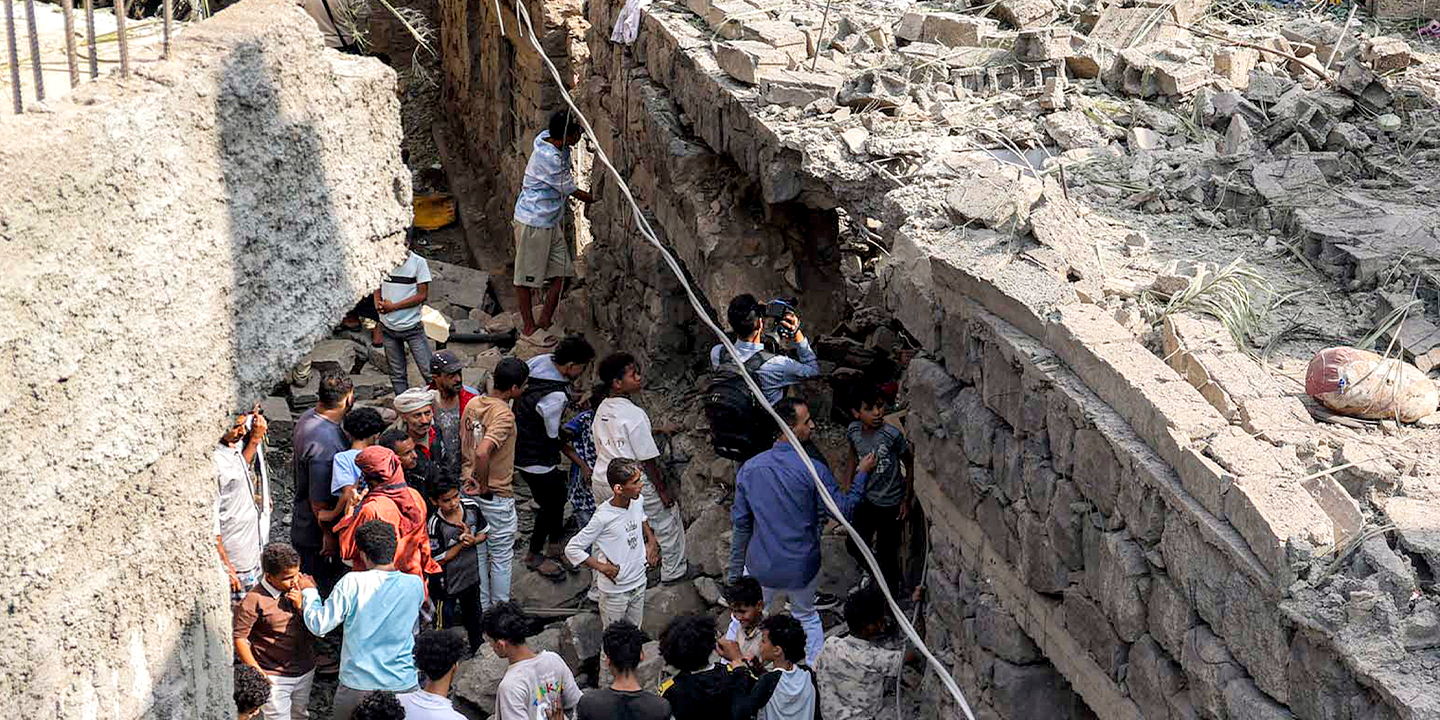
Simultaneously, the Houthis have continued their offensive against Yemeni government forces, striking a security force training camp in southern Yemen on 19 October and killing over 70 people. Meanwhile, Saudi strikes have also continued across Yemen, targeting fuel and oil facilities nearby Houthi-controlled areas. On 19 October a reported Saudi strike hit a residential home in Saada province, killing at least nine people, including five children.
The return to large-scale conflict has further exacerbated Yemen’s already dire humanitarian conditions, which remains one of the lowest-funded humanitarian crises globally. Since early September more than 250,000 people, including an estimated 110,000 children, have been displaced. On 15 October the UN Special Representative of the Secretary-General for Children and Armed Conflict warned that the recent escalation “threatens to reverse hard-won gains for children in Yemen and exposes yet another generation to fear, displacement and harm,” and expressed concern over growing reports of child recruitment.
In Taiz, a southwestern governorate and the epicenter of the current hostilities, the Houthis have tightened their long-standing siege. Over 25 international humanitarian organizations issued a joint statement on mounting risks across Taiz, including restrictions on civilian movement and humanitarian access, as well as rising prices, which have left residents increasingly unable to afford essentials such as food and cooking gas. Taiz is already facing some of the highest levels of food insecurity.
States must urgently press all parties to the conflict to de-escalate hostilities, uphold IHL, ensure the protection of civilians and guarantee safe and unimpeded access to humanitarian assistance. The international community must also pursue accountability for violations of international law, including violations perpetrated by all parties to the conflict that were previously documented by the Group of Eminent International and Regional Experts on Yemen, as well as potential war crimes that may be ongoing, and work to prevent recurring abuses against civilians.
Russian forces have intensified attacks across Ukraine in recent months, killing and injuring hundreds of civilians and damaging essential infrastructure as winter approaches. According to the UN Human Rights Monitoring Mission in Ukraine, at least 328 civilians were killed and 2,105 injured in September, an 85 percent increase in casualties compared to September 2025 alone. The violence has continued into October, with Russian missile and drone strikes killing at least 22 civilians and injuring 45 in Pryluky, Chernihiv region, on 6–7 October. Further large-scale strikes on 19–20 October killed civilians, damaged residential areas and disrupted electricity supplies across several regions.
The devastating strikes in September are a further escalation of a trend of increased bombardment and targeted attacks on civilians over the past year. Between January and September, the UN verified 2,570 civilian deaths and 15,211 injuries, a 59 percent increase compared to the same period in 2025. Long-range missiles and drones remain the leading cause of civilian casualties, while short-range drones increasingly endanger communities near the frontlines. UN investigations have also documented widespread torture, arbitrary detention, enforced disappearances and other serious violations in Russian-occupied territories.
Repeated Russian attacks on Ukraine’s energy infrastructure threaten to deepen civilian suffering ahead of winter. Strikes throughout October have damaged major energy facilities and left hundreds of thousands without electricity, disrupting access to heating, water and healthcare. Meanwhile, Ukraine has continued long-range drone strikes against targets inside Russia, particularly oil refineries and other energy facilities. On 11 October United States (US) President Donald Trump announced an immediate energy ceasefire, although neither party had formally confirmed an agreement. Russian attacks on Ukrainian energy infrastructure continued, prompting Ukraine to resume strikes against Russian oil facilities on 15 October.
These developments unfold amid uncertainty surrounding international support for Ukraine and ongoing negotiations. Ukrainian President Volodymyr Zelenskyy has raised concerns over US restrictions on intelligence sharing, including missed advance warnings of Russian strikes, which could undermine civilian protection. US officials have denied halting cooperation. Russian President Vladimir Putin has continued to demand Ukrainian territorial concessions, including control of Donbas, and has announced plans to maintain a non-negotiable security zone inside Ukraine.
As Russia’s attacks continue to threaten civilians and essential services, the international community must take concrete steps to protect civilians, particularly as winter approaches. Sarah Hunter, the Global Centre for the Responsibility to Protect’s Ukraine expert, said, “Any agreement to halt attacks on energy infrastructure must deliver meaningful protections for civilians, rather than merely a temporary pause in hostilities. This means safeguarding access to electricity, heating and water, strengthening air defenses and ensuring independent monitoring of violations. Efforts to negotiate an end to the war must also protect the rights of civilians living under Russian occupation and ensure accountability for atrocity crimes. Civilian protection and justice cannot be bargaining chips in the pursuit of peace.”
On 14 October the UN Security Council (UNSC) renewed its sanctions regime on Haiti for another year. The UNSC added no new designations, despite a Panel of Experts (PoE) report exposing the political, security and economic networks sustaining the gang crisis. Covering October 2025 to July 2026, the PoE found that gangs remain powerful because influential actors utilize them as strategic proxies to advance or protect their interests. The report cautioned that ties between some local authorities and gangs are being used to consolidate territorial control and influence the political transition, including the now postponed elections.
The PoE detailed allegations against several figures. Alfrédo Junior Antoine, a former legislator representing Kenscoff, was accused of arming and financing armed groups, including the Viv Ansanm gang alliance, as well as sponsoring a 2025 attack in Kenscoff that killed more than 100 people. Former Haitian Senator Nenel Cassy was accused of controlling a group in Miragoâne and supporting armed individuals. The PoE found at least one member of a municipal commission established in Cité Soleil in May is an active gang member.
The report’s findings emphasize persistent failures to enforce the sanctions regime and disrupt the networks sustaining gangs. The arms embargo is violated “on a regular basis,” while Haiti’s central bank had frozen no funds in accounts associated with multiple gang leaders and just $2.63 in the account of Dimitri Hérard, the former head of security at Haiti’s National Palace who has been accused in connection with the assassination of President Jovenel Moïse. The PoE also highlighted corrupt police officers accused of supplying gangs with weapons, ammunition and intelligence.
Meanwhile, as Haitian security forces and the UN-authorized Gang Suppression Force intensify operations, gangs have adapted their tactics, increasingly utilizing hostage-taking, intimidation and reprisals against civilians. The PoE noted growing sexual violence and child recruitment, alongside reports of summary executions of children allegedly associated with gangs by security forces and self-defense groups. In July and August alone, 689 women and girls were reportedly raped by gang members.
Civilians are also increasingly caught in crossfire or deliberately targeted amid “violent fractures” within Viv Ansanm, as rival factions compete for territory and revenue. The intense clashes in Cité Soleil and Croix-des-Bouquets illustrate the harm of this fragmentation, including civilian casualties, mass displacement and significant disruptions to healthcare.
The international community should strengthen measures to prevent the illicit flow of small arms and light weapons into Haiti. Haitian authorities should investigate and prosecute those responsible for serious violations and those financing or supplying armed groups. The UNSC should expand sanctions designations to include individuals and entities responsible for supporting, ordering or facilitating violations of International Human Rights Law. Haitian authorities and international partners must also strengthen prevention and protection measures, including support for the disarmament, rehabilitation and reintegration of children associated with gangs.

Ralph Bunche Institute for International Studies
The Graduate Center, CUNY
365 Fifth Avenue, Suite 5203
New York, NY 10016-4309, USA