
23 September 2026
Atrocity Alert
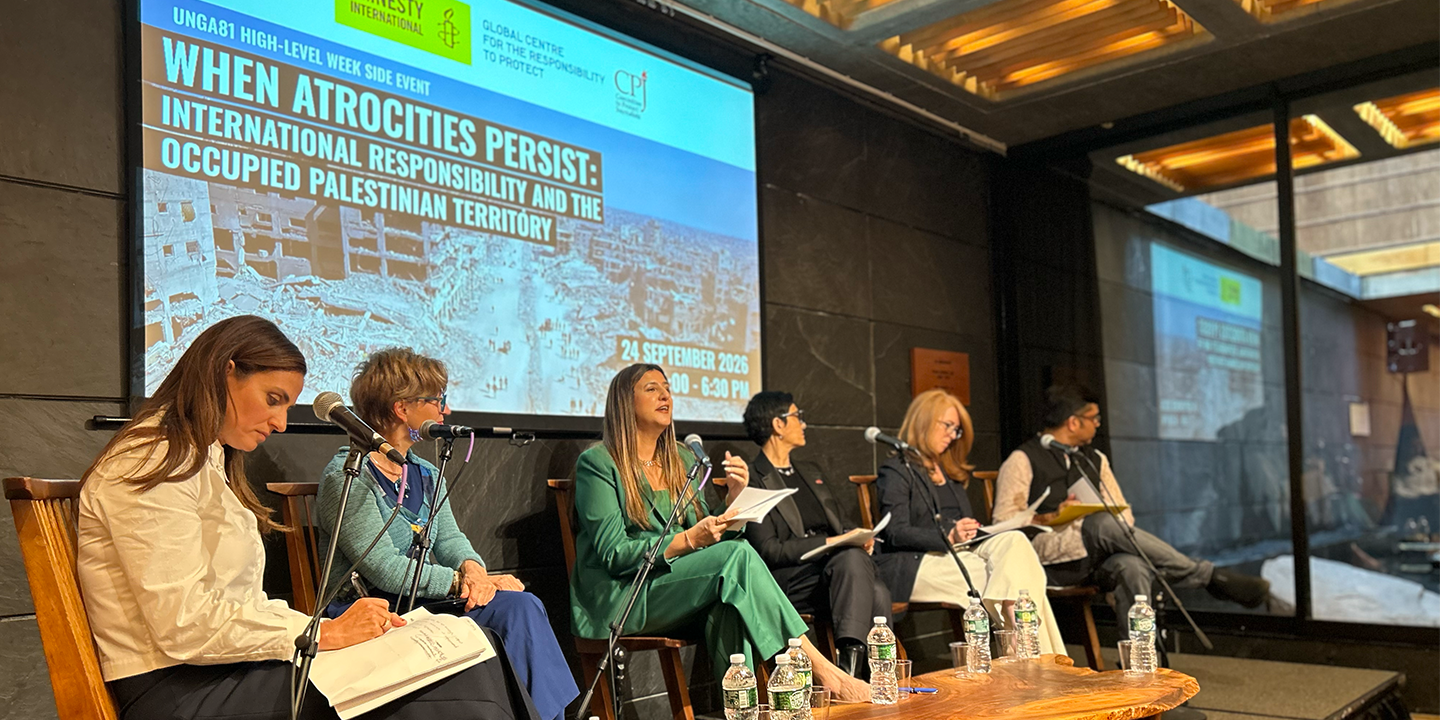
When we first conceived of this event, we did so with a painful awareness: nearly three years after the start of Israel’s assault on Gaza, and nearly a year since the ceasefire came into effect, little has changed when it comes to protecting Palestinians on the ground. And little has changed in multilateral discussions about how to ensure that protection.
We meet today amid a ceasefire in Gaza defined by near-daily Israeli attacks and a drastically deteriorating situation in the Occupied West Bank, where settlement expansion and state-backed settler violence are reaching new heights.
Yet, despite the continuing atrocities, discussions on Palestine still lack the urgency and resolve needed to address root causes, ensure accountability for atrocity crimes, implement third-state obligations and uphold the rights and dignity of a people being stripped of the most fundamental protections to which they are entitled by virtue of being human.
This time last year, member states convened for the High-Level International Conference on the Implementation of the Two-State Solution. That conference culminated in the endorsement of the New York Declaration, which set out a roadmap for realizing the two-state solution. Its annex contained dozens of concrete recommendations and action points, many of them put forward by civil society. This was accompanied by the recognition of the State of Palestine by nearly a dozen member states.
However, one year later, there has been no substantive progress in fulfilling those pledges.
So today is not about providing yet another assessment of the situation in Palestine. As you know, Israel’s conduct across Palestine, past and present, is one of the most deeply and systematically documented situations on the multilateral agenda.
It has been documented by Palestinians themselves, by human rights, humanitarian and development organizations, by UN agencies and independent experts, and by lawyers, journalists and doctors.
And yet, this reality has been diluted, deflected and denied.
There is no aspect of Palestinian life that has not been affected by Israel’s conduct or by the inaction and complicity of the international community – from security and human rights to accountability, humanitarian assistance, housing, water and sanitation, healthcare, education, civic space and climate.
Not one protected group has been spared from attack: aid workers, doctors, healthcare professionals, journalists, women and children.
And, in many cases, we have witnessed horrifying new global records.
We also know that tangible and sustained change across Palestine will not be achieved through fragmented responses. It requires a comprehensive approach to the overarching injustice at the heart of this crisis.
Yet, in the multilateral arena the space in which we can speak with clarity has been narrowed. It has squeezed actors and organizations into separate silos, each trying to advance some semblance of change within the narrow confines allotted to them.
And so, with this event, we are challenging that premise of working in silos. That begins with challenging the narrative imposed by the international community, because, friends, as we know, narratives define policy choices.
Those choices are generating new risks while preventing just, lasting and even immediate change on the ground.
This narrative has made international law selective. It has treated pledges to act as an adequate substitute for action. It has decided that the two-state solution, as the international community defines it, simply needs one more chance, even as the conditions necessary to realize it are systematically dismantled. It has denied Palestinians ownership over decisions about their own future. It has treated Palestinian men as the exception to sympathy. And it has treated recovery and reconstruction as simply another project to finance, rather than recognizing the destruction that necessitates them as the consequence of large-scale atrocities.
We see the same logic playing out in the implementation of the ceasefire. Israel is not required to meet the stipulations of the first phase and halt its attacks before further demands are placed on Palestinians. The fundamental rights of Palestinians are conditioned upon the total disarmament of Hamas. Hamas is presented as the sole obstacle and the sole instigator. Determinations of atrocity crimes, including genocide, are treated as though they have no place in what is singularly characterized as a humanitarian crisis. Efforts to advance meaningful action are deferred to elections in Israel.
And this narrative continues to prevail, despite escalating actions by Israeli authorities across the Occupied Palestinian Territory. It is sustained by isolated condemnations and piecemeal measures that circumvent the systemic injustice underpinning Israel’s treatment of Palestinians.
Friends, the Responsibility to Protect was developed in the aftermath of the horrors of Rwanda and Srebrenica. It represents a unanimous commitment by member states to protect populations at risk of crimes so grave that they shock the conscience of humanity.
Failures to uphold this commitment have allowed suffering on unimaginable scales to be repeated time and again. Those failures have also prompted internal UN reviews following large-scale atrocities, each intended to examine what went wrong and to course-correct international action.
And yet, here we are today.
The consequences of the international community’s failure to comprehensively and tangibly protect Palestinians do not end with Palestine. Fundamental legal protections underpinning safe zones and evacuation orders have been abused and these practices are being exported to Lebanon. The use of AI-driven systems in the commission of atrocities is creating dangerous precedents for conflicts elsewhere. And coercive efforts to obstruct international justice and accountability are multiplying.
As Israel’s violence across Palestine deepens, we must do what the international community has repeatedly pledged to do in the aftermath of past atrocities. We must develop a collective voice capable of challenging the prevailing narrative. We must meet every instance of less-than-the-bare-minimum progress with an unrelenting reminder of the pledges that have been made and the responsibilities that remain unmet. And we must never allow member states to forget their fundamental responsibility to ensure “Never Again.”
The obligations are clear. The commitments have been made. The New York Declaration sets out options for action.
What stands in the way is political will. And political will is shaped by narratives that determine whose suffering demands a response, which obligations are treated as urgent and which choices governments are willing to make.
We must challenge those narratives and the siloed responses they produce. Protection, humanitarian aid, accountability and Palestinian self-determination cannot be addressed in isolation.
Together, we must insist that member states act on the commitments they have already made.
Through an unrelenting insistence that pledges to protect must finally become action to protect.
Thank you.
Ralph Bunche Institute for International Studies
The Graduate Center, CUNY
365 Fifth Avenue, Suite 5203
New York, NY 10016-4309, USA