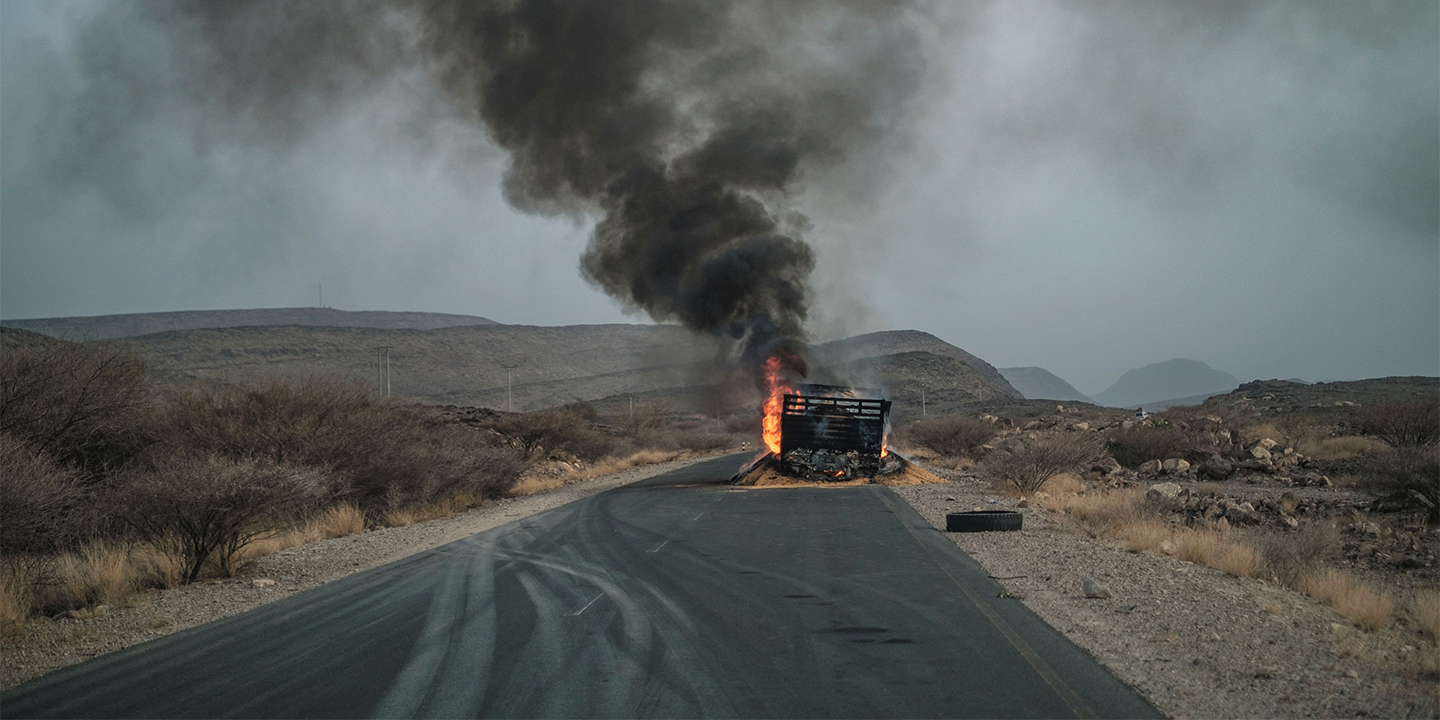
Photo Source: © Eduardo Soteras/AFP via Getty Images
Ethiopia: Renewed Escalation Demands Urgent International Action to Prevent Further Atrocities
10 September 2026
We, the undersigned civil society organizations, express our grave concern over escalating violence, instability and mass atrocity crimes across Ethiopia. Communities across the country continue to endure the consequences of protracted conflicts without meaningful justice, accountability or recovery. Warnings of expanding conflict in parts of Oromia and Amhara, as well as renewed conflict in Tigray, have intensified throughout 2026.
Renewed conflict and atrocities in Tigray
In Tigray, communities are once again facing the risk of large-scale conflict as violence escalates and prospects for de-escalation diminish. Fighting between the Ethiopian National Defense Force (ENDF) and Tigrayan forces resumed on 1 August, and the government has reportedly launched near-daily drone strikes in Tigray since then, including attacks affecting civilians and civilian infrastructure such as schools, river banks, farms and residential homes. The renewed fighting has also reportedly forced hundreds of civilians to flee into Sudan. These developments follow earlier government drone attacks in January 2026, as well as troop mobilizations and clashes. Attacks against civilians and civilian infrastructure are violations of International Humanitarian Law and require immediate investigation and accountability.
The renewed escalation is unfolding against the backdrop of the unresolved consequences of the 2020–2022 conflict and incomplete implementation of the November 2022 Cessation of Hostilities Agreement (CoHA), particularly with respect to the status of Western Tigray, and the continued presence of Eritrean forces. The unresolved situation in Western Tigray poses serious risks to peace and civilian protection. No durable agreement has been reached regarding the area’s status and governance, security arrangements or the return of hundreds of thousands of people displaced during the 2020–2022 conflict. The Pretoria Agreement calls for these issues to be resolved in accordance with the FDRE Constitution, including through the withdrawal of non-ENDF forces and the safe, voluntary and dignified return of displaced communities.
Human Rights Watch reported in April 2026 that ethnic Tigrayans in Western Tigray continued to face arbitrary detention and restrictions on movement, employment and access to services, and that conditions were not conducive to safe returns. In June 2023 Human Rights Watch reported that ethnic cleansing had occurred in Western Tigray. These findings must be understood in the context of extensive documented atrocities committed during the 2020–2022 conflict, including war crimes and crimes against humanity, and the continued absence of meaningful accountability for these abuses.
Atrocity risks in Amhara and Oromia
Atrocity crimes and serious human rights violations also persist elsewhere in Ethiopia. In Amhara, fighting between federal forces and ethnic Fano militias has been accompanied by unlawful killings, arbitrary detention, sexual violence and government drone strikes affecting Amhara civilians. In Oromia, fighting between the Oromo Liberation Army (OLA) and government forces, which began in 2019, has evolved into a complex conflict involving multiple layers of security forces and various armed actors. Government forces, the OLA, Fano and other armed actors continue to be implicated in serious violations against civilians. Government forces are intensifying forced conscription across the region and have been implicated in extrajudicial executions, the recruitment and use of children and other violations. Fano forces have been implicated in killings of civilians and forced displacement, while the OLA has been accused of abductions, killings and rape.
Regional risks, shrinking protection space and accountability gaps
Ethiopia’s crises are also increasingly intertwined with regional rivalries. The war in Sudan has become heavily internationalized, with external support enabling warring parties to continue committing atrocities. Sudanese authorities have accused Ethiopia and the United Arab Emirates (UAE) of facilitating drone attacks and support to the Rapid Support Forces (RSF), allegations both governments deny, while separate reporting has raised concerns about an alleged RSF training facility in Ethiopia. Alongside persistent tensions between Ethiopia and Eritrea, these developments raise the risk that conflicts across the Horn could become mutually reinforcing.
At the same time, the federal government’s continued restrictions on humanitarian access, independent monitoring and civic space further increase civilians’ vulnerability and impede efforts to document violations and prevent further atrocities. These constraints are compounded by the weakening of mechanisms for atrocity prevention and accountability. The mandates of the UN International Commission of Human Rights Experts on Ethiopia and the African Commission’s Commission of Inquiry on Tigray were terminated despite continuing violations, while Ethiopia’s transitional justice process has failed to deliver meaningful accountability.
Survivors of sexual and gender-based violence continue to face profound barriers to justice amid entrenched impunity. The recent acquittal and release of two men previously convicted and sentenced to life imprisonment for the killing of Zewdu Haftu underscore our concerns about accountability for violence against women and judicial independence in Tigray.
Ethiopia’s fraught national dialogue must not become a substitute for atrocity prevention, accountability or inclusive political processes. Sustainable peace requires civilian protection, meaningful participation by affected communities, respect for fundamental rights and efforts to address the grievances underlying conflict and the impunity enabling further abuses.
Our recommendations
The international community cannot again wait until widespread atrocities are underway before acting. We therefore urge:
- The Ethiopian federal government, Tigrayan authorities and all armed actors to immediately de-escalate, protect civilians and recommit to the full implementation of the CoHA. The African Union (AU), Kenya, Nigeria, South Africa, the European Union, the United States, the United Kingdom, Canada, and other partners should intensify diplomacy and press for resolution of outstanding disputes, including the administration and security of Western Tigray and the safe, voluntary and dignified return of displaced populations.
- UN Human Rights Council members to restore sustained scrutiny of Ethiopia, including through independent monitoring and regular reporting by the Office of the UN High Commissioner for Human Rights on violations, atrocity risks and accountability gaps. If the situation deteriorates further, states should be prepared to seek a special session and establish an independent investigative mechanism.
- States and donors to condition non-humanitarian assistance, security cooperation and other support on measurable progress on civilian protection, human rights and implementation of the CoHA. Lifesaving humanitarian assistance must remain impartial, needs-based and unhindered.
- States to ensure credible, victim-centered transitional justice and accountability efforts, including support for independent casualty recording mechanisms, as well as investigations and prosecutions, meaningful survivor participation and cooperation with international and regional human rights mechanisms.
- States and regional actors to address cross-border drivers of instability, including external military, financial and logistical support that enables serious violations in Ethiopia and Sudan, and to ensure that arms, technology and other assistance do not continue to contribute to atrocity crimes.
The warning signs are unmistakable. Ethiopia’s previous war demonstrated the catastrophic consequences of delayed and fragmented international action. Member states, the AU and the wider international community must act now to protect civilians, prevent renewed mass atrocities and ensure that peace is built on accountability rather than impunity.
Every Casualty Counts
Gender Empowerment Movement Tigray (GEM Tigray)
Global Centre for the Responsibility to Protect
Global Coalition for Genocide Reponse
International Bar Association’s Human Rights Institute
Legacy Tigray Advocacy Group
Omna Tigray
Organization for Justice and Accountability in the Horn of Africa
Source
Global Centre for the Responsibility to Protect and other NGOs
Related Content
7 October 2026
Atrocity Alert
Atrocity Alert No. 497: Ethiopia, Israel and the Occupied Palestinian Territory and the UN Human Rights Council
30 September 2026
Atrocity Alert