
22 July 2026
Atrocity Alert
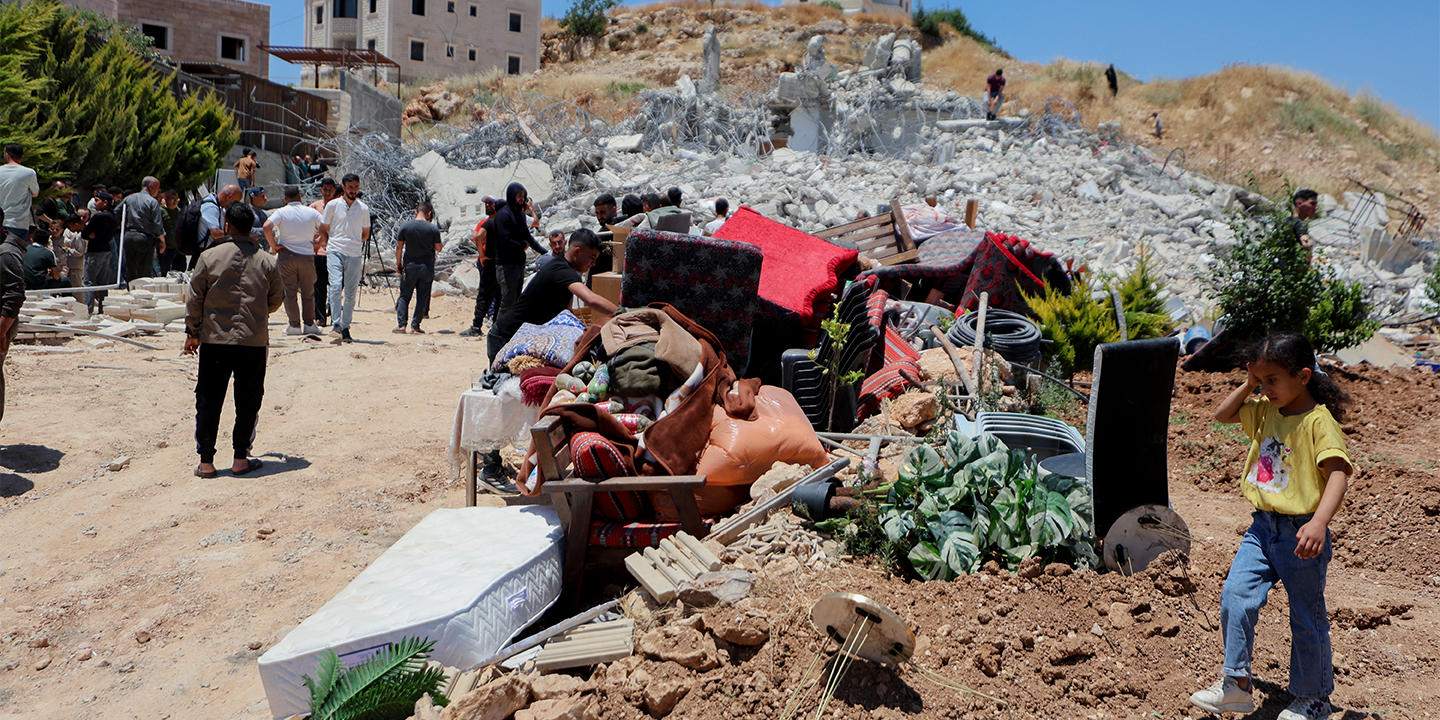
On 1 June UN experts warned that intensifying settler violence across the Occupied West Bank, carried out “with the support and acquiescence of the Israeli State,” is compelling the forcible displacement of Palestinians and “facilitating ethnic cleansing.” The experts stressed that the relentless attacks are employed as a “calculated, targeted tool” to refuse Palestinians access to vital services, agricultural and grazing areas, with the intention of “severing the people’s connection to the land.” According to the UN Office for the Coordination of Humanitarian Affairs, at least 44 Palestinians have been killed in the West Bank during 2026, including 13 by settlers and 30 by Israeli soldiers. Over 950 settler attacks have been documented so far, averaging six attacks per day.
Recent incidents highlight the worsening situation. On 6 June dozens of Israeli settlers damaged homes, stole livestock and severely beat residents in Huwara, injuring at least nine Palestinians. The previous day, Israeli soldiers opened fire on a vehicle carrying a Palestinian family in Hebron, after which a seven-month-old infant died from gunshot wounds. Over recent months, settlers have also erected barbed-wire fences restricting access to schools, attacked an educational facility, damaged critical infrastructure serving Palestinian communities and set fire to greenhouses, mosques and homes.
Alongside escalating violence, Israel has accelerated settlement expansion efforts, including the long-delayed E1 settlement project, which would effectively isolate East Jerusalem from the rest of the West Bank. Since August 2025 Israeli authorities have issued several construction tenders in the E1 area, including one expected to open shortly for over 3,400 housing units. On 19 May Israel’s Finance Minister called for the eviction of Khan Al Ahmar residents, a Bedouin community that has long resisted displacement. The UN Human Rights Office in the Occupied Palestinian Territory warned that this places the community “at imminent risk of forcible transfer – a war crime.”
Growing international concern has resulted in recent diplomatic responses. On 22 May the European Union and eleven states, including Spain, Norway and the United Kingdom (UK), issued a statement reiterating the illegality of Israeli settlements and warning businesses against bidding for tenders linked to settlement developments, including the E1 project. On 4 June members of the Organization of Islamic Cooperation and the Arab Group called on the UN Security Council to respond to Israel’s defiance of international law, including the accelerating efforts to annex and fragment Palestinian land. On 9 June the UK, Canada, France and Norway announced coordinated sanctions targeting networks enabling settler violence.
States must take concrete measures to deter further settlement expansion, settler violence and the forcible displacement of Palestinians, including by ensuring accountability for attacks committed by settlers and Israeli forces. Governments should prohibit trade and investment linked to illegal settlements, implement targeted sanctions against individuals and entities responsible for facilitating settler violence and impose a two-way arms embargo.
Since 3 June Somali security forces and militias aligned with opposition leaders have engaged in armed clashes in Mogadishu. The violence has heightened concerns over civilian protection following planned demonstrations against Somalia’s government. Fighting in several districts of the capital – at times involving heavy weapons – damaged civilian property and forced residents to flee. Although mediation efforts by clan elders have helped reduce the violence, tensions remain high. The UN and the African Union have urged all parties to exercise restraint and resolve disputes through dialogue.
The clashes stem from an escalating constitutional and political crisis following controversial constitutional amendments approved earlier this year. Opposition leaders have challenged the legality of changes that have allowed President Hassan Sheikh Mohamud to delay elections and remain in office beyond the expiration of his mandate on 15 May. Talks aimed at resolving the crisis, facilitated by the United Kingdom and the United States, ended without agreement on 15 May. Ongoing disputes over Somalia’s democratic transition and plans for one-person, one-vote elections have deepened political polarization and raised fears of broader instability.
The political crisis has also fueled violence beyond Mogadishu. On 30 May heavy fighting erupted in Baidoa, South West state, between forces aligned with regional political actors and federal government forces. The clashes reportedly resulted in armed groups briefly seizing parts of Baidoa and reflect growing tensions between federal and regional authorities.
These developments are unfolding against a backdrop of longstanding insecurity and protection risks across Somalia. Civilians continue to face attacks by Al-Shabaab, security forces and localized inter-communal violence that have amounted to war crimes and crimes against humanity. Despite military pressure against the armed group in recent years, Al-Shabaab remains capable of carrying out deadly attacks against civilians and civilian infrastructure. Earlier in May, militants from Al-Shabaab reportedly clashed with Somali security forces in South West state, highlighting concerns that political divisions may create opportunities for armed groups to exploit instability and expand their influence. Political disputes have repeatedly contributed to armed confrontations, exacerbated clan tensions, undermined state-building efforts and heightened risks to civilians.
In line with the Secretary-General’s calls for restraint, all parties should immediately de-escalate tensions, refrain from actions that place civilians at risk and engage in good-faith dialogue to resolve political disputes peacefully. Sarah Ewing, Horn of Africa expert at the Global Centre for the Responsibility to Protect, said, “Somalia cannot afford a return to political violence. Meaningful progress toward credible, inclusive and independent one-person, one-vote elections remains essential to addressing the root causes of instability, strengthening democratic governance and ensuring that the voices and aspirations of the Somali people are not only heard, but respected.”
On 27 May Haitian authorities formally inaugurated two specialized judicial units in Port-au-Prince, marking an important step toward addressing the pervasive impunity for recurrent abuses in Haiti. The units are staffed by 25 magistrates and will prosecute mass crimes, including massacres, sexual violence and child exploitation, as well as financial crimes, including corruption, the illicit trade of arms and money laundering. The initiative stems from a decree adopted by the transitional government in April 2025, although human rights organizations warned at the time that it did not adequately address the systemic corruption and institutional weaknesses that fuel impunity and ongoing abuses.
Haiti’s existing justice system has faced mounting criticism over chronic dysfunction, political interference, corruption and its inability to prosecute major crimes. Investigations into massacres, kidnappings, sexual violence and corruption scandals have frequently stalled for years without convictions. Courts across Port-au-Prince have repeatedly suspended operations or relocated due to gang violence. Several judicial buildings remain inaccessible and large sections of the capital are under gang control. Gangs have vandalized and occupied courts and destroyed case files and records, while magistrates and judicial personnel have faced attacks and death threats.
This dysfunction has contributed to a widespread climate of impunity that allows gangs, political actors and criminal networks to operate with little accountability. Political and economic elites continue to finance and support gang activity, perpetuating cycles of violence. Jean Joseph Lebrun, President of Haiti’s Superior Council of the Judiciary, said during the launch, “These units are meant to ensure that no one can escape justice because of influence, money or political protection.”
As the units begin operations, gang violence continues to intensify across Port-au-Prince and the Artibonite and Centre departments. So far this year, gang-related violence has resulted in at least 2,310 deaths, 1,106 injuries and 99 kidnappings. In addition, 699 people have been subjected to sexual violence, while hundreds of children continue to be trafficked, recruited and exploited by gangs. Women and children are disproportionately impacted, with gangs systematically using sexual violence, including collective rape and sexual slavery, to terrorize communities and consolidate territorial control. Many victims never receive protection, support services or access to justice.
For the new units to succeed, Haitian authorities must ensure that they operate independently and impartially and that judges, prosecutors and court personnel are protected from threats, reprisals and interference. The units should be staffed with personnel trained in human rights-based, trauma-informed and child-sensitive procedures. The international community should provide sustained technical and financial support to strengthen the rule of law, advance accountability and ensure survivors have access to reparations. Meaningful judicial reform must be accompanied by broader efforts to address poverty and corruption, dismantle criminal networks and restore public trust in institutions.
Ralph Bunche Institute for International Studies
The Graduate Center, CUNY
365 Fifth Avenue, Suite 5203
New York, NY 10016-4309, USA