6 July 2026
Summary
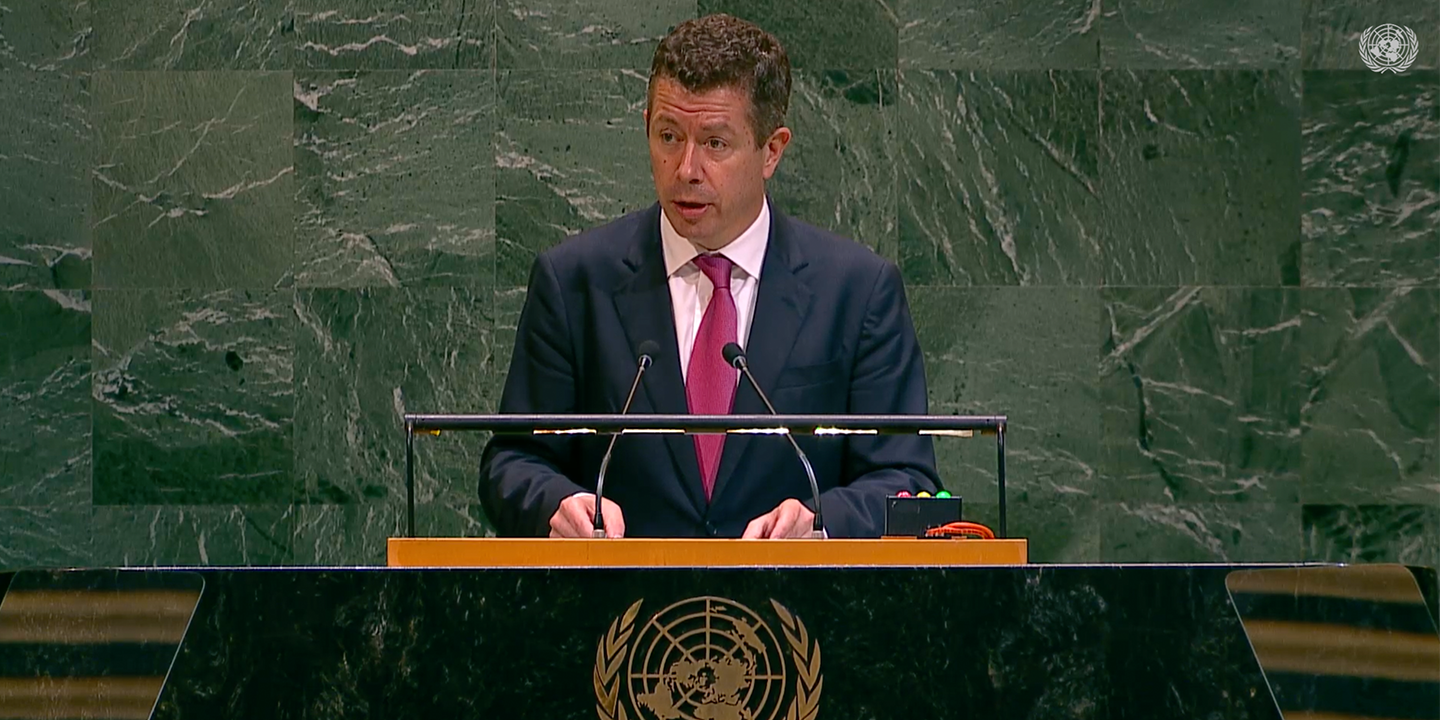
I have the honor to deliver this statement on behalf of 55* members of the Group of Friends of the Responsibility to Protect, which is co-chaired this year by Guatemala, Morocco, and my own country, Luxembourg.
We would like to thank the Secretary-General’s Chef de Cabinet, for his statement. We also thank the Secretary-General for his important report “Sustained implementation of the responsibility to protect at the national, regional and multilateral levels.”
The report stresses that, in the context of escalating armed conflicts, geopolitical fragmentation and growing disregard for international law, atrocity prevention cannot be reactive or episodic, but must be embedded across periods of stability, emerging risks, active crisis and post-conflict recovery.
This year’s debate is taking place when populations around the globe are facing extreme levels of violence, mass atrocities and displacement. The multilateral system is facing profound strain. Deep geopolitical divisions, inconsistent responses to conflicts and atrocities, blatant violations of international humanitarian and human rights law and growing impunity for atrocity crimes have contributed to a widening gap between the international community’s commitment to R2P and its consistent application.
As unanimously agreed by the General Assembly in 2005, the collective responsibility to protect populations from atrocity crimes should transcend political divisions, geopolitical rivalries and competing interests. Efforts to prevent such crimes must never be conditional, selective or secondary to political considerations.
When protection fails, it is civilians who pay the price – in lives lost, communities destroyed and entire populations forced to flee. The annual General Assembly debate on the Responsibility to Protect is not an abstract or symbolic exercise. It is an opportunity for Member States to reaffirm that mass atrocity crimes are never inevitable, collectively confront what is at stake when prevention fails, and assess whether our commitments are matched by action. It is a space that must keep urgency at its core, because for those at risk, these debates are measured not in words, but in whether protection arrives in time – or whether it fails to arrive at all.
Madam President,
We also would like to recognize the important progress that has been made in strengthening global understanding of the drivers and risks of atrocity crimes, as well as in developing the tools, institutions and partnerships needed to prevent them. Over time, atrocity prevention has become more firmly embedded in national and multilateral frameworks, reflecting a growing recognition that the protection of populations is a shared responsibility that requires sustained attention and institutional commitment. Since 2005, more than a dozen Member States have established dedicated national mechanisms for atrocity prevention and over sixty have appointed national Focal Points for R2P.
While these developments are significant, progress remains fragile, uneven and insufficient, and continued political will is essential to translate commitment into consistent action. Upholding the Responsibility to Protect requires sustained and coordinated action across the entire multilateral system, with each actor fulfilling its part within existing mandates and capacities.
Member States bear primary responsibility to protect populations and to turn commitments into action, both bilaterally and through engagement in multilateral fora.
The United Nations Secretariat, including through the work of the Special Advisers on the Prevention of Genocide and the Responsibility to Protect and the wider human rights pillar, plays a central role in early warning, analysis and system-wide prevention efforts. At the same time, the Security Council, the Human Rights Council and the General Assembly remain indispensable in ensuring timely attention to emerging risks, responding to atrocities and keeping justice, accountability and civilian protection at the center of international decision-making. We also welcome the ongoing process for the negotiation of a Convention on the Prevention and Punishment of Crimes against Humanity, building on the International Law Commission’s draft articles, as an important opportunity to strengthen the international legal framework for atrocity prevention and accountability, and encourage continued constructive engagement in this process
Yet collective action is too frequently overshadowed by deep geopolitical divisions, double standards, violations of international law and growing impunity. It is only through more consistent and principled engagement that the promise of R2P can be made effective in practice.
In this context, civil society remains indispensable, particularly in ensuring that the voices and experiences of affected communities meaningfully inform international responses. We thank the Global Centre for the Responsibility to Protect for their invaluable work as Secretariat of the Global Network of R2P Focal Points and the Group of Friends, both in New York and Geneva.
Madam President,
The Responsibility to Protect was never intended to be aspirational rhetoric, but a shared commitment to prevent the gravest crimes before they occur. Doing better requires more than reaffirmation; it demands consistency, political courage and sustained engagement across all parts of the international system. Let us therefore ensure that each of us upholds our individual responsibility, and through collective action, stand on the side of those whose lives are at risk.
Thank you.
*Argentina, Australia, Bangladesh, Belgium, Bosnia and Herzegovina, Botswana, Bulgaria, Canada, Chile, Costa Rica, Côte d’Ivoire, Croatia, Czechia, Denmark, European Union, Finland, France, Germany, Ghana, Guatemala, Hungary, Ireland, Italy, Japan, Liberia, Liechtenstein, Luxembourg, Mali, Marshall Islands, Mexico, Morocco, Mozambique, Kingdom of the Netherlands, New Zealand, Nigeria, Norway, Panama, Peru, Portugal, Qatar, Republic of Korea, Romania, Rwanda, Senegal, Sierra Leone, Singapore, Slovakia, Slovenia, South Sudan, Spain, Sweden, Switzerland, United Kingdom, United Republic of Tanzania, and Uruguay
Ralph Bunche Institute for International Studies
The Graduate Center, CUNY
365 Fifth Avenue, Suite 5203
New York, NY 10016-4309, USA