8 December 2016
Speech
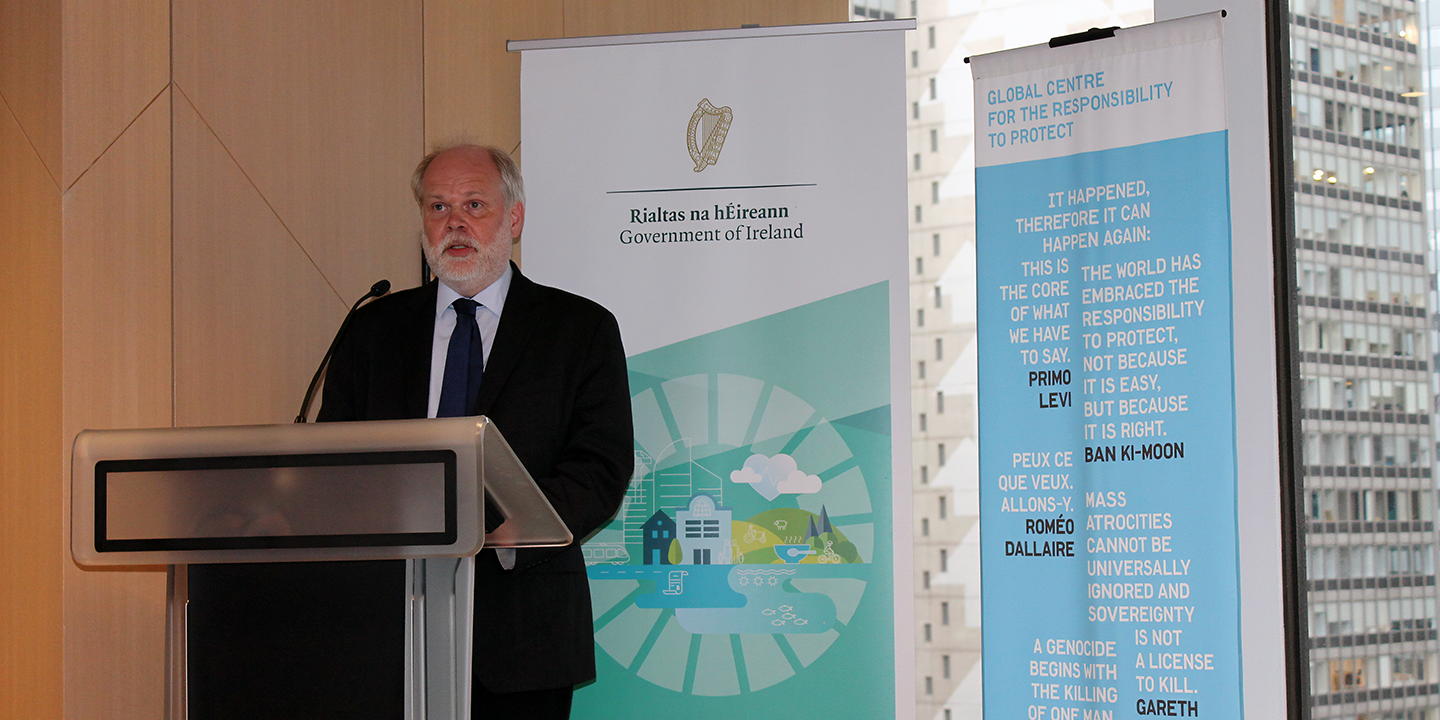
On 9 July Richard Gowan, Program Director, Global Issues and Institutions at the International Crisis Group, delivered the keynote address at the annual Evans-Sahnoun lecture co-organized by the Global Centre for the Responsibility to Protect and the Permanent Mission of Ireland to the UN in New York. The lecture honors Gareth Evans, former President of International Crisis Group, and Mohamed Sahnoun, co-chairs of the International Commission on Intervention and State Sovereignty, which shaped the idea of R2P.
I thank the Permanent Mission of Ireland and the Global Centre for the Responsibility to Protect for the opportunity to give this year’s Evans-Sahnoun lecture.
It is particular pleasure to speak at an event in honor of Gareth Evans, who played a huge role not only in shaping the R2P agenda but also building up the International Crisis Group.
I did not work at Crisis Group when Gareth was president, but I have benefited from his kindness, wisdom and wit many times over the years. Although I did not have the privilege of knowing Mohamed Sahnoun personally, his work has been an enduring point of reference for all of us.
That said, I will not use this lecture to reflect on the foundations of the Responsibility to Protect.
Instead, I will try to focus on the linkages between diplomacy, prevention and the ongoing struggle against mass atrocities in the context of today’s fraught geopolitical moment.
The initial impulse for codifying R2P was a set of crises in the 1990s – the Srebrenica massacre, the Rwanda genocide and the Kosovo war – that revealed the weaknesses and contradictions of the international system in the face of atrocities.
Those events three decades ago still linger in our discussions. So, too, does the Western intervention in Libya in 2011, a “proof of concept” for military action justified in terms of R2P that in many ways backfired, with lasting consequences for debates about the norm.
But, more immediately, we have also witnessed a series of new crises in just the last five years – including the devastating internal wars in Myanmar, Ethiopia and Sudan, Russia’s all-out aggression against Ukraine, Israel’s destruction of Gaza following the Hamas attacks of 7 October 2023 and the U.S.-Israeli war with Iran – that have once again cast a harsh spotlight on the flaws of the UN and the international system.
Two decades after the General Assembly pledged to protect populations “from genocide, war crimes, ethnic cleansing and crimes against humanity”, it appears that we still lack the capacity to fulfil that commitment. Moreover, instead of improving our imperfect collective crisis management tools, we have let them deteriorate.
Over the last five years, those of us who work around the UN have seen the Security Council and the wider UN system respond to fast-breaking crises in a depressingly consistent fashion.
When violence breaks out, the Security Council usually meets quickly. There are statements of concern. But soon enough, cracks emerge among the Council’s members, making a robust response unlikely. Sometimes the General Assembly steps up, but its interventions are generally rhetorical only. A UN envoy will try, but frequently fail, to engage the parties to the conflict. More often than not, the UN’s role will be to funnel emergency relief to civilians caught in violence.
Today, I want to address three questions. Why are we seeing this surge in crises? Why is the UN’s response so dilatory? And can the UN – and in particular the incoming Secretary-General – reestablish a role both as a platform for more effective diplomacy to avert and mitigate crises, and as an institutional actor that can avert, mediate and resolve conflicts?
In addressing these questions, I will focus on diplomacy and prevention in broad terms. I will talk less about R2P as a concept. In my view, the key to the UN regaining a role in protecting civilians from mass atrocities is to restore the institution’s overall credibility as a platform for conflict prevention. There is a lot of talk about the UN going “back to basics” when it comes to promoting peace and security these days. In this lecture, I will try to define some of those basics.
Trends in Conflict
The causes of the current surge in crises and conflicts are sadly easy enough to identify.
As Crisis Group sets out in a briefing that we have published this week, the post-Cold War architecture for conflict prevention and management is breaking down as we enter a new era of international competition involving both the major powers and many middle powers.
We should not of course romanticise the post-Cold War architecture. It failed the people of Bosnia and Herzegovina and Rwanda, among many others. Nonetheless, for all the old order’s faults, we did see states work together to mediate disputes, stand up UN peace operations and authorise international criminal tribunals.
Formally, that architecture remains in place. But as we look around the world, we see many governments and publics asking whether they can still trust it to offer them security. In many cases, their conclusion appears to be negative. Instead, states are investing heavily in military capacities to deter their rivals. Global military expenditures have grown by 40 per cent over a decade.
We also see what we term a “renormalisation of war” as more states conclude that the use of force is the best means of attaining their goals – whether internationally or in dealing with domestic challengers – and that they are unlikely to face serious penalties for opting for violence.
New figures from the Uppsala Conflict Data Project indicate that there were more wars in 2025 – some 65 – than in any year since 1946. Moreover, the number of interstate wars (which have been rare by historical standards in recent decades) jumped from four to eight last year. While some of these are fairly limited border clashes, others – such as the conflict between the U.S. and Israel, on one side, and Iran and its various proxies and allies in the Middle East – are regional escalations that have sown widespread chaos through shocks to global supply chains.
This renormalisation of war is tied to another grim trend: the willingness of armed actors to ignore international humanitarian law and employ atrocities as a deliberate military strategy. From Sudan to Gaza, we have seen warring parties deliberately restricting or blocking food supplies to civilians. From Ukraine to Myanmar, we see militaries using air power against civilians. Armed groups from Hamas to the M23 militia in the Democratic Republic of Congo have used sexual violence as a weapon of war. We risk become inured to horrific levels of violence.
The UN’s Marginal Role
Yet the international response to these incidents and trends often seems fragmented. This is not because nobody is making diplomatic efforts to avert or contain outbreaks of violence. In fact, we see some positive trends in peacemaking. Middle-power mediators such as Qatar and Türkiye – with long traditions of peacemaking – have expanded their ambitions, helping guide peace processes with varying degrees of success from Latin America to Asia.
This year’s crisis in the Middle East has reaffirmed the importance of these middle-power mediators, as Pakistan, Türkiye, Egypt and their partners in the Gulf stepped in help the U.S. and Iran find an erratic pathway to a ceasefire, although as of today that is on shaky ground.
Yet while these mediators have an important role to play in addressing current and future conflicts, their rising prominence raises uncomfortable issues for those institutions – notably but not only the UN – that might previously have been at the center of peace efforts.
Representatives of the UN and other institutions – such as the African Union – regularly appear to be relegated to, at best, supporting roles in efforts to deal with major conflicts. This does not mean that they are totally irrelevant, but their contributions are often more focused on managing the humanitarian fallout of conflicts than on addressing the core political issues driving violence.
It is striking that even the Security Council – supposedly at the apex of the international peace and security system – now often concentrates so much of its attention on humanitarian matters that the ambassador of a recent elected member referred to it as “the Humanitarian Council”.
And it is perhaps symbolic that the most noteworthy mediation success of Secretary-General António Guterres was the Black Sea Grain Initiative – an effort to limit the fallout of Russia’s war in Ukraine rather than resolve the war itself – with then Under-Secretary-General for Humanitarian Affairs Martin Griffiths playing a leading role in negotiating the deal.
It appears, to be brief, that the UN is being edged out of the conflict resolution business while retaining a significant role in the conflict mitigation business. This makes a degree of strategic sense in a geopolitical moment in which the major powers that dominate the Security Council are frequently divided – meaning that the organisation’s envoys and peacekeepers have weak political backing – and ambitious alternative mediators can take the reins of political processes that were once the domain of the UN.
The UN’s biggest remaining assets are all too often its humanitarian agencies, which can deliver assistance to the needy on a scale and level of efficiency that few other actors can match. Yet even officials from the big UN relief agencies question if it is sustainable, especially at a time when aid budgets are shrinking and – as I have laid out – the number of conflicts is going up.
I do not want to suggest that the relief agencies are the only assets at the UN’s disposal. The organisation’s capacities to support mediation efforts and peace operations remain significant and sometimes under-appreciated. And the Security Council’s power to create legal frameworks for peace missions is unique.
In the last year, we have seen Qatar and the U.S. turn to UN blue helmets to prop up their peace efforts in the Democratic Republic of Congo, and the Security Council has mandated the UN to backstop the new Gang Suppression Force in Haiti. Behind the scenes, UN experts are often more deeply involved in political talks led by other actors than is generally acknowledged.
But overall, it is true that the UN is rarely the political lead in such cases, and is instead responsible for providing support functions for other players. Even where the UN has significant political or uniformed field presences, much of their focus is also on mitigating the effects of protracted conflicts by offering protection for civilians and backing aid efforts.
Rebooting the UN’s Diplomatic Role
There is a growing sense around UN headquarters that it is necessary to refocus on the political dimensions of conflict prevention and response, rather than solely the humanitarian aspects.
This trend has been very clear in discussions about the challenges facing the next Secretary-General of the organisation. A few years ago, Crisis Group noted that most discussions of the next Secretary-General’s priorities in New York circles centred on “sustainable development and the financial concerns of poorer states”. These remain hugely important matters.
But we now find that most diplomats agree that – in addition to tough managerial and budget issues – the next UN leader should be more active in using her or his mandate for good offices and mediation, to get a handle on the growth in armed conflict.
Crisis Group agrees with that analysis. But we also recognise that is easier said than done.
How can the incoming Secretary-General, the UN secretariat and member states align to rebuild the UN’s role as a platform for, and institutional actor in, prevention and crisis diplomacy?
To answer this question, we need to start with a dose of realism. Absent major strategic changes, geopolitical frictions will continue to place limits on the UN for the foreseeable future. Appeals to the major powers – or the wider UN membership – to embrace good relations for their own sake will fail.
In this context, we need to frame the UN’s role not simply as a framework for facilitating cooperation, but also as a platform for encouraging deconfliction and mutual accommodation between rivalrous powers.
As I have argued elsewhere, it is natural that the UN Security Council is less united and active than it was in its post-Cold War heyday given the strained nature of major-power relations. What is striking is that the Council – even in the wake of paralysis over Syria, Ukraine, Gaza, Sudan and Iran, among other places – remains a space where the rivalrous major powers can still meet, talk and find common ground on many issues, even if the space is hard. In recent months we have seen, for example, Council members eke out difficult compromises on the renewal the UN missions in Afghanistan and South Sudan. The UN as a whole retains great value as a clearinghouse for states large and small to engage – whether in public or private – to reduce frictions.
What is necessary – but sadly often lacking – is for member states to take advantage of this unique platform, using the UN system as a space to hold exploratory discussions of how to address the tensions that divide them or conflicts of common concern. That does not mean agreeing on everything. But it can mean agreeing to disagree less. Secretary-General Guterres put this quite well in his 2023 New Agenda for Peace, in which he stated that “diplomacy should be a tool not only for reducing the risks of conflict but for managing the heightened fractures that mark the geopolitical order today and carving out spaces for cooperation on shared interests”.
One role of the next Secretary-General may be precisely to cajole and persuade member states – who often operate under a cloud of mutual mistrust – to take such opportunities. As my colleague Daniel Forti argued in a thoughtful recent article on the role of the chief UN official on peace and security, this will involve cementing solid working relations with different international constituencies. They include the five veto powers – and perhaps Washington, Beijing and Moscow above all – but also the middle powers that now lead in so many conflict management efforts.
As Daniel says, “the next Secretary-General should encourage cross-regional coalitions that can buttress UN peacemaking efforts, particularly when a veto power is either directly involved in the conflict or blocking action by the Security Council”. In some cases, as our friends at the UN University Center of Policy Research noted in their excellent 2024 report “Assembly for Peace”, these coalitions may be able to trigger diplomatic action through the General Assembly. In others, it may be preferable to work outside formal structures and prioritise ad hoc contact groups.
I am sometimes asked what I would like to see the next Secretary-General prioritise early in her or his term (the famous if arbitrary initial “one hundred days” in which she or he will have fresh political capital). One simple answer would be to move quickly to seed diplomatic alliances with like-minded states to address current conflicts, not on the assumption that they can easily be solved, but to revitalise the UN’s reputation as a proactive force in political crisis resolution.
What the UN Has to Offer
But this raises a further tricky question: what can the UN Secretary-General, and the UN system as a whole, bring to the table that will make ambitious middle powers and conflict parties listen? It would be nice to say that the UN’s values and principles will suffice. They won’t. In the wake of the fall of President Bashar al-Assad in Syria, we heard from Syrian interlocutors that the new authorities were unhappy with UN officials urging them to prioritise “inclusion” in the ensuing transition, especially given the organisation’s own painful history of involvement in the country’s civil war. They, like all political actors, wanted concrete incentives to cooperate with the UN.
The UN has the expertise and resources to offer many different types of concrete assistance, whether through technical advice, peacebuilding support or, yes, humanitarian aid. The question is how to put them on the table in a timely and effective fashion, and persuade the parties to use them. As Daniel argues in his recent piece, “diplomats and UN officials alike acknowledge that the quality of ideas emerging from the UN system [in response to requests for advice on conflicts] often falls short of their expectations”. On a number of recent occasions when the Security Council has asked the Secretary-General for options on crises on its agenda – including Sudan and Haiti – the resulting options papers have been slow to emerge and short on ambitious ideas when they do come out.
Why is this the case? It is partly a matter of culture. Senior UN officials have become highly risk-averse in the face of recent political headwinds. But there is also a systemic factor in place. Although the UN high command does have various mechanisms and committees for assessing crises and conflict risks, there is no central cell playing what U.S. sports fans would call a “quarterbacking” role, pushing the system for fresh ideas and coordinating their development.
To quote my colleague Daniel a final time, Crisis Group’s research on this issue turned up differing solutions to the problem. As he notes:
Some UN officials suggest that the Secretary-General and senior management need to set clearer expectations for different parts of the organization to align their efforts. Others argue that the Secretariat should invest in a dedicated planning cell that supports the peace and security pillar, which could both improve both the quality of proposals emerging from the Secretariat and reduce the likelihood that policy options put on the table are coloured by turf battles.
I am personally agnostic about which exact formula is best (and I have been around the UN long enough to doubt that there will ever be a way to end turf battles inside the organisation). But to return to the question of what the next Secretary-General should do in the first hundred days, on top of the diplomatic outreach I described, there is a strong case for prioritising the creation of a more credible options generation process or mechanism. I would certainly emphasise this strategic shift over attempting broader – and inherently more drawn-out and institutionally unpleasant – efforts to rewire the organogram of the peace and security pillar of the UN in its entirety.
These diplomatic and institutional ideas are, of course, only a precursor to more substantive discussions of how the UN can prevent, resolve and reduce the risk of mass violence in specific conflicts. We could also have a separate – and significant – debate about how the Secretary-General and member states can address challenges to R2P as a norm, in addition to more practical measures.
I have however chosen to concentrate on these diplomatic and institutional questions because I believe that the next Secretary-General will need to find her or his diplomatic footing early, and one way they can do that is by pushing the UN to bring more and better ideas for dealing with conflict to the table early.
The UN’s place in international conflict prevention and the prevention of mass atrocities is fragile. But with determined diplomacy, it can be preserved and adapted to meet a new era of conflicts and threats to civilians.
Ralph Bunche Institute for International Studies
The Graduate Center, CUNY
365 Fifth Avenue, Suite 5203
New York, NY 10016-4309, USA