26 March 2026
Commentary
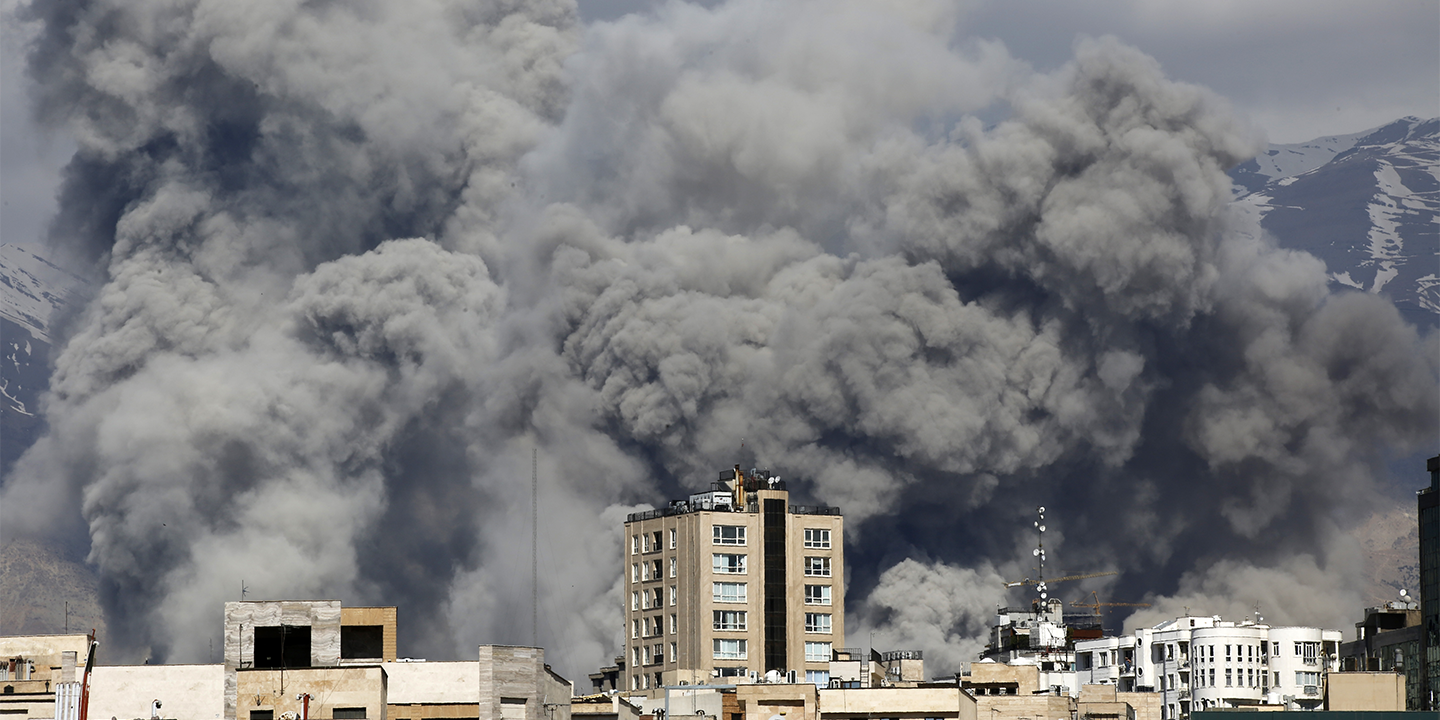
The United States (US) and Israel launched a joint offensive against Iran on Saturday, 28 February, striking command and control structures, nuclear facilities and military sites. The aerial attacks triggered Iran to launch widespread counter-attacks across the region, targeting US military bases in Bahrain, Kuwait, Qatar and the United Arab Emirates, followed by additional strikes that targeted civilians and civilian infrastructure, including Dubai’s International Airport, residential buildings in Bahrain and a town in central Israel. Over a dozen people have been killed and many more injured. Jordan and Saudi Arabia have also intercepted Iranian attacks. These escalating developments are endangering the lives of millions of people across the Middle East. The delivery of humanitarian aid throughout the region has been undermined by airspace and logistical restrictions.
Over 20 of Iran’s 31 provinces have been affected by the US-Israeli military offensive, with Tehran facing intensifying strikes. As of 2 March, US-Israeli strikes have killed at least 555 people in Iran and wounded hundreds more, according to the Iranian Red Crescent Society. This includes over 165 people killed when an elementary girls’ school in southern Iran was struck just hours after parents had dropped off their children.
Iran’s supreme leader, Ayatollah Ali Khamenei, and many senior Iranian officials, including the defense minister and the commander of the Islamic Revolutionary Guard Corps, were killed in the US-Israeli strikes, leading to significant uncertainty. Reports indicate that some officials are preparing to enact contingency plans to restructure the leadership, while Iranians say they have received text messages from state numbers warning them against protesting.
Amid the destabilization and destruction, many Iranians experienced a significant sense of relief following the news of the Ayatollah’s death. Under his leadership, populations endured severe, systemic government repression for nearly four decades. As recently as January, Iranians faced a widespread, deadly crackdown on anti-government protests, during which Iranian authorities committed likely atrocities. The UN Independent International Fact-Finding Mission on the Islamic Republic of Iran received credible reports that thousands of people were killed and over 24,000 were arrested. Nevertheless, while Khamenei’s death marks the end of his rule, Iran’s system of power, along with its repressive structures, extends far beyond a single individual.
The US-Israeli act of aggression against Iran was undertaken in violation of international law and the UN Charter, as they exercised use of force without authorization from the UN Security Council (UNSC) or without a demonstrated threat to their security that would trigger the right to self-defense under Article 51 of the UN Charter. The attack came amid ongoing nuclear talks between the US and Iran and just hours after Oman’s Foreign Minister – a key mediator in the negotiations – shared details on progress achieved and announced that a breakthrough was near. The attack also mirrors the recent unlawful actions undertaken by the US in Venezuela on 3 January, culminating in the kidnapping of the head of state and setting in motion profound uncertainty for the region and the global order.
Despite the illegality of the US-Israeli strikes and the dangerous threat they pose to the maintenance of international peace and security, as well as to the preservation of the integrity of the rules-based legal order, during an emergency session of the UNSC on Saturday few members condemned the use of force by Israel and the US in a manner consistent with their condemnations of Iran’s subsequent retaliation. Instead, states reinforced a pattern of double standards. While Iran’s regional attacks, violations of international law and repression of its own population were rightly condemned, US-Israeli actions were framed as justified exceptions rather than blatant violations of the UN Charter framework that binds all states. It is deeply alarming that several other states have expressed that further scrutiny of US-Israeli actions is not conducive at the moment, with Germany signaling that it is not the time “to lecture our partners and allies.” In contrast, Finland, Norway and Spain have stood out as among the select few European states calling for respect for international law by all parties and condemning breaches committed by Iran, Israel and the US.
This reflects a broader pattern among member states of framing violations in ways that implicitly and explicitly confer de facto permissiveness for unlawful, unilateral actions by states viewed as partners, while condemning similar conduct by others. The US continues to face limited consequences for its invasion of Venezuela and Iran, whereas the international condemnation of Russia’s invasion of Ukraine in 2022 was swift and unified. In the immediate aftermath of the 7 October 2023 attacks, Israel was similarly granted carte blanche to brazenly ignore its obligations under International Humanitarian Law and perpetrate wanton destruction against an already besieged population in Gaza, and the international community issued only shallow warnings as Israel perpetrated strikes on Lebanon and Syria over the past two years.
Realpolitik has devastated the protections enshrined in international law. The use of brute force and the timidity of inaction are not isolated failures; they reinforce a dangerous structure that privileges power over law and sends a clear message of impunity to those who seek to exploit it. Regardless of the oppressiveness of the authorities, regime change through force and in violation of the UN Charter is illegal under international law. In the face of a now uncertain and destabilized future, Iranians must be enabled to provide a vision for that future, rather than having the will of powerful states imposed upon them.
States must unequivocally condemn all violations of international law and the UN Charter, including those by the US and Israel, and demonstrate a principled defense of international law, even when it is not convenient. All states should refrain from participating in unlawful military actions in the region, press for de-escalation and the resumption of negotiations, ensure accountability for abuses and atrocities committed by Iranian authorities and ensure that policy positions are guided by the aspirations of the Iranian people. It is incumbent upon the international community, in its entirety, to uphold international law – without fear or favor – in recognition that the decisions made today will shape the course of the future.
Ralph Bunche Institute for International Studies
The Graduate Center, CUNY
365 Fifth Avenue, Suite 5203
New York, NY 10016-4309, USA