Remarks Delivered at the UN General Assembly High-Level Week Side Event, Enhancing the Capacity to Prevent Atrocities: Human Rights-Based Approaches to Artificial Intelligence
24 September 2026
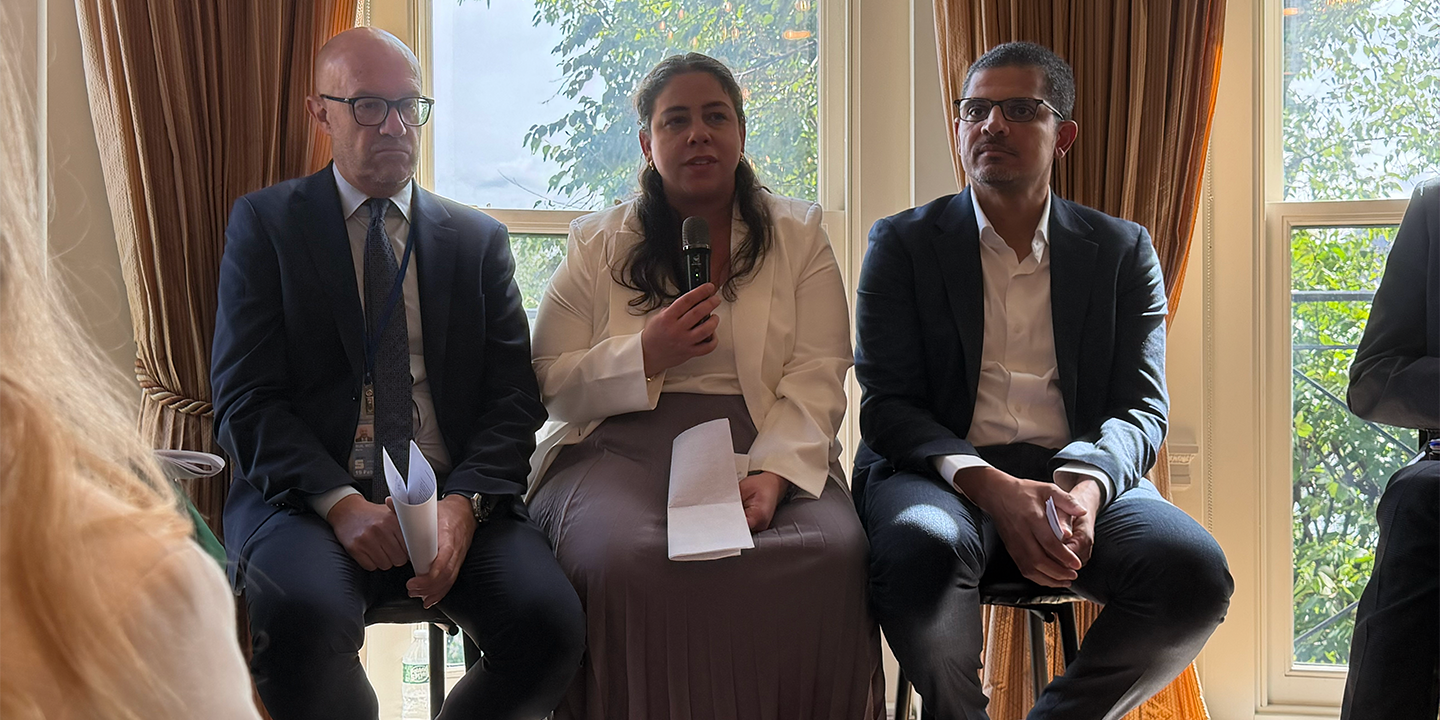
These remarks were delivered on 24 September 2026 by Global Centre for the Responsibility to Protect Deputy Executive Director, Jaclyn Streitfeld-Hall, during the UNGA81 High-Level Week side event entitled, “Enhancing the Capacity to Prevent Atrocities: Human Rights-Based Approaches to Artificial Intelligence.”
I want to emphasize a few key points on the changing nature of atrocity risks in the age of AI.
First, while international cooperation on the risks posed by frontier AI is important, we cannot allow those fears to distract from the abuses already taking place. AI-enabled drones and decision-support systems are already being used in the conflicts in Ukraine, Gaza, Iran and elsewhere, while AI-enhanced surveillance in China has been used to discriminate against and repress Uyghur communities in ways that contribute to atrocity risk. These harms are not hypothetical, and AI itself is not the perpetrator: the critical questions are who is deploying these tools, against whom and for what purpose. Our analysis therefore needs to center the agency of perpetrators rather than treating the technology itself as an autonomous source of risk.
Second, it’s important to recognize that while AI is changing the nature of atrocity risk, it has not changed who is most likely to be targeted – but has rather just enhanced abuses against them. An atrocity prevention lens requires us to recognize how particular populations face heightened risks because of their identity, perceived identity or role in society, including ethnic and religious minorities, women and girls, Indigenous Peoples, LGBTQIA+ people, human rights defenders and journalists. AI can reinforce these existing patterns of discrimination by making it easier to identify, monitor and target those already at heightened risk, particularly amid shrinking civic space and increasing attacks on those who scrutinize government action.
Reporting from civilians, human rights defenders and UN bodies has shown that many of the populations and communities already at heightened risk of atrocities are also being further marginalized and targeted through AI-enabled tools. Reporting from the UN Working Group on the use of mercenaries last week emphasized how technology is being used to specifically target women, Indigenous populations and other marginalized groups, as well as human rights defenders and journalists.
Most significantly AI is changing the scale and speed of abuse by making it easier for state and non-state actors to carry out coordinated campaigns of targeting, repression and information manipulation against particular communities.
In atrocity situations, AI is increasingly acting as a force multiplier, expanding the speed, scale and destructive capacity with which perpetrators can surveil, identify and target populations. AI-powered surveillance systems, autonomous weapons and drones can magnify the ability of actors to commit serious violations of human rights and International Humanitarian Law (IHL), including acts that may constitute atrocity crimes. Even where there is no explicit intent to target a particular group, the use of AI in military decision-making can heighten risks to civilians and undermine human rights and IHL. We have already seen the consequences of this in Iran earlier this year when more than 150 people, mostly children, were killed in a strike by the United States on a school that was based on outdated information.
AI-enhanced surveillance technology also amplifies existing patterns of repression. In Afghanistan, tens of thousands of AI-enabled cameras have been installed throughout the country under the guise of increasing security and fighting criminality – but civilians have indicated that they have also been utilized to enforce the country’s strict morality codes that regulate the behavior of women. This increases the capacity of the Taliban to implement a campaign of repression against women and girls that the UN has indicated amounts to gender apartheid.
AI has also amplified misinformation and disinformation that deepen divisions within communities. Deepfakes and coordinated rumor campaigns in places like Sudan and Syria have fueled fear and incitement, at times contributing to displacement and localized violence. In Sudan, deepfakes of leaders were utilized to encourage displaced populations to return home while conflict remained ongoing, while in Syria, AI-generated voicemails spread fears of sectarian violence ahead of the Sweida attacks in 2025. AI-manipulated content glorifying violence or spreading xenophobic messaging can also create enabling environments for abuse and has been used in the recruitment of children into armed groups.
These examples also illustrate a fundamental governance challenge. Many of the same technologies that can strengthen civilian protection can also expand perpetrator capacity. AI-assisted satellite imagery can document attacks and destruction where independent access is limited, as in Sudan, Gaza and Ethiopia, while similar technologies can accelerate target identification. The same facial recognition and surveillance tools that have enabled identification and arrest of perpetrators of sexual violence are also being utilized under the guise of security to engage in digital authoritarianism, discriminatory profiling, the mobilization of force against marginalized communities and transnational digital repression.
So, what can we do to protect populations?
First, for all of us, human rights and confronting atrocity risks need to be central themes in all discussions on AI governance. In the Global Dialogue on AI governance, human rights were confined to a thematic discussion, and that discussion focused largely on a narrow set of rights violations. This needs be greatly improved in the next dialogue in May, as well as in all discussions on AI governance and industry regulation. Moreover, governance models need to confront the broader context of potential International Human Rights Law and IHL violations harnessed by perpetrators and enabled by technology – they cannot be agnostic on intent.
Second, for AI developers and those supporting technology companies, respect for human rights and IHL, as well as human rights due diligence, cannot simply be treated as compliance issues. They need to be purposefully built into the training of AI models. Human rights protections and measures to avoid reinforcing bias need to be embedded in industry standards. Stronger safeguards need to be built into existing systems to prevent perpetrators from exploiting data, using chatbots and other social media tools to manipulate information environments or conducting discriminatory surveillance. The EU AI Act and its list of “prohibited uses” and “high-risk uses” of AI provide an important launch point for further discussion among states.
Third, since states and nonstate actors are already using AI to determine targets, states need to go beyond reinforcing the need for greater human oversight in decision-making and ensure those humans are themselves sensitized to human rights and IHL compliance and to atrocity risk. Governments need to ensure that their militaries put safeguards in place to guarantee that the information and data utilized in targeting is up to date and accurate – or abstain from using imprecise AI-generated data for targeting altogether.
Fourth, states need to ensure accountability and responsible use of AI across its full lifecycle – from development and procurement to deployment and transfer. This includes ensuring traceability in their own use of AI by tracking how models are developed and deployed, how civilian data is acquired, used and stored and how consequential decisions can be traced back to responsible actors. States should also refrain from purchasing or using AI systems developed through abuses against affected populations or transferring AI tools and capabilities to governments implicated in technology-enabled atrocities.
And finally, I close with a challenge for the room. Today, this panel is addressing both the risks to civilians and the positive applications of AI. But mitigating the harms of AI and getting the most out of these tools for good – especially those used for early warning and documentation – relies on political will and political courage. Political courage to take seriously the need to impose regulations that curb perpetrators’ capacity, even when it is inconvenient to regulate an industry driving innovation. And political will to act to protect populations when AI-enhanced systems provide irrefutable evidence of atrocity risk.
Source
Jaclyn Streitfeld-Hall, Deputy Executive Director
Global Centre for the Responsibility to Protect
Related Content
23 September 2026
Atrocity Alert
Atrocity Alert No. 495: Artificial Intelligence and Climate Change

19 December 2025
Podcast