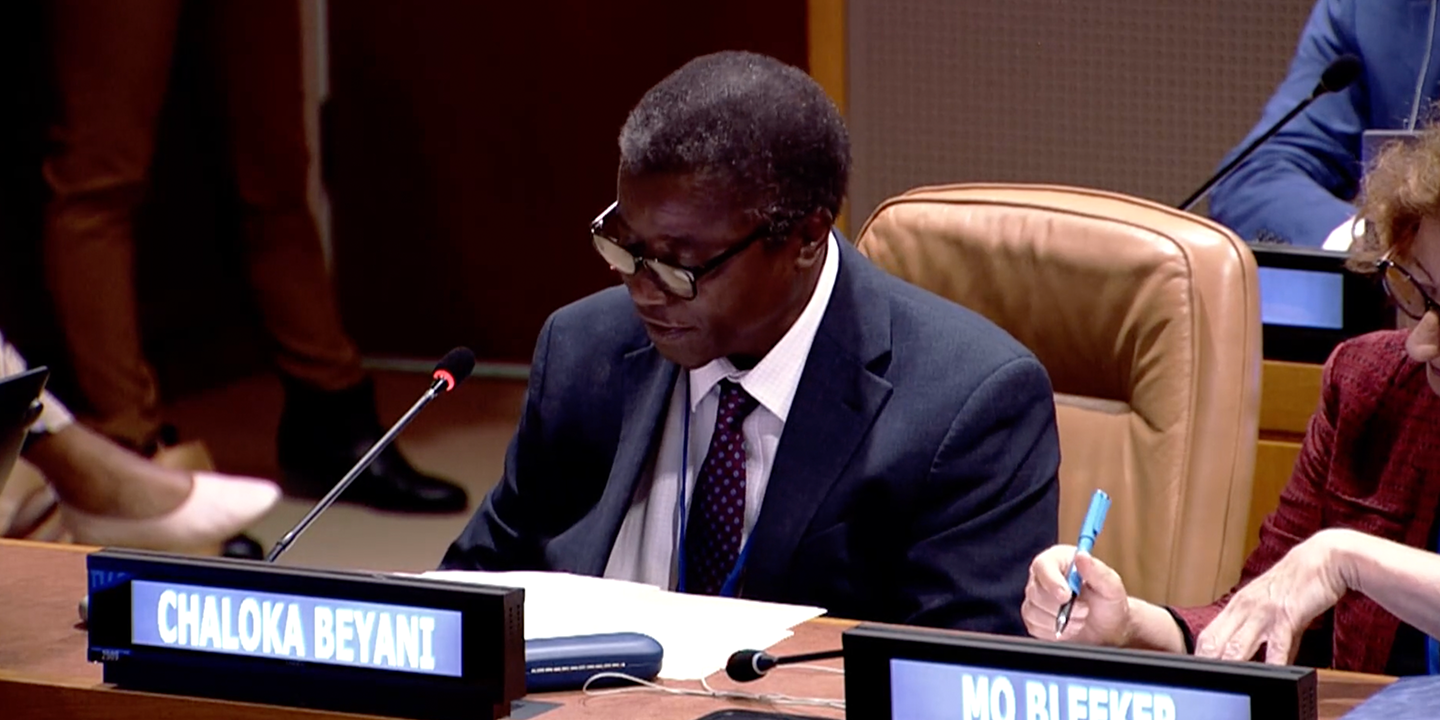
Statement by the Under Secretary-General and Special Adviser to the Secretary-General on the Prevention of Genocide, Mr. Chaloka Beyani at the Ministerial Meeting Commemorating the 20th Anniversary of the Responsibility to Protect
23 September 2025
Excellencies, Distinguished Delegates, Colleagues and Friends,
It is an honor to address you this afternoon as we commemorate the 20th anniversary of the Responsibility to Protect -an enduring principle born from shared conviction at the 2005 World Summit, to prevent and protect populations from genocide, war crimes, ethnic cleansing, and crimes against humanity.
Let me begin by thanking the Global Center and the co-sponsors, the Kingdom of Morocco, Grand Duchy of Luxembourg, Guatemala, Australia and Sierra Leone, for convening this important event.
This anniversary is more than a commemoration – it must be a moment of renewal. A reminder that the commitments we made must translate into action.
In the past twenty years, meaningful progress has been made. The normative framework has grown stronger. Prevention is now embedded in key parts of the UN system, including the inclusion of RtoP as a standing annual item on the agenda of the General Assembly following the adoption of resolution 75/277. National mechanisms have acted early and saved lives. Regional cooperation has expanded, early warning tools have improved, and the role of civil society is increasingly recognized.
Yet, twenty years on, we are confronted with a global landscape marked by protracted crises, mass displacement and atrocities committed with impunity. We stand at a turning point, and we must be honest about what we have learned.
-
-
- No society is is immune. Prevention and protection must begin at home, with inclusive governance and strong national institutions.
- Impunity fuels recurrence. A failure to address past crimes is a powerful indicator of future violence.
- Early warning must lead to early action. Timely and decisive responses are essential to prevent escalation.
- Prevention must be sustained. It must be proactive, not reactive, and rooted in long-term commitment.
- Civic space must be protected. Human rights defenders and local actors are often the first to raise the alarm. Their protection is our responsibility.
-
Excellencies,
As the recently appointed Special Adviser on the Prevention of Genocide, I bring to this role deep personal commitment and institutional memory, having advised the International Commission on Intervention and State Sovereignty before 2005.
Today, I reaffirm the commitment of the Joint Office on Genocide Prevention and the Responsibility to Protect to work as one – reflecting two mutually reinforcing mandates. Both the mandate of the Special Adviser on the Prevention of Genocide and the Special Adviser on the Responsibility to Protect play a critical role. Our shared goal is clear: to provide effective, timely, practical and consistent support to the UN system and its Member States, in collaboration with civil society and regional partners.
Aligned with the Secretary-General’s 2025 report on the responsibility to protect, our current priorities are focused across five key areas:
- Strengthening National Prevention Mechanisms
Prevention starts at the national level -with the rule of law, accountable institutions, and political will. The Joint Office stands ready to support governments in developing national action plans, strengthening early warning systems, and enhancing resilience against hate speech and identity- based violence. When atrocity crimes do occur, we work to ensure prevention and protection are embedded in peacebuilding, accountability and reconstruction processes.
- Strengthening Regional Partnerships
Effective prevention must be nationally grounded and regionally driven. The Joint Office is prepared to collaborate with regional and sub-regional organizations, including the OSCE and ICGLR, as well as with Member States, to facilitate tailored dialogues across Africa, Europe,
Latin America, and Asia. These discussions will help identify strengths, share good practices and build regional mechanisms dedicated to atrocity prevention.
When national level and regional actors cooperate, and are experienced as such, the entire international system is stronger.
- Developing Practical Tools and Guidance
The Joint Office has developed a range of practical tools, including the Framework of Analysis for Atrocity Crimes and the Plan of Action for Religious Leaders and Actors to Prevent Incitement to Violence that Could Lead to Atrocity Crimes. Building on these, and as referenced in the Secretary-General’s 2025 report, a guidance note on operationalizing the Responsibility to Protect is being prepared. This process will involve broad consultations with Member States, civil society and academia to ensure joint ownership and regional relevance, making the guidance relevant and implementable.
- Strengthening Early Warning and Risk Assessment
A core function of the Joint Office is to advise the Secretary-General with timely early warnings and recommendations. This requires close coordination with UN Country Teams, peace missions and the relevant headquarters departments. We are continuously improving our system-wide risk analysis platform to identify emerging threats early and translate warnings into coordinated, meaningful action. Vulnerable communities deserve no less.
-
- Supporting the Secretary-General’s Prevention Agenda and the Future UN 80 Architecture
Looking ahead -regardless of the form that UN80 ultimately takes- prevention and protection must sit at its core. The Joint Office stands ready to help shape a coherent, whole-of-system early warning, and prevention architecture that is fast, data-informed and rooted in shared responsibility, supporting not only the Secretary-General and the Security Council, but thebroader UN and its Member States. For this, a dedicated focus on the specific risk factors and indicators of genocide, war crimes, ethnic cleansing and crimes against humanity will remain essential.
Excellencies,
Prevention and protection must happen where it matters most -on the ground. The Joint Office is committed to supporting Member States and working closely with regional and sub-regional organizations to build capacity, deepen engagement with UN mechanisms, and foster a global architecture of prevention where protection and prevention is seen as a continuum and integrated in governance structures.
If I may be clear: this architecture will only succeed if it is inclusive. Civil society, human rights defenders, affected communities and minorities, local actors and leaders must be part of early warning, prevention, and response efforts at every stage. The 118 national human rights institutions already active and the Peacebuilding Commission within the UN are powerful partners in this work.
Distinguished Delegates,
This anniversary cannot be symbolic.
The Responsibility to Protect was never meant to be remembered -it was meant to be realized.
The challenges we face today -protracted wars, hate speech and digital incitement to violence, shrinking civic space- demand that we be bold, consistent, and united.
Atrocity prevention is not a moral obligation. It is a strategic imperative for peace and stability.
So today, I call on all of us -to move from commitment to action. From words, to will and to results.
Let us make this 20th anniversary a turning point.
Let us honor the promise of 2005 -not only with our voices, but with our choices.
The world is watching. Affected communities are counting on us. The stakes have never been higher, and the path forward is clear.
Thank you.
Source
UN Special Adviser on the Prevention of Genocide
Related Content
8 October 2025
Resolution
Resolution 60/34 (Central African Republic) A/HRC/RES/60/34
6 October 2025
Resolution