10 December 2025
Atrocity Alert
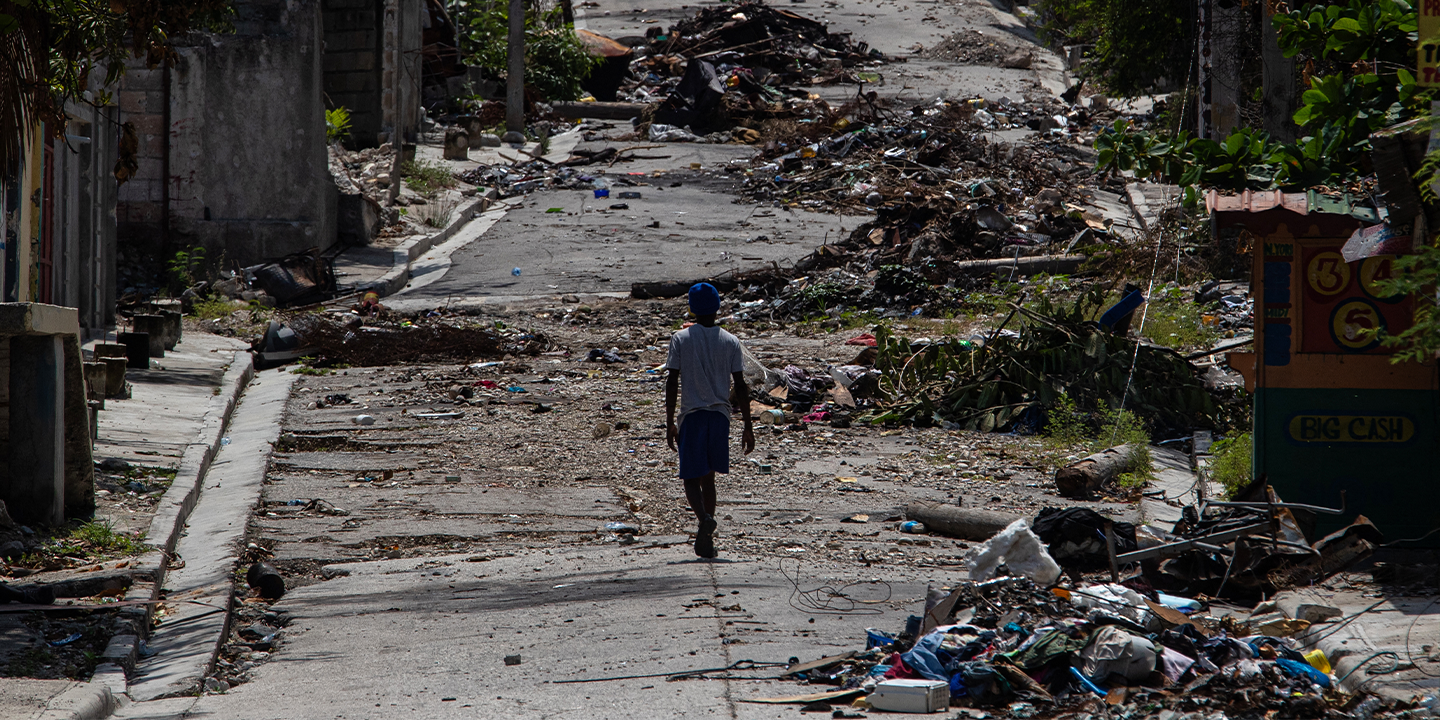
Populations in Haiti are enduring relentless trauma and devastation amid widespread and unimaginable violence perpetrated by armed gangs. Millions live in fear, grieving lost loved ones and lacking a safe place to call home. Daily life has become perilous: going to work, school or the hospital means risking death.
What began as fragmented gang violence has become a coordinated assault on Haitian society, with gangs now serving as de facto authorities over large swathes of territory and increasingly operating as criminal armed militias. They exercise control over neighborhoods, roads, ports and even access to food, water and fuel. The violence is not random criminality but deliberate, organized and systematic. Gangs target entire neighborhoods, destroy and loot public infrastructure, homes and markets and manipulate aid distribution to depopulate territory, terrorize civilians and assert control.
Two years ago, the UN Office for the Coordination of Humanitarian Affairs issued a rare plea for Haiti, “The world must act now to prevent further atrocities,” publicly recognizing the abuses perpetrated by armed gangs as atrocities and acknowledging the risk their actions posed for further crimes. Haitian civil society, human rights defenders and international experts echoed these calls, while the former Special Adviser on the Responsibility to Protect (R2P) of the Organization of American States (OAS) concluded in May 2025 that mass killings, rape, torture and sexual enslavement in Haiti constitute crimes against humanity.
Yet, while the scale and systematic nature of the gangs’ predatory tactics pose clear atrocity risks, the frameworks designed to prevent such crimes have largely overlooked them. The crisis in Haiti therefore reveals an urgent need to adapt atrocity prevention frameworks to contemporary forms of organized violence, including the actions of gangs. Gang violence is not merely a security or law enforcement issue; it can create conditions for atrocity crimes and may itself constitute crimes against humanity.
Haiti’s experience is not an anomaly – it reveals a growing global pattern of organized violence that falls between the cracks of existing protection frameworks. Around the world, non-state actors, criminal networks and hybrid armed groups pose profound protection risks. The failure to recognize these threats for what they are – systematic attacks on civilians – has left entire populations unprotected. As Haiti shows, this results in a dangerous mismatch between the scale of the threat and the scope of the response, and a steady erosion of the international community’s credibility in upholding its most fundamental promise: to prevent atrocity crimes before they unfold.
Haiti as a Case Study: Gang Violence Reaching the Atrocity Threshold
Following the assassination of President Jovenel Moïse in July 2021, Haiti has spiraled into a state of near collapse, marked by the dramatic rise of armed gangs and unprecedented brutality. The crisis reached a turning point in February 2024, when two powerful rival gangs united under the Viv Ansanm coalition and launched a coordinated campaign to seize control of Port-au-Prince. What began as fragmented turf wars transformed into a systematic effort to dismantle state institutions, terrorize civilians and assert territorial dominance. Civilians are no longer incidental victims; they are the deliberate targets.
The violence is unfolding amid state failure. The Haitian National Police are overwhelmed and outgunned, while gangs wield substantial firepower and territorial control. In this vacuum, so-called self-defense groups have emerged, blurring lines of accountability and fueling deadly cycles of retaliation. Gangs have responded by attacking communities perceived to support these groups, leaving residents caught between predators on all sides.
The presence of gangs alone does not inevitably lead to atrocities. What distinguishes Haiti is the convergence of organized criminal power with structural risk factors: paralyzed political institutions, non-functional and politicized courts and entrenched impunity. Multiple members of the Transitional Presidential Council (TPC) are credibly accused of corruption and collusion with gangs. This dynamic is not new; successive political elites have long used armed groups as instruments of power, embedding criminal networks within political and security institutions and providing weapons and financing to these groups.
Today, Viv Ansanm controls an estimated 90 percent of Port-au-Prince, leaving residents trapped in an “open-air prison.” Their influence is expanding throughout the Artibonite region and Centre department, spreading palpable fear among communities. Thousands have fled their homes with nothing but the clothes on their backs, as forced displacement is no longer a byproduct of violence but a strategic tool used to maintain territorial and social dominance.
Women and girls bear a disproportionate brunt of this violence. Gangs are perpetrating widespread and systematic sexual violence – labeled by some UN officials as a “weapon of war” – to instill fear, expand or retain areas of influence, punish communities and extort money. The UN’s 2024 annual report on Conflict-Related Sexual Violence (CRSV) cited Haiti as a situation where such abuses mirror those seen in armed conflicts. It noted that non-state armed groups, including organized criminal groups, in Haiti, alongside those in the Central African Republic and Democratic Republic of the Congo, are using sexual violence to assert power and profit. In June 2025, the UN Special Representative on Sexual Violence in Conflict condemned the “widespread atrocities perpetrated by armed gangs, including conflict-related sexual violence.”
This pattern extends to children and is equally staggering. In late 2024, Virginia Gamba, then UN Special Representative for Children and Armed Conflict (CAAC), warned that “children are being used by armed gangs,” noting grim evidence of “sexual violence, including rape and collective rape, being used as a weapon of war by gangs.” Thousands cannot attend school, many have witnessed the most horrific acts of violence and are trafficked, forcibly recruited or exploited by gangs, putting them at risk of becoming both victims and perpetrators of violence.
How Misclassification and Conceptual Gaps Hinder Protection
Despite growing evidence of atrocities in Haiti, the international community has largely responded with little more than platitudes – exactly the sort of complacency R2P was meant to confront when it was adopted 20 years ago. The lack of adequate action is not only political but conceptual. It reflects a deeper gap in how atrocity crimes are understood and classified, particularly when these crimes are perpetrated by gangs. To honor the promise of R2P, atrocity risk analysis and prevention frameworks must evolve to ensure that no populations at risk remain neglected or excluded from the protection they deserve.
Organized crime and gang violence remain overlooked as risk factors for atrocities. Haiti, though not an isolated case, demonstrates the consequences of this oversight. When atrocity situations are mischaracterized as “gang violence,” as in Haiti, or “banditry” as in Nigeria, they are treated narrowly as a law-and-order issues rather than atrocity risks. This misclassification sidelines protection frameworks, leads to inadequate responses and risks normalizing mass suffering as “mere criminality.”
Yet when populations are being systematically killed, displaced and terrorized, and when these groups challenge or replace state authority, the debate over whether a situation qualifies as “criminality” or “armed conflict” should not determine whether protective action is taken. The scale, pattern and impact of violence against populations should guide the response. Confronting this gap requires a fundamental shift in how we conceptualize gang violence and organized crime.
The prevailing narrative on Haiti focuses on state collapse, the proliferation of organized crime and the need for policing or stabilization measures. While partly accurate, this framing misses the more troubling reality: these groups are deliberately targeting civilians in a calculated and widespread manner – hallmarks of crimes against humanity. The determination of crimes against humanity by the OAS’s former Special Adviser on R2P, for example, was based on evidence of the coordinated and widespread nature of the patterns of violence; the gang’s organizational policy to generate fear, control populations and eliminate dissent; and the existence of hierarchical command structures supported by transnational arms flows and criminal networks.
Debates over whether organized criminal groups fall under International Humanitarian Law (IHL) have obscured the fact that civilians in places like Haiti face war-level violence. The inconsistency surrounding Haiti’s classification is particularly stark. UN reports on CRSV and CAAC include Haiti and senior officials have described the use of sexual violence there as a “weapon of war.” In crises with comparable patterns of systematic sexual violence and grave violations against children, such acts are recognized as war crimes. Despite Haiti’s inclusion in these global protection agendas, the crisis has not been formally recognized as an armed conflict under IHL.
In Port-au-Prince today, families flee crossfire as entire neighborhoods are destroyed, yet the international community still frames it merely as gang violence. On the ground, the distinction between criminal groups and conventional non-state armed groups is often negligible. Whether driven by ideology or profit, these actors often wield similar levels of firepower, control and brutality. Just as non-state armed groups in Myanmar or South Sudan, for example, have been recognized as perpetrators of atrocities, so too should gangs, armed bandits and criminal networks be viewed through that same lens when they systematically target civilians.
To determine when a situation qualifies as an armed conflict, IHL considers both the intensity and duration of violence and the degree of organization among perpetrators, criteria that Haiti’s situation increasingly meets. The UN Panel of Experts on Haiti noted that the creation of Viv Ansanm “demonstrates an evolution in gangs’ abilities to define, coordinate and operationalize strategies.” As early as May 2023, the UN Secretary-General warned that insecurity in Port-au-Prince had “reached levels comparable to countries in armed conflict.” UNICEF has described playgrounds and schools as “war zones.” In September 2025, Laurent Saint Cyr, President of the TPC, stressed, “This is the face of Haiti today: a country at war, a modern-day Guernica.”
This mismatch between recognition and classification reveals a deeper conceptual confusion. If UN bodies acknowledge that the acts in Haiti are conflict-related yet continue to frame the overall crisis as “gang violence,” then the very tools and legal frameworks designed for prevention, protection and accountability are misaligned with reality. Haiti is relegated to a different policy silo, resulting in a dangerous gap – one where atrocity crimes unfold without meaningful protection or avenues for justice.
These semantic debates matter. They determine what law applies and what kind of international response is mobilized. But when the focus on classification overshadows the reality of mass suffering, the conversation becomes an abstraction. Haiti’s tragedy exposes the cost of such paralysis. While the international community debates labels and acts in silos, populations at risk are left to their fate. When the scale and systematic nature of violence reach the threshold of atrocity crimes, responses must be guided first and foremost by the legal and moral obligation to protect.
The Consequences
Two decades since R2P’s adoption, the landscape of atrocity situations – both within and outside conflict settings – looks markedly different. Conflicts today are increasingly urbanized, asymmetric and dominated by non-state actors who hold real territorial and political power. Expanding the atrocity prevention lens to recognize crimes committed by non-state armed groups outside conventional conflict settings is urgent. Haiti makes that abundantly clear.
This conceptual gap carries steep human costs. It delays or prevents the mobilization of meaningful international attention and action. Early warning signs and the structural causes are too often dismissed as symptoms of law-and-order breakdowns rather than indicators of mass atrocity risk. It also narrows the policy response: security and policing take precedence over prevention, human rights or civilian protection strategies. The result is a stark mismatch between the scale of the threat and the response. For those living through such crises, this misdiagnosis has meant years of unrelenting violence and abandonment. In policy terms, it turns atrocities into crime statistics – and warnings into afterthoughts.
Despite the severity of Haiti’s crisis, international engagement has been cautious and fragmented. This hesitance is partly shaped by the UN’s troubled legacy in Haiti, which has constrained political will and undermines trust today. Measures taken so far, including the OAS Roadmap for Stability and Peace and the UN Security Council-authorized Gang Suppression Force – represent a notable shift, but they require long-term, coordinated and well-financed engagement, as well as human rights protections and accountability mechanisms. Yet the persistent failure to halt the steady flow of arms and ammunition, mostly from the United States, continues to undercut every effort.
This slow, hesitant response, despite clear evidence of atrocities, is not only a political failure but a moral one under R2P.
Adding a Layer of Understanding to Atrocity Prevention Frameworks
Closing this protection gap requires expanding how atrocity prevention frameworks are applied to hybrid, complex contexts. This means broadening risk assessments and aligning short and long-term responses with the protection needs of populations living under violent criminal governance.
Early Warning and Risk Assessments
Early warning frameworks must be adapted to capture the dynamics of organized violence and criminalized political economies. That means recognizing gangs and other armed groups as potential atrocity perpetrators in analysis frameworks, including the UN’s Framework of Analysis for Atrocity Crimes, and conducting situation-specific analysis of tactics, relationships, financial flows and strategies of control utilized by gangs.
The Role of Pillar II and Holistic, Long-Term Strategies
Early warning alone is insufficient without institutions capable of acting on it. Building institutional resilience is not only a technical task, but also a protection imperative. In places like Haiti, where corruption and impunity have hollowed out the state, rebuilding independent and robust security, justice and governance systems is essential to preventing future atrocities.
In situations marked by organized crime and gang violence, atrocity prevention strategies demand more than security measures. An effective approach must integrate anti-corruption reforms, professional policing, independent courts, gender inclusion in decision-making roles and leadership and socio-economic programs that reduce incentives for gang recruitment. Transitional justice mechanisms are essential components to breaking cycles of impunity, rebuilding trust, supporting healing and preventing recurrence.
These efforts must be shaped and led in partnership with local actors already working to strengthen state institutions. For Haiti, it is critical that international actors reshape how support is provided. For too long, local voices and strategies have been sidelined. Any future response must be shaped by Haitian civil society and affected communities, not imposed on them.
Conclusion
Haiti’s crisis is a stark warning about the evolving nature of atrocity risks and the global failure to see those risks when they emerge outside conventional wars. The neglect toward Haiti represents a profound betrayal of the global commitment to R2P and the promise made in 2005 that the world would not turn away when populations face the gravest crimes. The failure to respond is a symptom of a wider blind spot in how we understand and respond to mass violence.
Around the world, gangs and criminal enterprises are evolving into organized armed actors, capable of perpetrating abuses that meet the threshold of atrocity crimes. Yet our atrocity prevention frameworks still treat them as a problem of policing, not protection. Meeting this moment requires a fundamental shift in how we identify and address these threats: gangs must be recognized as potential perpetrators, integrated into risk assessments, early warning systems and protection strategies and held accountable under the same norms that apply to other armed actors.
Haiti may be the warning, but it will not be the last. Unless we adapt our frameworks to this new reality, the global promise of “never again” will remain a hollow refrain.
Ralph Bunche Institute for International Studies
The Graduate Center, CUNY
365 Fifth Avenue, Suite 5203
New York, NY 10016-4309, USA