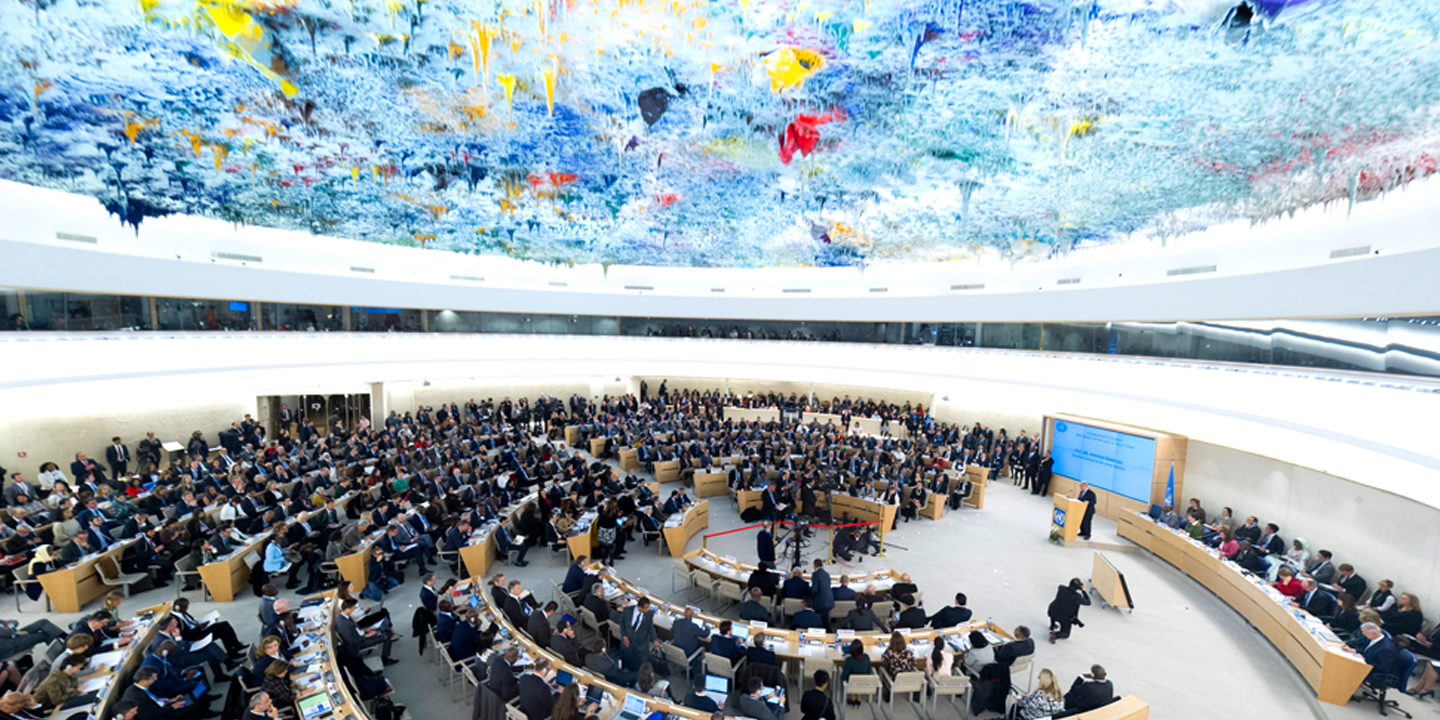
Photo Source: © UN Photo/Violaine Martin
Recommendations for the 52nd Session of the Universal Periodic Review
26 March 2026
Your Excellency,
The Global Centre for the Responsibility to Protect is writing to you regarding the 52nd session of the Universal Periodic Review (UPR) of the UN Human Rights Council (HRC) in Geneva.
In 2005 heads of state and government unanimously agreed on the responsibility of states to protect populations from genocide, war crimes, crimes against humanity and ethnic cleansing. Under the Responsibility to Protect (R2P), it is the primary responsibility of each individual state to protect their own population and the responsibility of the international community to assist them in doing so. The UPR can play an important role in assessing each country’s institutional preparedness to protect human rights and prevent mass atrocities. During the 52nd session of the UPR working group, we would therefore like to respectfully encourage you to provide all states that are under review with the following recommendations, where applicable:
-
-
- Expeditiously appoint an R2P Focal Point – a senior government official responsible for the promotion of mass atrocity prevention at the national, regional and international level;
- Sign, ratify and implement the core instruments of International Human Rights Law (IHRL) and International Humanitarian Law (IHL);
- In keeping with R2P’s Pillar II, request support from other states, as well as regional and international organizations, when atrocity risks exist that cannot be addressed by your state alone;
- Ensure that all national security forces respect human rights and IHL and fulfill their responsibility to protect all populations within the territory of your state, regardless of race, gender, nationality, ethnicity, religion, sexual orientation or any other status;
- Support accountability for atrocity crimes and all relevant institutions of international justice;
- Issue open invitations to HRC-mandated Special Procedures and fully cooperate with all other HRC mechanisms and procedures;
- Protect human rights defenders and the media, as well as the rights of civil society to operate freely, safely and independently;
- Consult and utilize the Framework for Action for the Responsibility to Protect, to assess gaps and identify opportunities to address national atrocity risks.
-
In addition, please consider the tailored recommendations below for Mozambique, Niger and Somalia.
Mozambique
Since October 2017 an armed extremist group, known locally as “Al-Shabaab,” has carried out a violent insurgency in the Cabo Delgado province in northern Mozambique. The insurgency was partly prompted by the discovery of offshore natural gas fields near Cabo Delgado and longstanding grievances linked to corruption and exclusion. The group, which is loosely affiliated with the so-called Islamic State, has perpetrated indiscriminate attacks against civilians. These abuses include extrajudicial executions, beheadings, sexual and gender-based violence, sexual slavery, abductions and destruction of civilian infrastructure. Children have been disproportionately affected, with the UN Secretary-General’s 2025 report on Children and Armed Conflict identifying Mozambique among the countries with the highest numbers of verified grave violations against children, noting a 525 percent increase in 2024. Throughout 2025 insurgent activity expanded southward toward Nampula province, further exacerbating humanitarian and protection concerns.
Mozambican security forces and affiliated private security groups, including the Wagner Group, have been implicated in IHL violations during counter-insurgency operations, including extrajudicial executions and torture, among other abuses that may amount to war crimes. During its most recent UPR review, Mozambique received 266 recommendations and accepted 236 overall, including several urging authorities to ensure prompt, thorough and impartial investigations into alleged violations of IHL and IHRL, particularly in Cabo Delgado, and to hold perpetrators accountable. Despite this, Mozambique has made limited demonstrable progress toward full implementation.
Concerns also persist regarding civic space and the protection of fundamental freedoms. Although Mozambique previously accepted recommendations to strengthen the rights to freedom of expression, association and peaceful assembly, civilians continue to face risks during periods of political unrest. Law enforcement authorities have used excessive and, in some cases, lethal force, as well as arbitrary arrest and detention, to restrict peaceful protests and silence opposition voices. Following the October 2024 elections – marked by widespread allegations of irregularities and mass protests – security forces carried out a violent crackdown. To date, the authorities have failed to ensure that those responsible for the post-election violence are brought to justice.
The Global Centre therefore urges you to include the following recommendations to Mozambique during the UPR session on 5 May:
-
-
- Ensure the protection of civilians and internally displaced persons (IDPs) in Cabo Delgado and Nampula, including through enhanced patrols and protection measures in high-risk areas;
- Conduct prompt, independent and transparent investigations into all alleged human rights violations and fully cooperate with regional and international bodies to strengthen accountability and public confidence;
- Adopt and implement child protection protocols, including formalized handover procedures to ensure the swift transfer of children allegedly associated with armed groups to civilian child protection actors, supported by appropriate age-assessment safeguards;
- Ensure that all military and security operations strictly comply with Mozambique’s obligations under international law, including by prioritizing civilian harm mitigation and strengthening command responsibility;
- Strengthen oversight, vetting and human rights training for security forces to ensure the respect for the rights to freedom of expression, association and peaceful assembly;
- Address the root causes of conflict and instability, including poverty, unemployment and marginalization in affected areas.
-
The Global Centre further respectfully encourages you to consider the following advanced questions for the review of Mozambique:
-
-
- Considering continued reports of violations by state security forces and non-state armed groups, and the limited number of transparent investigations to date, how does the government of Mozambique assess its implementation of previously accepted UPR recommendations related to accountability and civilian protection? What concrete, time-bound measures will it adopt to strengthen accountability and prevent further violations?
-
Niger
Since Niger’s last UPR cycle in May 2021, the human rights situation has dramatically deteriorated amid significant political transitions. In July 2023 members of the Nigerien army forces, operating under the self-proclaimed National Council for the Safeguard of the Homeland, overthrew democratically elected President Mohamed Bazoum, and detained him, as well as his several other members of his government. Bazoum remains arbitrarily detained despite rulings by a regional court and UN bodies calling for his release. Since the coup, the military authorities have failed to implement previously accepted UPR recommendations, and the security and protection situation have worsened considerably.
Armed Islamist groups have carried out attacks in Niger for several years, threatening populations with human rights abuses and likely atrocity crimes. Since March 2025 the so-called Islamic State in the Sahel Province has escalated its attacks against civilians in the western Tillabéri region. Nigerien armed forces have reportedly failed to adequately respond to warnings of imminent attacks and to effectively protect populations at risk. Some counterinsurgency operations have resulted in grave IHL violations and likely war crimes, including indiscriminate attacks on civilians. The military authorities have not credibly investigated alleged violations by their forces or abuses by armed Islamist groups. In August 2025 the junta launched “Garkuwar Kassa” (“Shields of the Homeland”), an initiative to recruit and train civilians to assist the armed forces, raising concerns about the risk of creating abusive and unregulated militias.
Since seizing power, the military authorities have severely restricted civic space. They have dissolved all political parties, threatened, harassed, intimidated and arbitrarily arrested journalists, human rights activists and political opponents. Authorities have also instrumentalized the judiciary for political purposes and adopted a new counterterrorism law that raises serious human rights concerns. In March 2025 military junta leader Abdourahamane Tiani was sworn in as transitional president without elections, further entrenching military rule and delaying a return to civilian democratic rule.
At the regional and international level, recent decisions risk further weaking accountability. In January 2025 Niger withdrew from the Economic Community of West African States (ECOWAS), limiting opportunities for populations to seek justice through the ECOWAS Community Court of Justice. In September Niger also announced its intention to withdraw from the ICC, undermining access to justice for victims of atrocity crimes.
The Global Centre therefore urges you to include the following recommendations to Niger during the UPR session on 4 May:
-
-
- Promptly and impartially investigate all allegations of human rights abuses and IHL violations by all parties to the conflict, regardless of rank or affiliation; prosecute those responsible in accordance with international fair trial standards and provide regular public updates on progress;
- Ensure that security forces receive adequate training in IHRL and IHL, including on the protection of civilians, and strictly uphold these standards during counterterrorism operations;
- Develop and implement effective civilian protection strategies in conflict-affected areas, including Tillabéri, to deter attacks by armed Islamist groups and create more responsive warning systems;
- Ensure journalists can operate freely and safely, including when reporting on alleged human rights violations, and immediately release journalists arrested and prosecuted for their reporting;
- Guarantee a safe and enabling environment for civil society and human rights defenders, including by respecting the rights to freedom of expression, association and peaceful assembly;
- Grant access to independent human rights monitors, including the Office of the UN High Commissioner for Human Rights (OHCHR) and the African Commission on Human and Peoples’ Rights;
- Immediately release all individuals detained on politically motivated charges.
-
The Global Centre further respectfully encourages you to consider the following advanced question for the review of Niger:
-
-
- What concrete steps will the transitional military authorities take to investigate and appropriately prosecute alleged war crimes and other serious violations committed within Niger’s territory and rebuild trust with conflict affected communities?
-
Somalia
Since Somalia’s last UPR cycle in May 2021 the human rights situation has remained precarious. During its previous review, Somalia supported 246 of 273 recommendations, including those relating to ending the recruitment and use of child soldiers, improving the protection of children in armed conflict, strengthening protections for IDPs, preventing sexual and gender-based violence, ending attacks on journalists and human rights defenders and ensuring accountability for grave human rights abuses.
Despite these commitments, populations across Somalia remain at risk of atrocity crimes amid ongoing conflict and attacks perpetrated by armed extremist groups, particularly Al-Shabaab,* as well as the operations conducted by forces combating them. For more than two decades, Al-Shabaab has perpetrated attacks that may amount to war crimes and crimes against humanity, including deliberate attacks against civilians, hospitals and schools, obstruction of humanitarian aid, widespread sexual and gender-based violence and the use of human shields. According to the UN Transitional Assistance Mission in Somalia (UNTMIS), at least 144 civilians were killed between 24 March to 25 September 2025, with 40 percent of those deaths attributed to Al-Shabaab.
Between March and August 2025 UNTMIS verified 1,096 victims of grave violations against children. Al-Shabaab was responsible for 77 percent of these violations. Clan militias and unidentified armed groups were each responsible for 9 percent, while Somali security forces were responsible for 5 percent. The Somali National Army (SNA) and the Somali Police Force (SPF) were delisted in the Secretary-General’s 2025 Children and Armed Conflict with respect to the recruitment and use of children. This delisting was conditional upon continued implementation of the 2012 Action Plan and 2019 Road Map aimed at ending and preventing child recruitment and use, as well as the sustained decrease in these violations. However, both the SNA and SPF remain listed for killing and maiming and rape and other forms of sexual violence against children.
The longer-term drawdown of the African Union Support and Stabilization Mission in Somalia, alongside the gradual transfer of security responsibilities to Somali forces, may also heighten risk to civilians if not accompanied by strengthened accountability and civilian protection mechanisms.
The Global Centre therefore urges you to include the following recommendations to Somalia during the UPR session on 8 May:
-
-
- Ensure that all military operations are carried out with strict adherence to IHL and IHRL and that all violations and abuses are promptly, independently and impartially investigated, with perpetrators held accountable;
- Strengthen the human rights and civilian protection capacities of national security forces, including through enhanced coordination with OHCHR, and assess areas where additional technical assistance is required;
- Continue implementing a coordinated political and preventive strategy to counter violent extremism, aimed at preventing recruitment by Al-Shabaab and other non-state armed groups;
- Sustain implementation of the 2012 Action Plan and the 2019 Road Map to end and prevent the recruitment and use of children in armed conflict.
-
The Global Centre further respectfully encourages you to consider the following advanced questions for the review of Somalia:
-
-
- What progress has the government made in establishing effective accountability mechanisms for national and regional forces, particularly in relation to allegations of gender-based violence?
- How has the government strengthened its cooperation with OHCHR and other human rights monitoring mechanisms?
- What concrete measures are in place to prevent the re-recruitment of children following the delisting of the SNA and SPF for recruitment and use?
-
* Al-Shabaab in Somalia is distinct from the group sometimes referred to locally as “Al-Shabaab” in Mozambique.
Source
Global Centre for the Responsibility to Protect
Related Content
13 March 2026
Podcast
Expert Voices on Atrocity Prevention Episode 53: Eric Tistounet
23 February 2026
Open Letter