23 February 2026
Open Letter
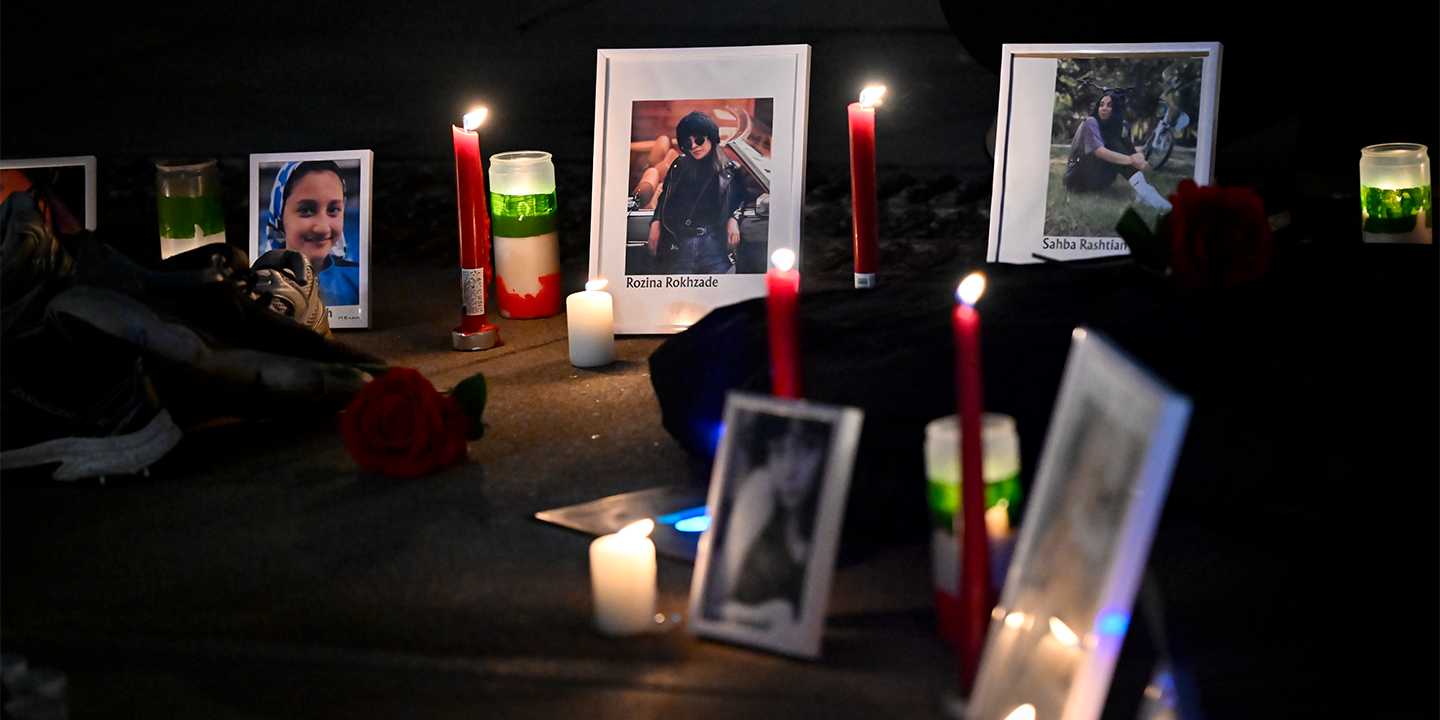
On 25 January the New York Times published an investigation into the Iranian authorities’ widespread crackdown on protesters since 8 January. The crackdown has been deemed the deadliest suppression of protests in Iran since the 1979 revolution. Video footage verified by the New York Times shows security forces opening fire on protesters in at least 19 cities. Interviews with Iranians detail a consistent pattern of abuse, including forces beating protesters with batons, using tear gas, indiscriminately firing live ammunition into crowds and deploying snipers on rooftops. Iranian authorities claim that at least 3,117 people were killed – a figure substantially lower than the tens of thousands estimated by others.
The scale and speed of the violence resulted in a rapid influx of injured Iranians, overwhelming hospitals across the country. In response, several doctors established improvised, discreet clinics to treat those who feared for their safety, after security forces demanded access to patients they sought for arrest.
Although protests have largely been suppressed since mid-January, Iranian authorities have continued their campaign of mass arrests and home raids aimed at deterring renewed mobilization. Children as young as 14 have been arbitrarily detained. Doctors who treated injured protesters and journalists who signed a public statement endorsing the protests have also been detained. Rights groups estimate that at least 40,000 Iranians are detained, with many at risk of torture and other ill-treatment.
Following a total internet shutdown in January, severe restrictions on internet and communications access remain in place. The UN Special Rapporteur on the human rights situation in Iran, Mai Sato, stressed that the shutdown has prevented “international witnessing of atrocities.” In 2022 the Office of the UN High Commissioner for Human Rights similarly warned that obstructing documentation through internet shutdowns “seems to contribute to further violence, including atrocities,” citing Iran’s actions as an example.
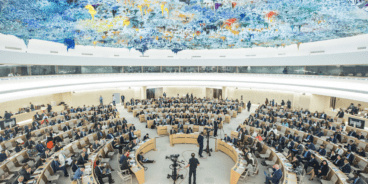
On 23 January, during an urgently convened UN Human Rights Council (HRC) Special Session on Iran, Sara Hossain, Chair of the Independent International Fact-Finding Mission on the Islamic Republic of Iran (FFMI), stressed that “the priority must now be on gathering evidence and establishing whether human rights violations and… crimes against humanity, may have occurred.” During the session, the HRC mandated the FFMI to conduct an urgent inquiry into the recent protests. One week later, the European Union designated the Islamic Revolutionary Guard Corps a terrorist organization and sanctioned several individuals and entities over their involvement in serious human rights violations.
Iranian authorities must immediately halt mass arrests and raids, release those detained for exercising their human rights and fully restore internet and communications access. UN member states should adequately fund the FFMI’s investigation and exercise universal jurisdiction to initiate national criminal investigations against responsible Iranian officials.
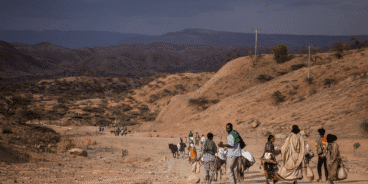
Renewed hostilities in northern Ethiopia are placing the 2022 peace agreement at serious risk. Clashes erupted on 26 January when the Tigray Defence Forces advanced into disputed areas, specifically Tselemti in north-western Tigray, sparking fighting with troops from Ethiopia’s federal government and regional militia forces from the neighboring Amhara region. On 31 January the federal government launched drone strikes, killing at least one person.
The current escalation reflects long-lasting territorial disputes and unresolved post-war tensions that continue to threaten a return to full-scale conflict. Tselemti and areas in Western Tigray remain contested territories, claimed by the Tigray and Amhara regions, and their control was a central issue left unresolved in the peace agreement that formally ended the conflict in Tigray and northern Ethiopia between November 2020–2022. The federal government has stated that governance of the disputed areas was to be determined through a referendum by the local population. That referendum has yet to take place, and prospects for its implementation remain uncertain. Human Rights Watch and Amnesty International both documented a campaign of ethnic cleansing against Tigrayan populations in Western Tigray during the conflict by Amhara regional security forces and local authorities. Hundreds of thousands of people remain displaced.
These clashes are unfolding against a broader backdrop of conflict and atrocity risks across Ethiopia, including political fragmentation in Tigray, tensions between the government and armed militias in Amhara and widespread abuses in Oromia, among others. Rising tensions between the Ethiopian and Eritrean governments, which were allied during the 2020–2022 conflict, are heightening risks throughout the Horn of Africa. A recent Associated Press investigation highlighted ongoing abuses in Oromia, Ethiopia’s largest and most populous region, despite the federal government restricting access for journalists and human rights monitors. A long-standing conflict between the Oromo Liberation Front (OLA) and federal forces has been characterized by human rights abuses. The OLA have been accused of targeted attacks on civilians along ethnic lines, while federal forces have been accused of executions, enforced disappearances, arbitrary arrests, rape and drone strikes against civilian populations perceived to support the OLA.
Sarah Hunter, Ethiopia expert at the Global Centre for the Responsibility to Protect, said, “Persistent impunity for abuses committed during the 2020–2022 war, alongside ongoing violence in Amhara, Oromia and Tigray, continues to fuel grievances across Ethiopia. With little international scrutiny or accountability, the Ethiopian government has been free to act without restraint, allowing grave human rights abuses and atrocities to persist.” Member states must urgently re-engage on Ethiopia to prevent a resurgence of conflict, including at the upcoming 61st session of the UN Human Rights Council. Preventing recurrence must be a priority, alongside de-escalating regional tensions that only serve to exacerbate internal conflict.
On 4 January the de facto Taliban authorities in Afghanistan issued a decree endorsing a new criminal code – known as the “Criminal Procedural Regulations for Courts.” Adopted without public notice or transparent consultation, the code stands in stark contradiction to international human rights treaties and conventions, many of which Afghanistan has ratified.
The code abandons fundamental due process guarantees by privileging confession and testimony without safeguards against coercion and eliminating independent investigation. The code also determines punishment based on an individual’s social and religious status rather than the nature or gravity of the offense and formalizes a caste-like social classification system, dividing society into four categories: “scholars” (ulama), “the elite” (ashraf), “the middle class” and “the lower class.” Religious authorities are granted sweeping discretion to impose and carry out the death penalty, while criticism of the Taliban is criminalized and the use of corporal punishment expanded. The code further authorizes arbitrary vigilante justice as a religious and legal duty, empowering private citizens in ways that risk violations of the prohibition against torture and cruel, inhuman or degrading treatment. It also explicitly permits the practice of slavery, raising grave concerns under international law.
Violence and discrimination against women and children, which are already codified in the Taliban’s so-called “vice and virtue” laws that subjugate women, girls and individuals with expansive gender identities, are reinforced and expanded further within the new code. Several articles indirectly legitimize abuse, maltreatment and punishment by defining harm broadly while prescribing disproportionately limited penalties for perpetrators. Clerics, religious figures and others who perpetrate violence – particularly against women and children – are afforded near-total immunity, while poorer and more marginalized Afghans face harsher, often violent, punishments.
Since the Taliban’s emergence in the 1990s, Sharia-based justice has been central to its stated objectives. Following the overthrow of the internationally recognized government in 2021, the Taliban dismantled Afghanistan’s existing legal framework. Julia Saltzman, Afghanistan expert at the Global Centre for the Responsibility to Protect, stated, “The Taliban’s distortion of Sharia to justify discriminatory and persecutory policies, combined with restrictions on fundamental freedoms and impunity for past and ongoing abuses, significantly heightens the risk of human rights violations and atrocity crimes.”
The international community should reject this code as a dangerous precedent. Regional and Islamic governments, as well as the Organization of Islamic Cooperation, should publicly condemn provisions contained in the new penal procedures, particularly those that entrench ongoing repression of women and girls. UNAMA and the UN Human Rights Office should regularly assess implementation of the code in their reporting to the Security Council and Human Rights Council. Reversal of this code, alongside other laws codifying persecution in Afghanistan, must serve as an essential and non-negotiable benchmark for progress in the Doha Process and other political dialogues.
Ralph Bunche Institute for International Studies
The Graduate Center, CUNY
365 Fifth Avenue, Suite 5203
New York, NY 10016-4309, USA