26 March 2026
Open Letter
In the early hours of 3 January the United States (US) military conducted strikes on Venezuelan territory and forcibly took into custody Nicolás Maduro, and his wife, Cilia Flores. Images of explosions in Caracas and surrounding areas circulated widely, contributing to widespread fear and uncertainty both within Venezuela and among Venezuelans abroad concerned for the safety of family members. The operation constitutes a flagrant violation of the UN Charter, including the prohibition on the use of force, and has compounded already severe risks facing Venezuelans across the country.
For more than a decade, Nicolás Maduro presided over an entrenched authoritarian state apparatus responsible for crimes against humanity. These crimes were carried out through an integrated system involving the civilian and military, security and intelligence apparatus enabled by judicial and legislative institutions that normalized repression, political persecution and pervasive impunity. While Maduro’s forcible removal generated some cautious hope for meaningful change, at the time of writing all senior individuals, institutions and state structures that have facilitated crimes against humanity remain intact.
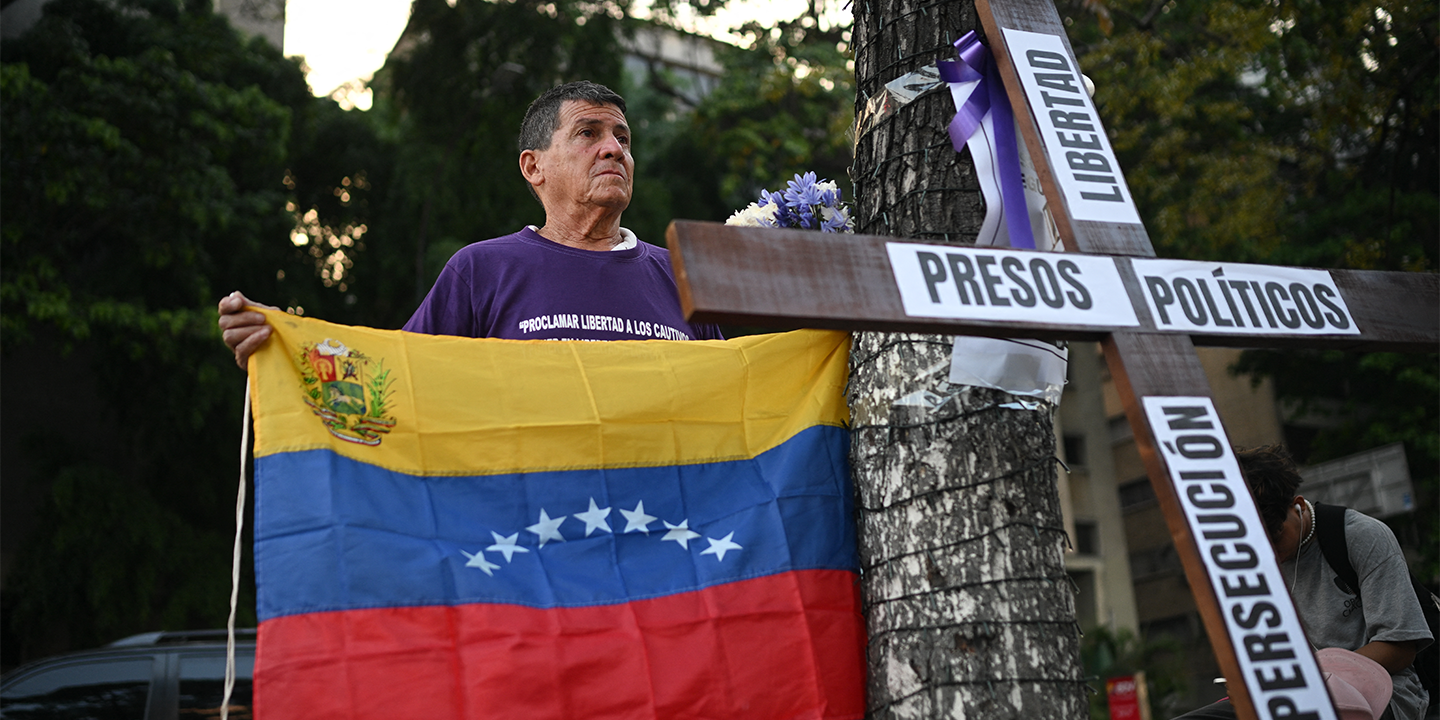
The Office of the UN High Commissioner for Human Rights has warned of the dangers emerging from this situation, stating, “We fear that the current instability and increased militarisation due to the U.S. intervention will further worsen the situation in Venezuela.” Warning signs are already evident. An emergency decree adopted in the aftermath of 3 January contains provisions that could be used to criminalize perceived dissent or alleged support for US actions. On 5 January more than a dozen journalists were temporarily detained in Caracas while reporting on unfolding events, raising serious concerns about an imminent new wave of repression.
This is occurring amid uncertainty over internal power dynamics within Venezuela’s ruling elite, where different factions control the military, police and intelligence services, as well as paramilitary actors like the colectivos, which have long been implicated in violent repression and social control. The security environment is further complicated by a broader range of armed groups and non-state actors operating across the country under opaque arrangements with state authorities, with poorly defined levels of territorial control and involvement in illicit economies.
Against this backdrop, reports that US authorities have issued threats against Interior Minister Diosdado Cabello – a powerful hardline figure and the key architect of political persecution – have coincided with videos showing armed colectivos roaming the streets of Caracas. Combined with the threat of potential US military action, these dynamics increase the risk of violence, human rights violations and atrocity crimes, while sharply compounding the vulnerability of millions already living under extreme socio-economic strain.
Governments with influence must exert coordinated leverage to prevent further escalation, prioritize the protection of civilians and support a genuine commitment to system-wide reform. Immediate measures should include demanding the full reopening of civic space, securing the immediate and unconditional release of hundreds of political prisoners and addressing Venezuela’s severe and urgent humanitarian needs. Any meaningful path forward must center the agency of Venezuelans themselves and advance through peaceful processes grounded in human rights, democratic will, justice and the dismantling of structures that have enabled atrocity crimes.
Attacks against civilians across Sudan have continued unabated in recent weeks, with a dramatic escalation in incidents involving drones in populated areas and against civilian infrastructure. In his briefing to the UN Security Council (UNSC) on 22 December, the UN Assistant Secretary-General for the Middle East, Asia and the Pacific, Khaled Khiari, highlighted the increasing use of indiscriminate drone strikes by both the Sudanese Armed Forces (SAF) and Rapid Support Forces (RSF) as a “particularly worrying” trend, saying that “each passing day brings staggering levels of violence and destruction.”
Drone strikes on 3 January reportedly killed at least 64 civilians in the Zarq and Ghurair areas of North Darfur, including attacks on a market and hospital. According to a statement issued by the RSF, the strike resulted in the complete destruction of Al-Zarq hospital, which had been the sole functioning health facility serving thousands of people in the area. The RSF accused the SAF of carrying out the attack.
In recent weeks, fighting in the Kordofan regions has also intensified, with civilians in Kadugli and Dilling trapped under siege in dire conditions amid ongoing shelling and drone strikes. On 30 December the RSF reportedly killed at least 25 people in Dilling, with strikes reportedly hitting civilian neighborhoods and a medical facility. The RSF allegedly launched further attacks on 3 and 4 January across El Obeid, cutting electricity to North Kordofan’s capital and disrupting essential services.
These attacks are unfolding amid a catastrophic humanitarian situation. On 26 December a small UN humanitarian team visited El Fasher for the first time since the RSF’s takeover in October 2025 amid mass atrocities. The UN Resident and Humanitarian Coordinator in Sudan, Denise Brown, described the city as “a crime scene,” stating El Fasher remains the “epicentre of human suffering.” The team found hundreds of traumatized people living without adequate access to food, medical care and proper shelter. On 29 December the UN Children’s Fund warned of an “unprecedented level” of child malnutrition in North Darfur, highlighting the catastrophic impact of ongoing violence and access constraints on children.
The SAF and RSF must immediately halt drone strikes and other attacks targeting populated areas, hospitals, markets and essential services. States that provide military equipment, including armed drones, to either party must immediately suspend such transfers, as they directly contribute to attacks on civilians and critical infrastructure. All parties must urgently ensure that humanitarian actors can access affected areas to deliver lifesaving medical care, food and water. The UNSC, regional organizations and UN member states must press for an immediate ceasefire, including explicit commitments to prevent further drone strikes on civilian areas.
At least 30 people were killed, several others abducted and many remain unaccounted for after unidentified gunmen attacked a village market in Borgu Local Government Area of Niger State, Nigeria, on 3 January. According to local police, armed men – commonly referred to as “bandits” – stormed the market, opened fire on civilians indiscriminately, burned stalls and looted food items. Witnesses reported that the area had been under siege for at least a week, as part of a series of raids that began days earlier in nearby villages in Borgu, as well as in the Agwara Local Government Area. In response, security authorities have deployed a joint response team to conduct rescue and recovery operations.
The number of people taken hostage remains unclear. However, some of those abducted reportedly attended St. Mary’s Catholic School in the village of Papiri, Agwara Local Government Area, where more than 300 students were abducted in November and subsequently released several weeks later.
The attack in Niger State occurred days after the United States (US) military launched airstrikes against alleged Islamic State-linked targets in northwestern Sokoto State on 25 December. The airstrikes were reportedly intended to curb the activities of Islamic State-linked groups and criminal bandits. The Nigerian government has stated that the 3 January attack was carried out by “terrorists suspected to be fleeing from Sokoto and Zamfara following the United States’ airstrike.”
Northern Nigeria has for years faced overlapping security crises involving armed extremist groups, notably Boko Haram and splinter factions, alongside criminal bandit groups. These actors have committed serious human rights abuses and mass atrocity crimes against civilians. Kidnappings have increasingly become a key tactic to finance operations and exert control over rural communities, including through a recent wave of mass abductions from schools in Niger State. Sokoto State, like many parts of northern Nigeria, has long experienced widespread insecurity, including attacks on civilians, looting and kidnappings for ransom.
Priscila Vazquez, Nigeria expert at the Global Centre for the Responsibility to Protect, warned, “Attacks by armed groups have intensified across several northern states in the days following the US operation, underscoring the fragility of the security situation and persistent risks to civilians. The surge in violence highlights how military responses alone fail to address the underlying drivers of atrocity risk in northern Nigeria, including weak state presence, inadequate civilian protection, widespread impunity, poverty and competition over scarce resources.”
Without sustained protection, meaningful accountability and governance and development reforms, populations across northern Nigeria remain highly vulnerable. The Nigerian government should urgently strengthen protection measures, including by improving early warning and rapid response mechanisms and expanding community-based protection initiatives. Authorities must promptly and impartially investigate all attacks against civilians and ensure those responsible are held accountable.
Ralph Bunche Institute for International Studies
The Graduate Center, CUNY
365 Fifth Avenue, Suite 5203
New York, NY 10016-4309, USA