17 December 2025
Atrocity Alert
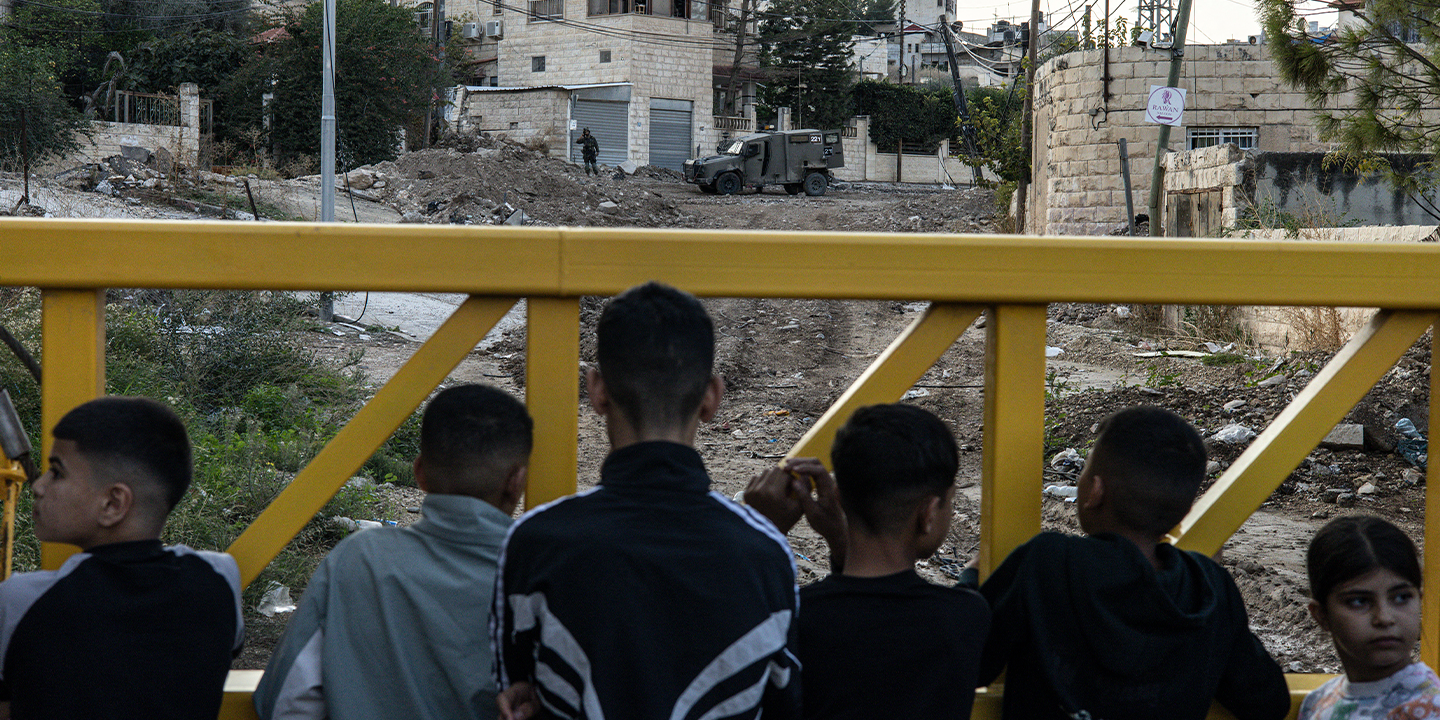
On 20 November Human Rights Watch (HRW) published a report documenting the forced displacement of Palestinians in the Occupied West Bank during the large-scale military campaign Israel launched on 21 January. Within less than a month, Israel’s assault expanded across the northern West Bank, where Israeli forces forcibly displaced over 32,000 residents of the Jenin, Tulkarem and Nur Shams refugee camps. The camps were left virtually emptied, marking the largest forced displacement of Palestinians in the Occupied West Bank since 1967. HRW concluded that Israel’s conduct amounted to war crimes, crimes against humanity and ethnic cleansing.
Residents, mostly families displaced in 1948 and their descendants, described being forced to flee with only minutes’ notice as Israeli ground forces advanced, accompanied by drones, armored tanks and Apache attack helicopters. Homes were raided, family members interrogated and people fled amid widespread bulldozing of roads and buildings. Israeli forces often used coercive measures to expel residents, provided no shelter or assistance and have kept the camps cordoned off, preventing most displaced Palestinians from returning. HRW determined that the forcible displacement and systematic destruction of infrastructure constitute war crimes and crimes against humanity carried out as part of a widespread and systematic attack on civilians.
Over the ten months since the start of the campaign, displaced camp residents remain in limbo. Israel has demolished over 850 homes and buildings across the three refugee camps and continues to issue new demolition orders, including for a dozen buildings in Jenin last week. As Israel seeks to permanently alter the emptied camps, a displaced resident told HRW, “my fear is that what happened in 1948 will happen to us here. I have an inner belief that we won’t be able to come back ever.”
HRW’s findings highlight the atrocity crimes committed by Israel during its military operation launched just two days after the last temporary Gaza ceasefire took effect on 19 January. While the international community remains focused on preserving and advancing the latest Gaza ceasefire – during which Israel has continued its genocide and committed routine violations – it has continued to neglect Israel’s ongoing criminal conduct in the Occupied West Bank. Simultaneously, Israel has also escalated attacks on neighboring countries. Despite the 1974 Disengagement Agreement with Syria, Israel has repeatedly violated Syrian sovereignty over the last year. On 28 November at least 13 people were killed in Beit Jinn after residents resisted an Israeli ground incursion. Meanwhile, the UN has documented Israel perpetrating around 10,000 violations of the ceasefire agreement with Lebanon over the past year.
This week, under Slovenia’s presidency of the UN Security Council, Council members will visit Syria and Lebanon – the first such trip to the region in six years. The Council should seize this opportunity to denounce Israel’s ongoing atrocities, including its destabilizing actions across the region. All states – particularly those with influence – must pressure Israel to halt its military operation in the Occupied West Bank, suspend military and financial assistance to Israel and support efforts to investigate and prosecute Israeli officials responsible for the operation. Israel must allow displaced Palestinians to return to their homes and provide reparations for the harms incurred.
The latest Landmine Monitor report by the International Campaign to Ban Landmines (ICBL) documents 6,279 people killed or injured in 2024 by landmines and explosive remnants of war (ERW) – the highest annual total in four years. Civilians accounted for 90 percent of casualties, nearly half of them children. Improvised landmines continued to cause the highest number of casualties globally, while casualties from manufactured antipersonnel mines tripled between 2020 and 2024. Today 57 countries remain “massively contaminated.”
The sharp rise in casualties is largely driven by mine use in conflict-affected countries, particularly by states not party to the Mine Ban Treaty. Myanmar (Burma) remains the most dangerous country for the second consecutive year, with over 2,000 casualties – double the figure documented in 2023. The ICBL reports increased abuses by the military junta and multiple armed groups, including forcing civilian “guides” to walk ahead of troops and compelling civilians into mine-clearance and portering – grave violations of international humanitarian and human rights law. In Syria, families are increasingly at risk as they return home to mine contaminated areas following the fall of the Bashar al-Assad regime last December. The ICBL documented 1,015 civilian casualties in Syria, the second highest number of casualties during 2024.
While addressing the 22nd Meeting of States Parties of the Anti-Personnel Mine Ban Convention on 1 December, UN Secretary-General António Guterres warned that wavering commitments amid ongoing conflicts risk eroding the Mine Ban Treaty, stressing that, “Any weakening…could spark a dangerous race to the bottom. And civilians would pay the highest price.”
The ICBL cautions that progress toward a mine-free world is under serious strain. Continued and renewed use by Russia and Myanmar, alleged use by Cambodian forces and indications of new production by India, Myanmar, Russia and South Korea threaten the global norm. The United States’ (US) 2024 transfer of antipersonnel mines to Ukraine broke its 32-year export moratorium, undermining the stigma against these weapons. Although 166 countries have joined the Mine Ban Treaty, including the Marshall Islands and Tonga who joined in 2025, Estonia, Finland, Latvia, Lithuania and Poland are withdrawing, while Ukraine has attempted to “suspend” its obligations, an action not permitted under the convention.
At the same time, major funding cuts – including from the US, historically the largest donor – have resulted in reduced survivor support and the termination of several humanitarian mine action programs compared with prior years. Victim assistance has been particularly affected, with international support falling 23 percent.
Landmines and ERWs are inherently indiscriminate, endangering civilians now and for generations. The erosion of the global commitment to ban these weapons threatens hard-won humanitarian gains and collective security. Governments attending this week’s 22nd Meeting of States Parties must condemn all production, acquisition, stockpiling, use, retention or transfer of antipersonnel mines and take every necessary measure to fully implement the Mine Ban Treaty.
The security and human rights situation in Ethiopia, and the broader Horn of Africa, has sharply deteriorated amid recurrent and escalating conflicts, placing already vulnerable populations at increased risk of grave abuses.
This deterioration is starkly evident in the Amhara region, where conflict between the Fano, an ethnic Amhara militia, and the federal government has intensified since April 2023, alongside reports of grave human rights abuses. An 18 November BBC investigation documented thousands of cases of sexual violence between July 2023 and May 2025, with victims ranging from eight to 65 years old. Nearly half of victims tested positive for sexually transmitted infections, and many were left pregnant and deeply traumatized. From 43 health facilities, representing only about four percent of all health facilities in Amhara, the BBC recorded 2,697 reported cases of rape, with children under 18 accounting for 45 percent of all cases.
Despite these alarming figures, the true scope is likely far greater. Sexual violence is largely underreported due to fear of stigma and reprisals. Restrictions on access have further hindered independent monitoring. However, the BBC’s findings corroborate evidence from the Office of the UN High Commissioner for Human Rights and international human rights groups.
Ongoing extrajudicial killings, indiscriminate drone and air strikes on populated areas, destruction of civilian property – including homes and health facilities – and mass arbitrary arrests have also been documented in Amhara. These violations, prohibited under international humanitarian and human rights law, likely amount to war crimes and crimes against humanity.
Grave violations in Amhara are unfolding against a backdrop of unresolved political grievances and rising regional tensions. The underlying drivers of the conflict remain unaddressed, including unimplemented provisions of the Cessation of Hostilities Agreement that ended the 2020–2022 war in Tigray, Amhara and Afar. Meanwhile, federal forces that allied with neighboring Eritrea during the war are now entangled in escalating tensions fueled in part by Prime Minister Abiy Ahmed’s ambitions to secure port access for landlocked Ethiopia. Both the Ethiopian and Eritrean governments have exchanged increasingly hostile rhetoric, raising concerns of renewed conflict. These regional frictions, combined with political fragmentation in Tigray and accusations of factions aligning with either Eritrea or the federal government, have further deteriorated the security situation.
The Global Centre for the Responsibility to Protect Horn of Africa expert, Sarah Hunter, said, “This volatile environment risks igniting renewed violence in regions where communities are still recovering from past atrocities. Addressing this crisis demands urgent diplomatic engagement and principled action grounded in prevention, the protection of civilians and accountability for abuses past and present.”
Ralph Bunche Institute for International Studies
The Graduate Center, CUNY
365 Fifth Avenue, Suite 5203
New York, NY 10016-4309, USA