24 January 2024
Atrocity Alert
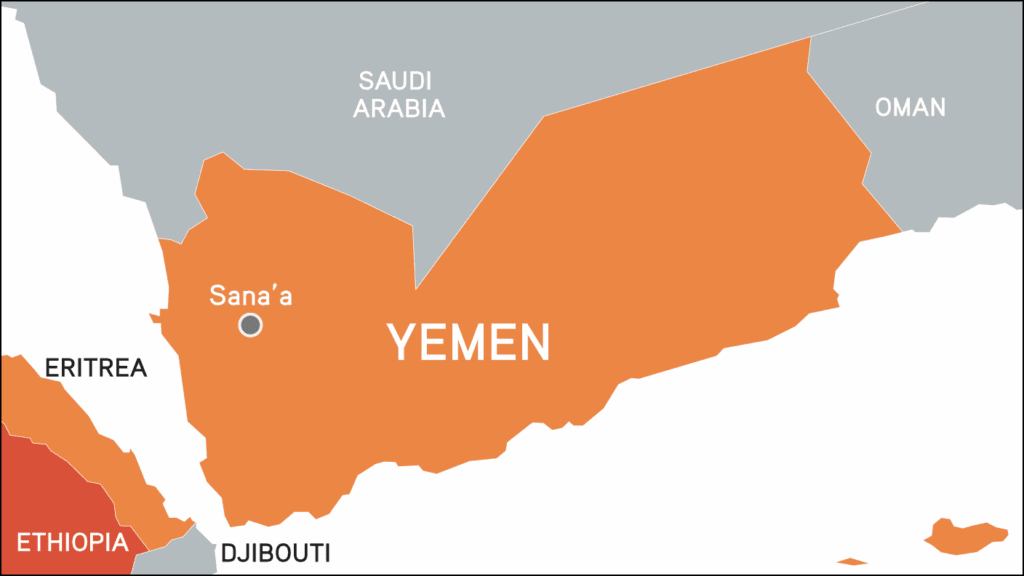
Populations in Yemen remain at risk of war crimes.
Since 2015 civilians in Yemen have suffered recurrent war crimes and crimes against humanity. Fighting between Houthi forces, the Southern Transitional Council (STC) – a United Arab Emirates (UAE)-backed southern secessionist group – and forces loyal to the internationally recognized government (IRG), together with airstrikes by a Saudi Arabia and UAE-led international coalition, have resulted in widespread civilian casualties. Coalition airstrikes alone killed or maimed more than 19,200 civilians, including over 2,300 children largely between March 2015 and April 2022. At least 4 million people have been displaced.
From 2018-2021 the UN Group of Eminent Experts (GEE) on Yemen documented a pattern of violations of international law perpetrated by all parties that may amount to war crimes, including indiscriminate airstrikes and shelling, torture, arbitrary detention and sexual and gender-based violence, as well as attacks on essential civilian infrastructure, including water reservoirs and hospitals. The GEE alleged that Canada, France, Iran, the United Kingdom (UK) and United States (US) may be complicit in these violations due to their provision of military intelligence, arms and logistical support to some parties to the conflict. The UN Security Council (UNSC)-mandated Panel of Experts on Yemen has also reported that all parties to the conflict have perpetrated arbitrary arrests and detention, enforced disappearances, ill-treatment and torture of detainees since 2015.
On 2 April 2022 parties to the conflict commenced a UN-brokered country-wide ceasefire. The six-month truce resulted in a significant decrease in civilian casualties. However, some shelling, artillery, missile attacks, drone strikes and armed clashes continued, while civilians were also subjected to human rights violations and abuses, including enforced disappearances, torture and sexual violence. Although hostilities have not escalated significantly, at least 1,742 civilians have been killed following the ceasefire’s expiration. Current civilian harm estimates remain constrained by restrictions on media access and reporting.
A Presidential Leadership Council (PLC) – backed by Saudi Arabia and the UAE – was established in April 2022 to serve as the executive body of the IRG and consolidate Yemen’s anti-Houthi factions, including the STC. However, power struggles and internal clashes among member factions have persisted.
Broader regional tensions have increased risks for civilians in Yemen. Since November 2023, in response to Israel’s war on Gaza, Houthi forces in Yemen have carried out periodic attacks on vessels in the Red Sea. They announced a pause following the October 2025 ceasefire agreement but have pledged to resume attacks if the ceasefire is not fully implemented. In response to Houthi attacks, the US and UK launched airstrikes across Yemen from January 2024 and January 2025. According to the Yemen Data Project, over 300 airstrikes were carried out, resulting in 85 civilian casualties.
Saudi officials and Houthi leadership have engaged in negotiations brokered by Oman, as well as UN Special Envoy Hans Grundberg, and in December 2023 agreed to preliminary steps toward a ceasefire. Since then, limited progress has been made due to Houthi attacks in the Red Sea. Political negotiations thus far have not included affected communities, including victims and survivors, as well as certain parties to the conflict, minority groups and women. In July 2023 over 60 Yemeni civil society organizations released the Yemen Declaration for Justice and Reconciliation, in which they set forth their common vision for achieving justice and reconciliation in post-conflict Yemen.
The crisis in Yemen has been ongoing for over 20 years, but dramatically escalated during 2014 when, amid a UN-facilitated political transition process, Houthi forces and military units loyal to former President Ali Abdullah Saleh took control of numerous governorates, including the capital, Sana’a, and forced then President Abd Rabbu Mansour Hadi and his government to resign. On 26 March 2015 the Saudi/UAE-led coalition launched a military intervention in Yemen to restore the IRG of President Hadi.
The UNSC has subsequently imposed financial sanctions and travel bans on former President Saleh and Houthi leaders, as well as an arms embargo on the Houthis.
Houthi authorities have intensified pressure on international actors operating in Yemen. Since May 2024 they have arbitrarily detained dozens of UN and civil society staff, denying due process and accusing some of crimes punishable by death. At the time of writing, 73 UN staff remain arbitrarily detained.
Growing security concerns have resulted in the UN and other international organizations recently scaling back operations in Houthi-controlled areas.
Yemen’s political and security dynamics have shifted significantly in recent months. A brief offensive by the STC in late December 2025 aimed to expand its control in southeastern governorates, including Hadramout and al-Mahra near Saudi Arabia’s border. The offensive was repelled by Saudi and IRG-aligned forces, which also retook Aden. The STC was subsequently dissolved and removed from the PLC. The clashes displaced over 1,600 households and revealed previously documented secret detention centers in southern Yemen operated by the UAE and affiliated forces. The renewed fighting highlights the persistent risks to civilians amid political fragmentation and shifting territorial control.
Amid this evolving landscape, a forthcoming Southern Dialogue Conference was announced, which aims to facilitate discussions with Yemen’s southern factions on “just solutions” concerning their separatist aspirations. In February the PLC formed a new government, appointing 34 cabinet members.
In May the UN Special Envoy announced an agreement on the largest prisoner exchange in Yemen to date since the start of the conflict. Yemen’s government and the Houthis agreed to release over 1,600 conflict-related detainees.
Clashes between the Houthis and Yemeni government forces intensified in early July, with more than a dozen government troops killed in Hodeidah in one of the deadliest confrontations since the 2022 truce.
Atrocity risks remain until a permanent truce and inclusive negotiated peace settlement between the Houthis and Saudi-backed coalition are reached and extensive justice and accountability efforts, including reparations to victims, are advanced. Although fighting in Yemen has largely subsided following the IRG’s reclamation of control and the formation of a new government – offering an opportunity to revitalize the peace process – the security situation remains fragile. Key challenges include navigating the political vacuum following the dissolution of the STC and addressing the grievances of its supporters in the south, consolidating security threats and managing uncertainty surrounding Houthi engagement in the political process. The risk of Houthi involvement in wider regional escalations following US-Israeli attacks on Iran contributes to further uncertainty.
The lack of inclusive dialogue throughout all negotiation processes has limited the capacity of Yemeni civil society groups to advocate for their protection and risks entrenching impunity for past violations. Ongoing patterns of violations against minority communities demonstrate targeted persecution of religious minorities by Houthi forces.
All parties to the conflict have perpetrated indiscriminate attacks and targeted civilian objects, amounting to war crimes and crimes against humanity. The protracted crisis in Yemen has been exacerbated by pervasive impunity. Since the termination of the GEE in October 2021, no independent mechanisms have been dedicated to monitoring violations in Yemen, and no other international body has taken steps toward advancing justice and accountability.
All parties to the conflict should fully recommit to a country-wide truce and negotiate an end to the protracted conflict, while all stakeholders, including third party states, must preserve progress made thus far. The window of opportunity to revitalize a political process must be seized, incorporating all relevant parties and civil society, as well as ensuring that accountability and justice feature prominently in the peace process. Yemen’s new government should prioritize confidence-building measures, stabilization and impartially address the grievances of Yemenis. All key stakeholders must take steps to implement the Yemen Declaration for Justice and Reconciliation.
The government of Yemen should allow access for independent investigations into potential war crimes and crimes against humanity. All parties to the conflict – with assistance from the international community – must ensure the provision of reparations to all victims of international crimes. UN member states should urgently work to establish a new transitional justice-focused mechanism to advance accountability and reparations.
For more on the Global Centre’s advocacy work on the situation in Yemen, see our Yemen country advocacy page.
Ralph Bunche Institute for International Studies
The Graduate Center, CUNY
365 Fifth Avenue, Suite 5203
New York, NY 10016-4309, USA