26 March 2026
Commentary
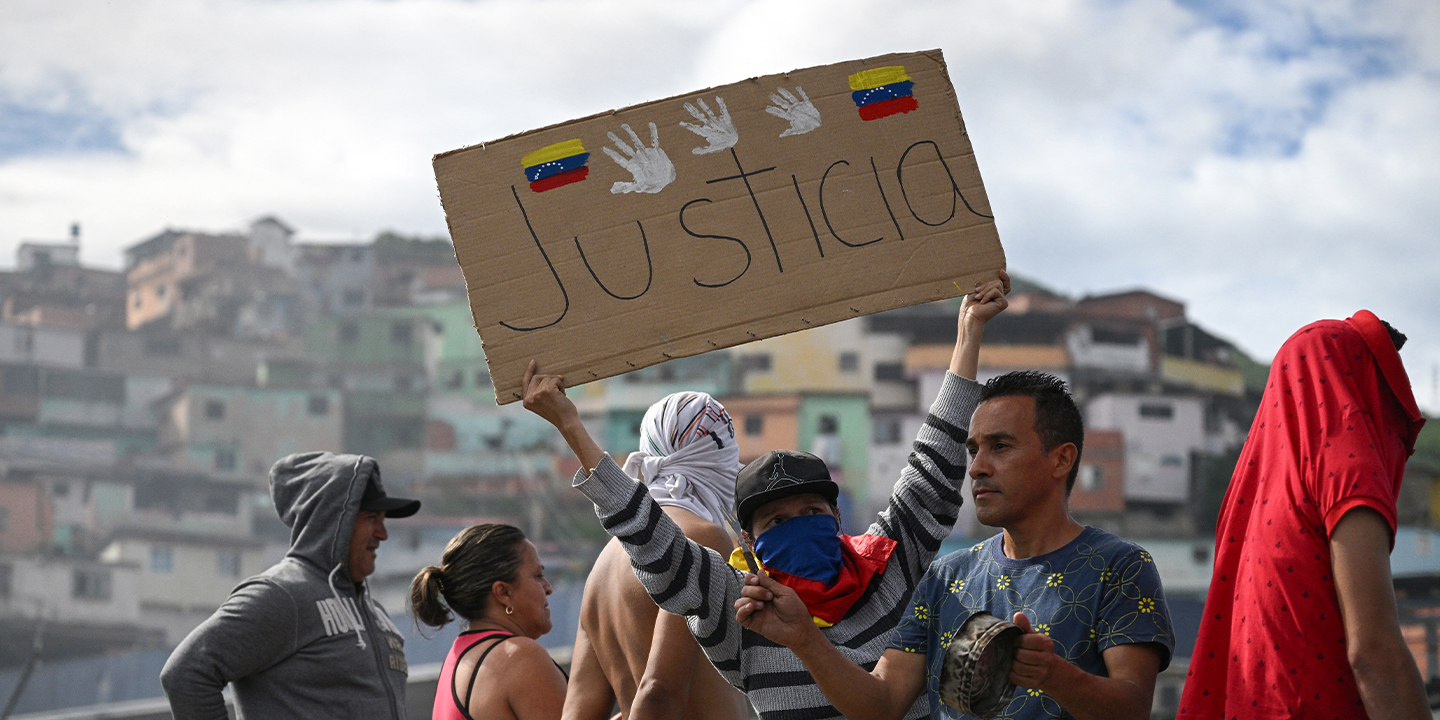
In the early hours of 3 January explosions and military helicopters were reported in Caracas and surrounding areas as United States (US) armed forces conducted an unprecedented operation on Venezuelan territory. Hours later, US President Donald Trump announced that Venezuela’s Nicolás Maduro, and his wife, Cilia Flores, had been forcibly taken into US custody. While Venezuelan officials reported unverified casualties, the human impact of these operations remains unknown. These events have heightened risks for civilians in Venezuela, while leaving intact the institutions responsible for perpetrating crimes against humanity for over a decade.
In the days following the operation, inconsistent statements by senior US officials, including President Trump and Secretary of State Marco Rubio, have created significant uncertainty regarding the exercise of authority within Venezuela and the process through which the country’s future will be determined. Since 3 January Delcy Rodríguez, who served as Vice President within the same repressive state apparatus as Maduro, has been sworn in as interim president.
For more than a decade, Maduro presided over an entrenched – and still fully intact – authoritarian system, clinging on to power even after the opposition won the 2024 presidential election by a landslide. Maduro’s government systematically repressed dissent through violence, intimidation and social control as state authorities committed well-documented widespread human rights abuses, including the crimes against humanity of arbitrary detention, torture, sexual violence and enforced disappearances. These abuses were accompanied by a systematic assault on civic space targeting civil society organizations, persecuting journalists and human rights defenders, and an erosion of the freedoms of expression, assembly and association. Throughout this time, populations endured a prolonged humanitarian emergency and the complete collapse of socio-economic systems and rights, leaving the vast majority of Venezuelans in need of assistance. Since 2014 an estimated eight million Venezuelans have left the country, constituting the largest displacement crisis in Latin America’s recent history.
For many Venezuelans, this moment is not experienced merely as a political rupture, but is deeply intertwined with years of collective trauma shaped by repression, family separation, persecution and survival under extraordinary strain. The forcible removal of Nicolás Maduro has created the perception and hope that a system long viewed as untouchable might finally begin to weaken and pave the way for the restoration of dignity, safety and democratic change. That fragile hope, however, has been swiftly called into question by the nature of the US intervention itself. Not only was the action unlawful, but it also sidelined democracy, human rights and accountability, further marginalizing Venezuelans and risking the entrenchment of the same repressive structures responsible for atrocity crimes under Maduro.
The actions undertaken by the US constitute a serious breach of the UN Charter, which prohibits the threat or use of force against the territorial integrity or political independence of any state. The Global Centre for the Responsibility to Protect condemns this blatant disregard for a core principle of the international legal order, which raises grave concerns about the future conduct of international relations by powerful states. The US decision to pursue charges of narcoterrorism against Maduro, rather than holding him to account for systematic violations committed against the Venezuelan people, denies victims their rights to truth, acknowledgment and potential reparations for crimes against humanity.
While the UN Secretary-General and the High Commissioner for Human Rights have issued unequivocal warnings, and several states – particularly in Latin America – have condemned the intervention, it is deeply concerning that many governments, including a number of European states and members of the UN Security Council, have failed to strongly denounce US actions. Such reluctance reflects a troubling pattern of selective application of international law, which emboldens perpetrators and increases risks for vulnerable populations around the world.
The Global Centre underscores that Venezuelans remain at serious risk of atrocity crimes. The removal of a single individual does not dismantle a system designed to repress, nor does it address the structural root causes that have enabled the commission of atrocity crimes for more than a decade.
All state structures – including security, intelligence and judicial institutions implicated in widespread violations – remain intact and at least 863 political prisoners, including human rights defenders, continue to be arbitrarily detained. An emergency decree adopted in the aftermath of 3 January contains provisions that could be used to target individuals accused of supporting US actions, raising serious concerns about an imminent new wave of repression. These risks are compounded by the threat of further US military escalation, as well as profound uncertainty over how internal power dynamics within the ruling elite will evolve, including among hardline figures exercising control over the military, police, intelligence services and allied paramilitary actors. In this already volatile context, Venezuela’s broader security landscape – marked by the presence of armed and criminal groups – further heightens risks for civilians.
The Responsibility to Protect requires states to place the prevention of atrocity crimes, the protection of civilians and accountability at the center of all actions concerning Venezuela. This obligation applies universally and demands that states address all drivers of atrocity risks – whether arising from entrenched state repression or from unlawful external use of force – in accordance with the UN Charter.
The Global Centre urges the US government and other cross-regional actors, particularly those with leverage over various stakeholders, to ensure a coordinated response focused on addressing imminent protection gaps and supporting a democratic transition. As an immediate measure, authorities must be compelled to release all political prisoners without delay. The international community should also ensure that any discussions on economic recovery are centered on urgently improving living conditions and immense socio-economic challenges of Venezuelans within the country. The expertise of Venezuela’s diverse civil society must be central to understanding evolving risks and developing mitigation strategies in this rapidly changing situation.
Venezuela’s future must be determined by Venezuelans, through peaceful processes grounded in human rights, democratic will, justice and the dismantling of structures that enable atrocity crimes. Any approach that treats the country’s future primarily through the lens of access to resources, such as oil, blatantly violates Venezuelans’ rights and self-determination and exposes civilians to further harm.
Ralph Bunche Institute for International Studies
The Graduate Center, CUNY
365 Fifth Avenue, Suite 5203
New York, NY 10016-4309, USA