2 March 2026
Statement
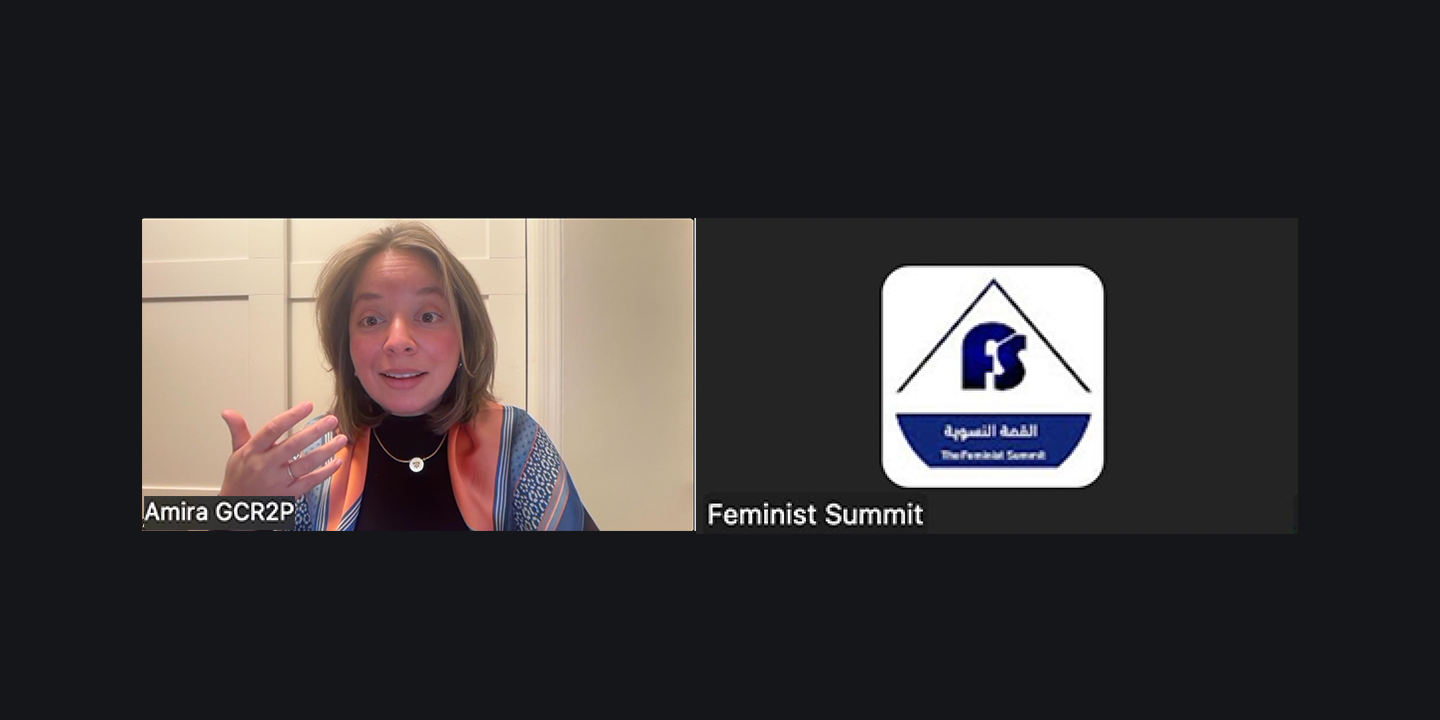
The following speech was delivered by Amira Rajasingham, Yemen expert at the Global Centre for the Responsibility to Protect, during the Yemen Feminist Summit. This marked the eighth year of the annual convening of Yemeni women leaders, civil society and government representatives to assess the current landscape of women’s rights and their indispensable role in shaping Yemen’s future.
Excellencies, distinguished participants, dear colleagues and friends,
It is an honor to join you at this Eighth Feminist Summit, an extraordinary space built entirely through feminist leadership, courage and persistence. At a time when civic space in Yemen is shrinking and women’s hard-won rights face unprecedented pressure, this summit stands as both a defiant act of solidarity and a powerful reminder: women will not be written out of Yemen’s future.
Today’s session, on transitional justice and the protection of women’s rights, goes to the heart of peacebuilding. Because without justice, there is no reconciliation. Without accountability, there is no deterrence. And without the protection of women’s rights, there is no sustainable or legitimate peace.
I would like to use this moment to reflect on the intersection between three important priorities:
Importantly, I’d like to consider how these frameworks can be implemented in Yemen, in ways that draw on lessons from other contexts.
Combating Violence Against Women as a Core Function of Transitional Justice and Prevention
Violence against women in Yemen – whether conflict-related sexual violence, domestic abuse, online harassment, restrictions on movement or discriminatory laws – is not only a human rights violation. It is also a warning sign of deeper patterns of instability and potential atrocities. From Bosnia to the Gambia, from Colombia to Syria, we have seen that large-scale violence against women is often a predictor of broader mass violence.
This means that efforts to protect women are not separate from peacebuilding. They are central to preventing escalation and recurrence of conflict.
Transitional justice processes – truth-seeking, reparations, justice and guarantees of non-recurrence/institutional reform – must not treat violence against women as a peripheral issue. It must be systematically integrated because:
In other words, combating violence against women is an atrocity prevention strategy.
Learning from Other Contexts: What Has Worked
Across different countries, we have seen concrete examples of how feminist movements have successfully shaped transitional justice:
These examples show that when women participate meaningfully – and when feminist perspectives shape national priorities – transitional justice becomes not only backward-looking but transformative.
Beyond shaping national peace and transitional justice processes, feminist movements have also collaborated across borders, learning from one another and building transnational networks of expertise. Survivors’ groups in the Balkans have exchanged strategies with activists in Colombia on documenting sexual violence. Liberian peacebuilders have shared lessons with Syrian women on community reconciliation. Likewise, Rohingya, Sudanese and Yemeni women have engaged in joint advocacy to demand accountability at the international level. These collaborations show that feminist movements are not isolated actors responding only to their own crises – they are part of a global ecosystem of solidarity, knowledge-sharing and mutual support. This organizing strengthens national efforts, accelerates learning and ensures that women’s rights remain at the center of global peace and justice agendas.
And these examples echo the strength of what Yemeni women have been working on and what is possible.
The Multilateral Dimension: Using Global Mechanisms to Support National Action
Implementing transitional justice in Yemen will require political will, resources and strong partnerships. Here, multilateral actors – the UN, regional organizations, donors and international experts – have a crucial role to play in providing support to a Yemeni vision of transitional justice.
This includes:
So much has already been done that multilateral actors can and must build on. We’ve seen:
Just as importantly, the Declaration demonstrates the power of collective civil society initiatives. Joint statements, common positions and coordinated advocacy among Yemeni organizations are essential for ensuring that transitional justice is not sidelined in a peace agreement. These collective efforts amplify victims’ voices, show broad national consensus and help generate the political and international support needed to bring transitional justice into the heart of negotiations.
If we speak about transitional justice in Yemen without addressing the restriction of civic space, arbitrary detention and systematic attacks on women activists, then we are only addressing half the story. Transitional justice begins now – not after a formal peace agreement – by protecting the people who are defending rights today.
Women, Peace and Security, R2P and Atrocity Prevention
Let me turn to how the Women, Peace and Security agenda intersects with R2P and atrocity prevention and what that means in practice for Yemen.
The WPS agenda was created 25 years ago to establish a commitment to the critical role of women in conflict prevention, peacebuilding and peacemaking and is fundamentally preventive in nature. It calls for:
R2P, meanwhile, is a commitment made by states and the international community in 2005 to prevent atrocities – war crimes, crimes against humanity, ethnic cleansing, and genocide.
The intersection is clear: Women’s participation and protection are early-warning tools and prevention tools. When women are excluded, silenced, or targeted, risks of atrocities increase. When women lead, peace is more durable and prevention more effective.
Transitional justice then becomes the bridge connecting these agendas:
In Yemen, this means that any political settlement without WPS implementation will be incomplete, and any atrocity-prevention effort that ignores women’s rights will be ineffective.
Implementing WPS and Transitional Justice in Yemen: Practical Steps
The reality is that, in an ideal world, the Women, Peace and Security agenda would not need to exist. The equal rights, protection and participation of women would be universally recognized as fundamental, not negotiated or conditional. But in the absence of that reality – and in the face of continued exclusion and violence – we must keep pushing for the full implementation of the WPS agenda. It remains one of the strongest tools we have to ensure that women’s voices shape peace, that their rights are protected and that prevention is taken seriously.
Based on global lessons and local demands, several steps are essential:
Women in Yemen are already documenting violations, mediating community disputes, providing humanitarian support and advocating for reforms. The question is not whether women are ready to lead – it is whether national and international actors are ready to follow their lead.
Closing
The Feminist Summit reminds us that peace is not merely the absence of war. It is the active presence of justice, accountability and equality. It is the courage to imagine a country where women’s rights are non-negotiable and where violence is neither normalized nor tolerated.
Transitional justice, WPS and atrocity prevention are not abstract frameworks. They are tools that can help Yemen build a future grounded in dignity, protection and shared responsibility.
Ralph Bunche Institute for International Studies
The Graduate Center, CUNY
365 Fifth Avenue, Suite 5203
New York, NY 10016-4309, USA