2 April 2026
Open Letter
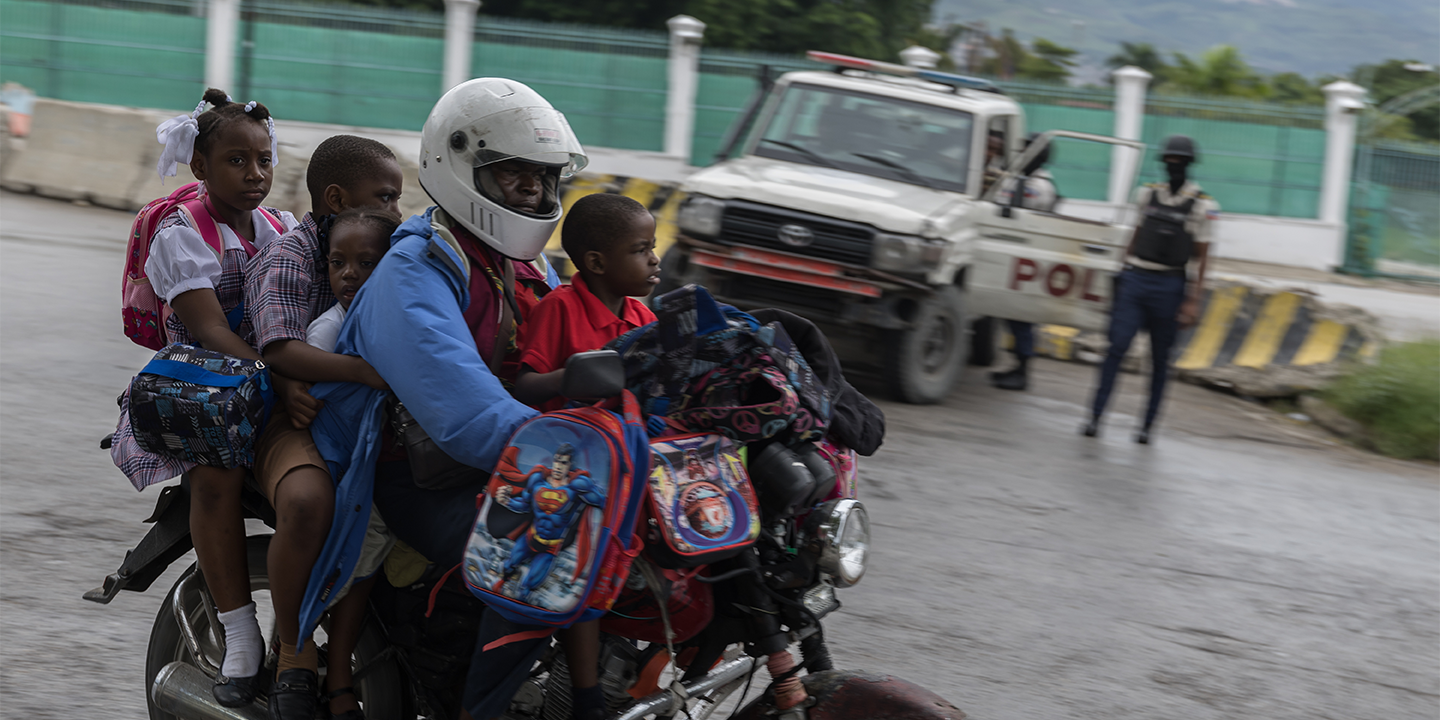
Ongoing and expanding violence in Haiti is fueling what the UN Children’s Fund describes as a “cycle of suffering,” as child recruitment and use by armed groups skyrocketed by approximately 200 percent in 2025. The increase reflects a deepening child protection crisis in Haiti and a growing reliance on children amid escalating violence by the Viv Ansanm gang coalition. The recruitment and use of children by armed groups is a grave violation under international law and children associated with armed groups face heightened threats of abuse, sexual violence and psychological trauma, among other risks.
Armed gangs, which control an estimated 90 percent of the capital, Port-au-Prince, and significant areas of the central region, have become increasingly dependent on children. According to the UN, an estimated 30 to 50 percent of armed group members are children, some as young as nine. Many are forced to join through coercion, threats against themselves or their families, economic desperation or family separation. For some, joining a gang becomes a means of survival in the absence of protection and essential services.
While boys are commonly used as lookouts, to carry ammunition and weapons and to guard kidnapping victims, girls are specifically targeted for systematic sexual violence, abduction and sexual slavery, and are forced into domestic labor. A new report by Médecins sans Frontières (MSF) documents a sharp rise in the brutality of sexual violence. Among survivors treated at MSF’s Pran Men’m clinic since 2022, 57 percent reported assaults by armed group members, often involving multiple perpetrators. More than 100 patients reported being assaulted by 10 or more perpetrators.
The broader humanitarian situation continues to deteriorate, heightening children’s vulnerability to recruitment and enabling gang expansion. More than 1.4 million people are internally displaced, while hundreds of thousands face starvation or near-starvation. Violence forced over 1,600 schools to close during the 2024-2025 academic year, with armed men occupying more than two dozen. Nearly half a million children have experienced educational disruption.
This surge in recruitment comes as Haitian security forces expand anti-gang operations across Port-au-Prince and a more lethal UN-authorized force – known as the Gang Suppression Force (GSF) – prepares to deploy its first military contingents in April, raising urgent protection concerns.
National authorities and relevant stakeholders should fully implement the 2024 handover protocol for the transfer and reintegration of children allegedly associated with armed gangs, strengthen child protection systems, ensure sustained access to essential services and reinforce family tracing and reunification efforts. Donors should increase funding for programs supporting affected children and families, including safe shelters. The GSF must prioritize child protection in the conduct of operations and establish oversight mechanisms to prevent human rights violations and abuses.
Despite a so-called ceasefire, Israel has continued its assault on Gaza, escalating strikes across the enclave in recent weeks. On 4 February – one of the deadliest days since the since the ceasefire began on 10 October 2025 – airstrikes and shelling killed some 23 Palestinians, including women and children. On 15 February at least 12 Palestinians were killed by Israeli strikes, several of whom where sheltering in tents after being displaced. The same day, United States President Donald Trump announced that members of the purported Board of Peace (BoP) pledged over $5 billion to the recovery and reconstruction of Gaza, as well as committed thousands of personnel to the UN Security Council authorized-International Stabilization Force.
Attempts to accelerate the BoP’s recovery and reconstruction plans for Gaza continue to be pursued without meaningful pressure on Israel to halt attacks and adhere to the agreed upon terms of the ceasefire. At least 600 Palestinians have been killed since the ceasefire went into effect. Moreover, Israeli Prime Minister Benjamin Netanyahu – who has a warrant out for his arrest by the International Criminal Court – has been appointed as a BoP member, while no Palestinian representation has been included in the supervisory body.
During a recent visit to Gaza, Alexander De Croo, Administrator and Under-Secretary-General of the UN Development Programme (UNDP), reaffirmed the findings of an earlier UNDP assessment that Gaza “has lost nearly 70 years of development progress” as a result of Israel’s sustained assault on the enclave. He stressed the importance of “working to kickstart a Palestinian owned and led early recovery.”
This Thursday, 19 February, President Trump will convene the BoP members in Washington, D.C., for its first official meeting, which includes a pledging conference to solicit further funding and troop contributions. Indonesia has already committed 8,000 troops while Morocco, Albania and Greece are reportedly engaged in discussions to contribute personnel. Although several states rejected invitations to join the Board, due to legal and political concerns relating to the BoP’s mandate, several have sought quasi-participation in its activities. Despite initial criticisms of the Board, Italy and the European Union announced they would send representatives as observers to the pledging conference.
States must refrain from joining the BoP so long as it undermines Palestinian statehood and the UN Charter and fails to require Israel to halt its attacks on Gaza and lift the occupation as essential preconditions for recovery and reconstruction. Any political solution that sidelines Palestinians as rights-holders and accountability for Israel’s ongoing atrocities will be unjust and unviable. Pursuant to the International Court of Justice’s 2024 July Advisory Opinion, all states must refrain from assisting Israel’s unlawful presence in the Occupied Palestinian Territory.
Following weeks of domestic and international scrutiny over the situation in Venezuela, interim President Delcy Rodríguez announced a draft Amnesty Law on 30 January, framing it as a commitment to “democratic coexistence.” According to Rodríguez, the bill would apply to political violence dating back to 1999, when Hugo Chávez first assumed power, and aims to facilitate the release of individuals imprisoned for political reasons to “heal the wounds left by political confrontation, fueled by violence and extremism.”
On 9 February the Human Rights Council-mandated Fact-Finding Mission on Venezuela cautioned that the initial draft applied only to narrowly defined political and related offences. As such, the law may exclude many individuals criminalized through civil, administrative or labor proceedings, as well as those charged under overly broad public order offenses or military jurisdiction. Since then – and amid continued lack of transparency from Venezuelan authorities – subsequent versions of the bill seem to no longer clearly define which political acts qualify for amnesty and appear to limit coverage to select episodes of unrest, increasing uncertainty about its scope.
The draft law also fails to address the broader pattern of systematic unlawful detention and prosecution used to silence dissent. For more than a decade, arbitrary arrests – frequently involving enforced disappearance, torture and opaque charges against perceived or actual opponents – have functioned as central tools of state-led repression. While hundreds of political prisoners have been released since 8 January, Justicia, Encuentro y Perdón, a Venezuelan rights organization, documented the continued detention of over 800 individuals for political reasons, with actual figures likely much higher. Many of those released face restrictive measures that perpetuate social control and sustain a “revolving door” dynamic of detention and release for political leverage.
Procedural shortcomings have compounded these substantive gaps. On 5 February the National Assembly approved the bill in its first reading without publishing the official text, in violation of constitutional norms. Consultations with civil society were not held until the draft became public. On 7 February several Venezuelan human rights organizations presented detailed proposals to the Parliamentary Commission, calling for binding participation by independent human rights bodies, civil society and victims. Although Foro Penal observed that “for the first time in so long, those with differences that at times appear irreconcilable were able to engage in dialogue in pursuit of justice,” amendments introduced on 12 February did not reflect the substance of those recommendations.
These mixed signals underscore the need for sustained international pressure to ensure the process delivers meaningful change rather than symbolic concessions. Governments in the region, together with the European Union and Canada, should press for a transparent, inclusive and victim-centred amnesty process, while reinforcing the concrete demands advanced by Venezuelan civil society. Elisabeth Pramendorfer, Venezuela expert at the Global Centre for the Responsibility to Protect, said, “The Venezuelan authorities’ sensitivity to international legitimacy creates a narrow window for other governments to treat the Amnesty Law as a test of their commitment to democratic transition. Whether the initiative advances rights protection and accountability will largely depend on the consistency and principled nature of international engagement with Venezuelan authorities.”
Ralph Bunche Institute for International Studies
The Graduate Center, CUNY
365 Fifth Avenue, Suite 5203
New York, NY 10016-4309, USA