29 October 2025
Atrocity Alert
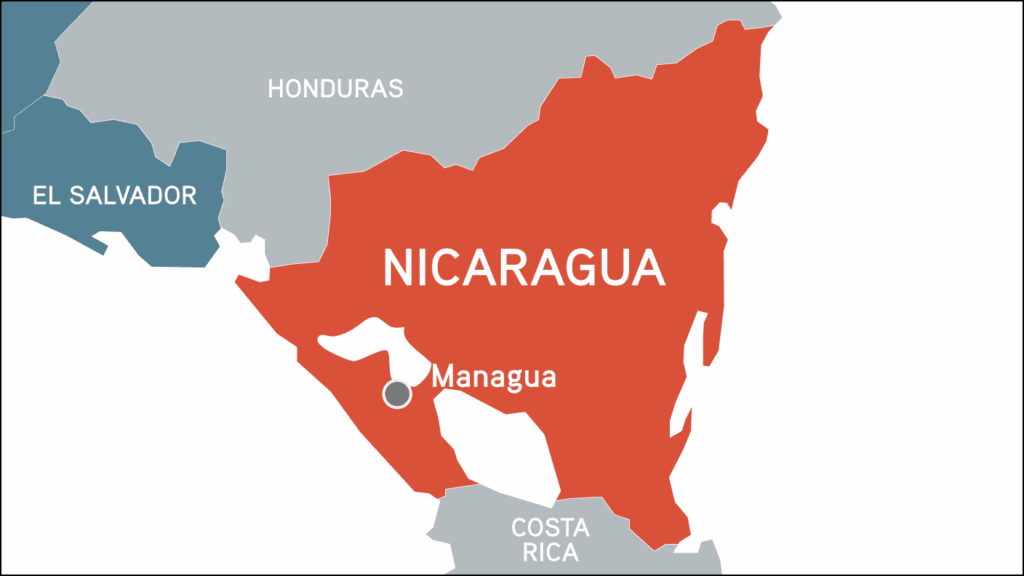
As part of a systematic attempt to silence critical voices, the government of Nicaragua is perpetrating violations and abuses that may amount to crimes against humanity.
For almost eight years, Nicaragua has experienced an unprecedented human rights crisis amid a rapid descent into authoritarianism. Under President Daniel Ortega, the government has engaged in a broad campaign of repressing dissenting or independent voices, including human rights defenders, women’s rights groups, journalists, community, peasant movement and religious leaders, students and academics, business owners, political opponents and ordinary citizens. As part of this campaign, various government structures have committed widespread human rights violations and abuses that may amount to crimes against humanity, including murder, imprisonment, torture, sexual violence, deportation and politically motivated persecution. In February 2025 the UN Human Rights Council (HRC)-mandated Group of Human Rights Experts on Nicaragua (GHREN) reported that the government has “weaponized every arm of the State” and that crimes against humanity are part of a “deliberate and well-orchestrated State policy carried out through defined chains of command from the presidency to local officials.”
The crisis first escalated in April 2018 when tens of thousands of people took to the streets to protest severe pension cuts. The police – at times in coordination with pro-government armed elements – cracked down on the demonstrations. State agents utilized disproportionate force against protesters, which triggered an escalation in the protests and resulted in the death of 320 people between April and September 2018. In response to the Office of the UN High Commissioner for Human Rights (OHCHR) and the Inter-American Commission on Human Rights (IACHR) documenting widespread and systematic violations and abuses, the government expelled OHCHR and the IACHR Experts from the country in 2018. Since then, no independent human rights monitoring body has accessed the country.
While the crisis has continuously worsened since then, domestic and transnational repression has intensified over the past two years, with the government approaching its goal of silencing all critical voices. The GHREN has found that the government, as well as pro-government groups, have committed crimes against humanity as part of a systematic campaign to eliminate any opposition. Dozens of government critics remain arbitrarily detained under what the GHREN has determined is a state policy. President Ortega and his wife, Co-President Rosario Murillo, have dismantled checks and balances and instrumentalized the country’s executive, judicial, legislative and electoral branches.
The GHREN warned that students, professors and other university staff have been targeted with murder, imprisonment, torture, deportation and political persecution – patterns that may amount to crimes against humanity. Religious leaders, including the Catholic Church invited to mediate after the 2018 violence, have likewise become primary targets. Violence has also been perpetrated against Indigenous and Afro-descendant Peoples, including killings, harassment, the invasion of their lands and the deliberate burning of homes.
Between 2018 and 2024 more than 5,000 non-governmental organizations (NGOs) were forcibly shutdown. More than 50 media outlets have been forced to close, and over 200 media workers have fled the country as journalists increasingly face prosecution on criminal charges such as alleged hate crimes and terrorism. Many universities have also had their legal status canceled.
In February 2025 the National Assembly finalized the approval process of constitutional reforms that consolidate President Ortega’s absolute power, including de-facto control over the legislature, judiciary and electoral institutions. On 26 February the GHREN warned that Co-Presidents Ortega and Murillo are acting as “the eyes and ears” that allow the government to maintain total control. In response to the GHREN’s February report, Nicaragua announced its withdrawal from the HRC on 27 February.
On 3 April the HRC extended the mandate of the GHREN for two years and requested a presentation of its findings to the UN General Assembly. The same day, the GHREN released a groundbreaking report identifying 54 government, military and ruling party officials responsible for crimes against humanity and other systematic and grave human rights violations and abuses.
On 27 June OHCHR warned of increasing transnational repression, including through the deprivation of nationality and other violations impeding family reunifications. In its report from 23 September, the GHREN similarly documented physical violence, threats, financial pressure, entry bans, the denial of consular services and passports, harassment, surveillance and coercion via family members of Nicaraguans in exile. Since 2021 there have been a series of murders and assassination attempts of exiled Nicaraguans. Following the murder of a prominent government opponent in Costa Rica in June 2025, the GHREN noted that “nowhere in the world seems to be safe for Nicaraguans opposed to the Government.”
State-led repression and targeted persecution have become more sophisticated over time, and now systematically extends beyond Nicaragua’s borders. Ongoing crimes against humanity have been facilitated by the deliberate dismantling of democratic institutions since President Ortega took office in 2007. Pervasive impunity for violations committed before and since 2018 further enables such crimes. Domestic avenues to ensure redress for victims of state-led violence remain nonexistent. The latest constitutional reforms further empower the government to arbitrarily revoke citizenship and enable state-led media censorship – both of which are already widely used to repress dissent.
Arbitrary criminal prosecutions are used as an instrument of political persecution, which has expanded over time and now targets a broad and diverse range of dissenting voices. Patterns of violence against opponents – including psychological torture – often vary by gender, with specific methods of torture used to target women.
Nicaragua’s regional and international isolation helps facilitate the commission of atrocity crimes. Although Nicaragua had previously refused to cooperate with the HRC, the withdrawal can be seen as part of a broader strategy to undermine the credibility and legitimacy of the UN human rights system. Continued investigations and public reporting by the GHREN remain crucial to ensure international scrutiny and exert pressure on UN member states to respond to ongoing atrocity crimes.
While UN member states have taken important steps to address ongoing atrocity crimes, including through the establishment of the GHREN, the international community has so far failed to apply a coordinated, holistic and robust strategy. The Nicaraguan government has also been unresponsive to targeted sanctions imposed by the European Union (EU), the United States, Canada and others.
The government of Nicaragua must immediately halt the systematic persecution of actual or alleged opponents, allow independent media and civil society organizations to operate safely and freely and immediately release all arbitrarily detained individuals. The government should commit to full and meaningful cooperation with regional and international human rights monitoring mechanisms. All human rights violations and abuses should be independently investigated and those responsible held accountable.
UN member states should utilize the evidence collected by the GHREN to pursue accountability for victims, including through universal jurisdiction, and strengthen and expand a robust individual sanctions regime against identified perpetrators at the highest level. Host countries should strengthen protection frameworks for Nicaraguans in exile, including fair and expedited asylum procedures and strict adherence to the principle of non-refoulement. Governments and regional institutions should also make use of the GHREN’s findings in all security, financial and trade relations and policies to increase pressure on the government to halt pervasive persecution. Latin American governments, together with the EU and other allies and in close consultation with Nicaraguan civil society, should intensify efforts to ensure a coordinated, consistent and holistic response to the crisis, which prioritizes human rights protection and democratic reform.
Ralph Bunche Institute for International Studies
The Graduate Center, CUNY
365 Fifth Avenue, Suite 5203
New York, NY 10016-4309, USA