14 January 2026
Atrocity Alert
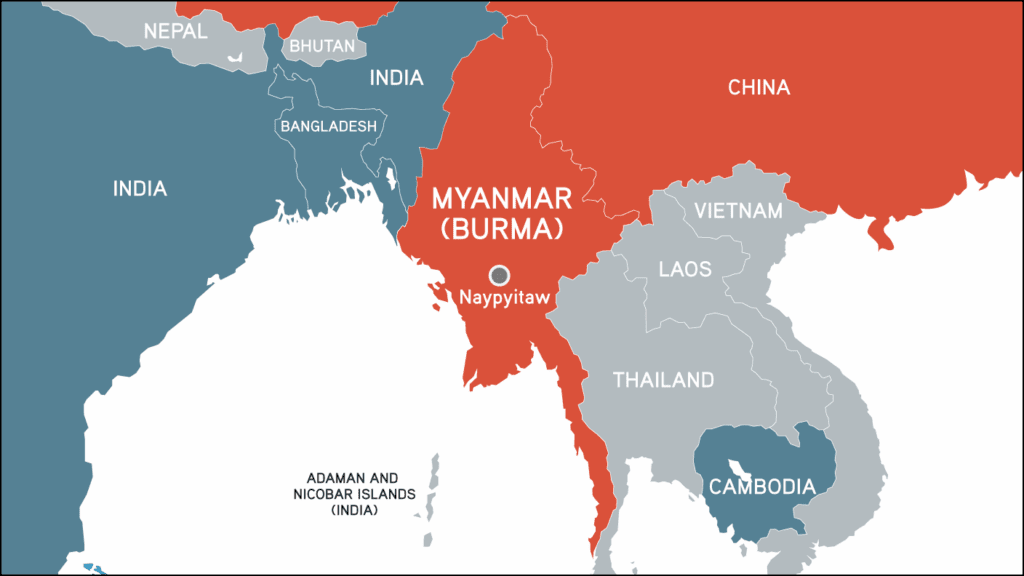
Populations in Myanmar are facing crimes against humanity and war crimes perpetrated by the military and armed groups following the February 2021 coup.
Since seizing power in a coup on 1 February 2021, Myanmar’s (Burma) military has perpetrated widespread violations, compounding the country’s existing human rights and humanitarian crisis. In the immediate aftermath of the coup, populations gathered in widespread peaceful mass protests that were met with a brutal crackdown by the junta. At the same time, civilian militias, known as People’s Defence Forces (PDFs), formed as part of an expanding armed resistance. Since then, the junta has retaliated with relentless airstrikes, scorched earth campaigns and other systematic attacks on civilian areas, while obstructing humanitarian aid, particularly in Magway and Sagaing regions and Chin, Kachin, Shan, Kayah and Karen states.
A significant escalation occurred on 27 October 2023, when a coalition of ethnic resistance organizations (EROs) launched “Operation 1027,” capturing military outposts across the country. Other groups, including some PDFs and the Arakan Army (AA), an ERO in Rakhine State, also intensified operations. In response, the junta escalated its campaign, carrying out intensified – often indiscriminate, disproportionate or targeted – attacks on civilians. Anti-junta armed groups also threaten civilians and have been accused of torture, extrajudicial killings, sexual violence, forced recruitment and other abuses.
The military adopted new tactics in 2025 to target civilians, including the use of fertilizer-based explosives and armed paramotors to drop munitions with little precision or warning. The Office of the UN High Commissioner for Human Rights has documented abuses against aid workers and the burning alive, dismembering, raping and beheading of civilians unable to flee attacks. The junta has also arbitrarily detained civilians perceived as opposing its rule; more than 22,000 people remain in detention, including both verified and unverified cases documented by the Assistance Association for Political Prisoners (Burma). At least 8,150 people have been killed in attacks by the junta since February 2021, 3.6 million have been displaced and 21.9 million need assistance.
In Rakhine State, the junta has intentionally stoked inter-communal conflict between the ethnic Rakhine and Rohingya communities. Following significant advances in December 2024, the AA controls nearly all of Rakhine State, except for the capital and two smaller areas. Throughout the takeover, the UN reported widespread abuses by the junta and AA, including indiscriminate attacks, destruction of villages, forced recruitment, denial of humanitarian aid and mass displacement. Since November 2023 approximately 150,000 Rohingya have fled to Bangladesh, further compounding the conditions facing over 1.3 million refugees in overcrowded camps. Despite the ongoing risks facing the Rohingya community, the junta and Bangladesh have promoted a “pilot repatriation program” for their return to Myanmar.
The current crisis in Rakhine State builds on recurrent instability and long-standing persecution of the Rohingya. Prior to the coup, in August 2017 the military launched so-called “clearance operations” in Rakhine State, ostensibly to confront the Arakan Rohingya Salvation Army. During the operations, the military committed acts of genocide against the Rohingya, forcing most of Myanmar’s Rohingya population to flee to Bangladesh. In 2018 the UN Human Rights Council (HRC)-mandated Fact-Finding Mission on Myanmar concluded that senior military officials, including junta leader General Min Aung Hlaing, should be prosecuted for genocide against the Rohingya and for crimes against humanity and war crimes in Kachin, Rakhine and Shan states. Separately, a Human Rights Watch report documented evidence of a massacre of Rohingya civilians in Hoyyar Siri village in 2024 allegedly carried out by the AA.
International and diplomatic efforts to address the crisis have remained limited. In April 2021 the Association of Southeast Asian Nations (ASEAN) adopted a Five-Point Consensus (5PC) calling for a cessation of hostilities and other measures but failed to secure its implementation or impose consequences for the junta’s non-compliance. In December 2022 the UN Security Council (UNSC) adopted its first and only resolution on Myanmar but has taken no further substantive action. The HRC has adopted several resolutions on the crisis, including one urging states to halt aviation fuel sales to the junta. While many governments have imposed targeted sanctions on military leaders, military-affiliated companies and other enablers, international measures remain fragmented and insufficient to increase pressure on the military authorities.
Several accountability processes are underway for crimes committed in Myanmar, including those against the Rohingya. These include the UN Independent Investigative Mechanism for Myanmar (IIMM) and proceedings before the International Court of Justice (ICJ), initiated by The Gambia, alleging that Myanmar violated the Genocide Convention. The Court heard oral arguments and evidence in January 2026. In November 2024 the Chief Prosecutor of the International Criminal Court (ICC) applied for an arrest warrant for junta leader General Min Aung Hlaing for the crimes against humanity of deportation and persecution of the Rohingya. Courts in Argentina, the Philippines, Timor-Leste and Türkiye have filed cases under the principle of universal jurisdiction.
The military’s rule has been further entrenched following widely criticized elections that resulted in General Hlaing assuming the presidency in April. During ASEAN’s Foreign Ministers meeting in May, the bloc maintained restrictions that barred Myanmar’s political leadership from participating but conceded to allowing Foreign Minister Tin Maung Swe to join online meetings on the sidelines of the next meeting in July.
Ongoing fighting continues to drive widespread human rights violations and civilian harm. Airstrikes, shelling and attacks by the military against populations in Kachin, Chin, Karen, Sagaing and Rakhine states and regions are contributing to further displacement and killings of civilians. Armed clashes between junta forces, resistance groups and ethnic armed organizations remain intense across multiple frontlines, while humanitarian access continues to be severely restricted in many conflict-affected areas. In a particularly grave attack, the junta killed more than 40 people, including women, children and monks, during a 20-day scorched-earth campaign that began on 10 May in Magwe Region. The attack also displaced 80,000 people.
Serious concerns remain regarding abuses against Rohingya communities in Rakhine State. On 14 May the Burmese Rohingya Organisation UK released a new report documenting patterns of sexual violence against Rohingya women and girls in areas controlled by the AA, including allegations of rape, forced marriage, sexual exploitation and intimidation.
International accountability efforts have continued amid these ongoing abuses. In April Rohingya survivors and civil society groups filed a criminal complaint in Indonesia under universal jurisdiction, accusing President Hlaing of genocide and crimes against humanity against the Rohingya.
Impunity for past atrocities has allowed the military to continue widespread and systematic abuses, especially against ethnic minorities and perceived opponents. Sexual and gender-based violence remains a recurring tactic by the junta. The Rohingya face heightened risk of genocide and other atrocities amid junta-stoked inter-communal tensions and attacks by armed groups, including the AA. As the junta aims to consolidate control following the elections, populations remain at increasing risk of further atrocities, especially in minority areas.
Divisions within ASEAN and the UNSC, and ASEAN’s strict commitment to the 5PC, coupled with increasing influence and support by China to the junta, have hampered the development of a coordinated international response to atrocities in Myanmar. Despite extensive targeted sanctions, fuel and arms continue to be shipped into Myanmar, including from entities based in countries imposing sanctions.
The UNSC should impose a comprehensive arms embargo and targeted sanctions on Myanmar, ensure continued reporting on the crisis and refer the situation to the ICC. All UN member states, regional organizations and the UNSC should impose sanctions on Myanmar’s oil, gas and banking sectors and block the military’s access to arms and fuel. Foreign companies should immediately divest and sever ties with all military-linked businesses.
The junta should not be diplomatically recognized as the legitimate representatives of Myanmar, including following the election. ASEAN states should condemn the Tatmadaw, increasingly engage with the exiled shadow National Unity Government and urgently reassess the 5PC.
More states should formally intervene in the ICJ case. All those responsible for atrocity crimes, including senior military leaders, should face international justice.
EROs must operate within the parameters of international humanitarian and human rights law.
For more on the Global Centre’s advocacy work on the situation in Myanmar, see our Myanmar country advocacy page.
Ralph Bunche Institute for International Studies
The Graduate Center, CUNY
365 Fifth Avenue, Suite 5203
New York, NY 10016-4309, USA